AQA · A-Level · History
Course version: 7042 · Version from Sept 2017
The reign of Edward IV, 1471–1483 (A-level only): The consolidation of…
Full specification wording
2B The Wars of the Roses, 1450–1499 – 'The Sun in Splendour': the reign of Edward IV, 1471–1483 (A-level only): The consolidation of royal authority under Edward IV and the development of new methods of government
During his second reign (1471–1483), Edward IV consolidated royal authority by eliminating Lancastrian rivals at Barnet and Tewkesbury, and managing his nobility through a system of regional…
Checked against the AQA 7042 specification (opens in a new tab) on .
- Point 1 of 4
- 4 key terms
Study notes
From the checked teaching notes for this specification point.
The idea
During his second reign (1471–1483), Edward IV consolidated royal authority by eliminating Lancastrian rivals at Barnet and Tewkesbury, and managing his nobility through a system of regional delegation. He developed new methods of government to restore order and royal finances. Crucially, Edward expanded the Chamber system of finance, bypassing the slow Exchequer to manage crown lands directly, significantly increasing royal revenues and achieving solvency. To control the localities, he established regional councils, notably the Council of the North under Richard, Duke of Gloucester, and the Council of Wales under the Woodvilles, effectively decentralising power to trusted magnates.
What earns the marks
- Explain how Edward IV consolidated royal authority after 1471 by eliminating Lancastrian claimants and managing noble affinities.
- Analyse the development of the Chamber system of finance, contrasting its efficiency in managing crown lands with the traditional Exchequer.
- Describe the establishment of new methods of regional government, specifically the Council of the North and the Council of Wales and the Marches.
- Evaluate the effectiveness of delegating regional authority to powerful magnates like Richard, Duke of Gloucester, in maintaining law and order.
Common mistakes and how to put them right
Confusing Edward IV's first reign (1461-1470) with his second reign (1471-1483) regarding the extent of financial reform.
Put it right: Focus on the mature Chamber system and formalised regional councils established after 1471.
Assuming 'new methods of government' meant a modern, centralised bureaucracy.
Put it right: Explain that his methods relied on personal monarchy and delegating regional authority to powerful, trusted nobles.
Claiming Edward faced constant rebellions after 1471.
Put it right: Recognise that his second reign was largely peaceful, with consolidation achieved through effective regional control and financial solvency.
Exam tips
- Use the Chamber system of finance as a primary example when discussing 'new methods of government' and the restoration of royal solvency.
- Contrast Edward's approach to regional control in the 1470s with his earlier reliance on Warwick to highlight how he restored a degree of royal authority.
- When evaluating Edward's consolidation of power, weigh his financial and administrative successes against the risks of over-empowering regional magnates like Gloucester.
Try the lesson
The start of the 2B The Wars of the Roses, 1450–1499 – 'The Sun in Splendour': the reign of Edward IV, 1471–1483 (A-level only): The consolidation of royal authority under Edward IV and the development of new methods of government lesson, made from checked teaching notes for this specification point.
Have a go first
Which financial system did Edward IV increasingly utilise to bypass the slow procedures of the Exchequer and consolidate royal authority?
Listen
During his second reign (1471–1483), Edward IV consolidated royal authority by eliminating Lancastrian rivals at Barnet and Tewkesbury, and managing his nobility through a system of regional delegation. He developed new methods of government to restore order and royal finances. Crucially, Edward expanded the Chamber system of finance, bypassing the slow Exchequer to manage crown lands directly, significantly increasing royal revenues and achieving solvency. To control the localities, he established regional councils, notably the Council of the North under Richard, Duke of Gloucester, and the Council of Wales under the Woodvilles, effectively decentralising power to trusted magnates. A strong answer earns marks for these points. Explain how Edward IV consolidated royal authority after 1471 by eliminating Lancastrian claimants and managing noble affinities. Analyse the development of the Chamber system of finance, contrasting its efficiency in managing crown lands with the traditional Exchequer. Describe the establishment of new methods of regional government, specifically the Council of the North and the Council of Wales and the Marches. Evaluate the effectiveness of delegating regional authority to powerful magnates like Richard, Duke of Gloucester, in maintaining law and order. A common slip: Confusing Edward IV's first reign (1461-1470) with his second reign (1471-1483) regarding the extent of financial reform. Instead, Focus on the mature Chamber system and formalised regional councils established after 1471. Exam tip: Use the Chamber system of finance as a primary example when discussing 'new methods of government' and the restoration of royal solvency.
See it
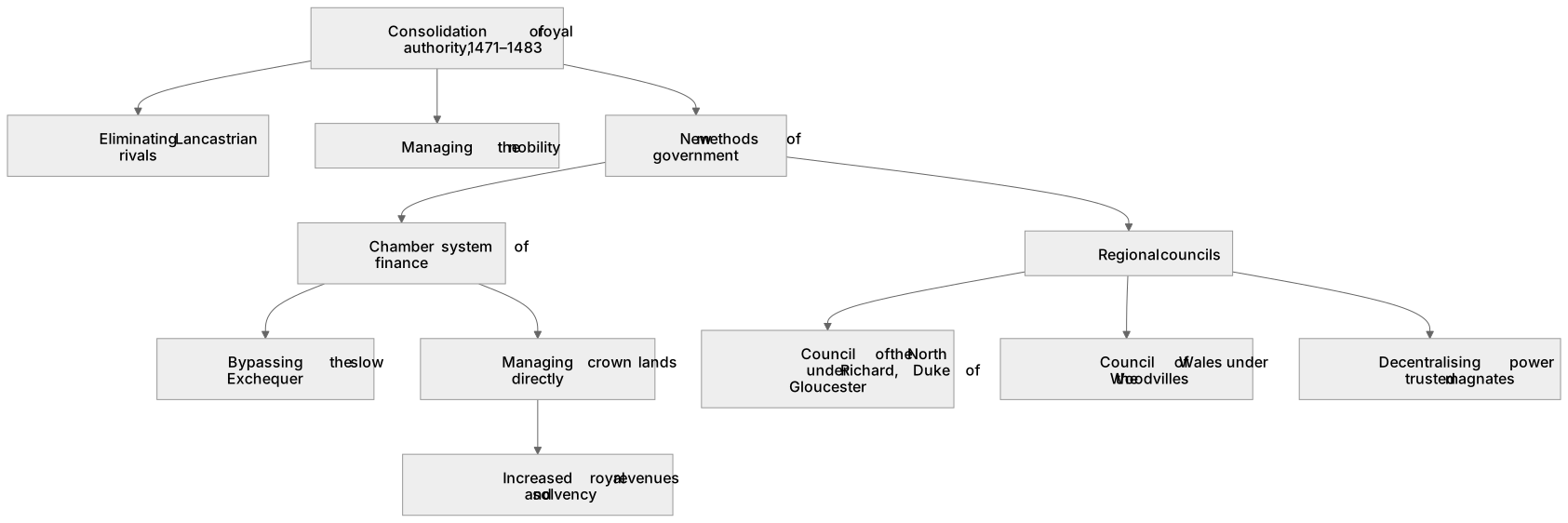
Key words
Say what each word means before you turn the card.
Royal authority
Try answering aloud or in your head before turning the card.
Financial reform
Try answering aloud or in your head before turning the card.
Regional government
Try answering aloud or in your head before turning the card.
Personal monarchy
Try answering aloud or in your head before turning the card.
See every definition
- Royal authority
- The power consolidated by Edward IV during his second reign by eliminating Lancastrian rivals and managing his nobility through a system of regional delegation.
- Financial reform
- New methods of government developed to restore order and royal finances, expanding the Chamber system of finance to manage crown lands directly and achieve solvency.
- Regional government
- New methods established to control the localities, notably the Council of the North and the Council of Wales, decentralising power to trusted magnates.
- Personal monarchy
- Methods of government that relied on delegating regional authority to powerful, trusted nobles rather than a modern, centralised bureaucracy.
Label the diagram
Some boxes have lost their names. Pick the right name for each number.
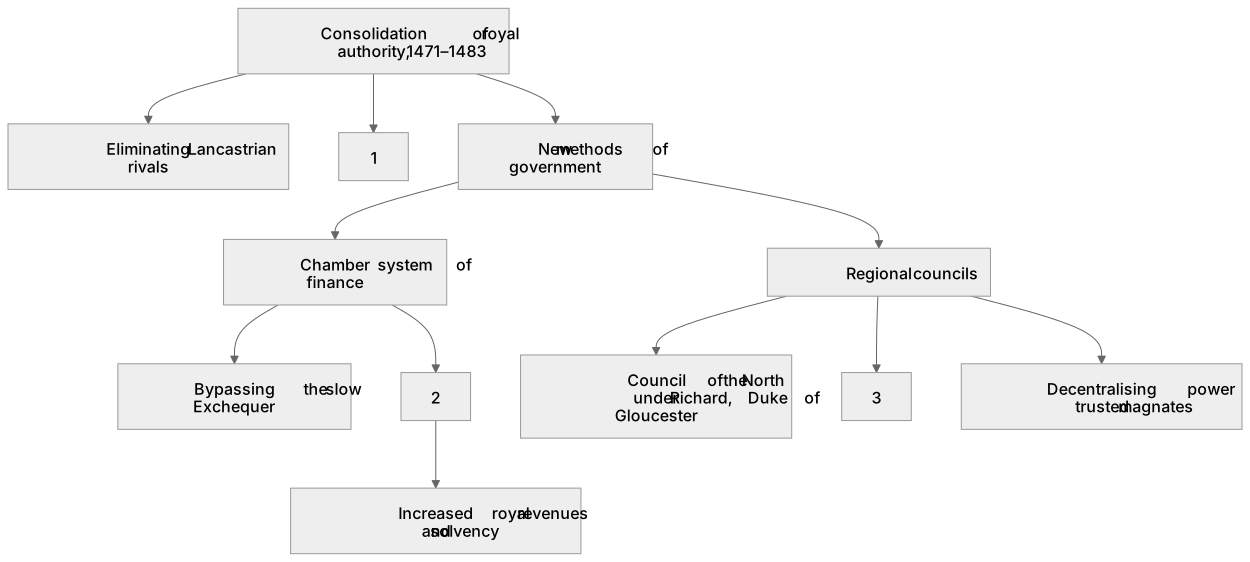
1Box 1
2Box 2
3Box 3
There is more to this lesson
The full lesson goes on to check your understanding and help you earn the marks. Create a free account to carry on, with your progress saved.
A week of Premium from your first lesson · Then the free plan continues · No card, no charge
Test your understanding of 2B The Wars of the Roses, 1450–1499 – 'The Sun in Splendour': the reign of Edward IV, 1471–1483 (A-level only): The consolidation of royal authority under Edward IV and the development of new methods of government
Active recall beats re-reading. Take an instant quiz now to test what you’ve learned and lock it into long-term memory.
A week of Premium from your first lesson · Then the free plan continues · No card, no charge