AQA · A-Level · History
Course version: 7042 · Version from Sept 2017
The impact of the baronial wars on English society by 1471: the weakening…
Full specification wording
2B The Wars of the Roses, 1450–1499 – The triumph of the Yorkists, 1461–1471: The impact of the baronial wars on English society by 1471: the weakening of the aristocracy; the impact on trade and the economy
By 1471, the Wars of the Roses had impacted English society, though effects were uneven.
Checked against the AQA 7042 specification (opens in a new tab) on .
- Point 4 of 4
- 4 key terms
Study notes
From the checked teaching notes for this specification point.
The idea
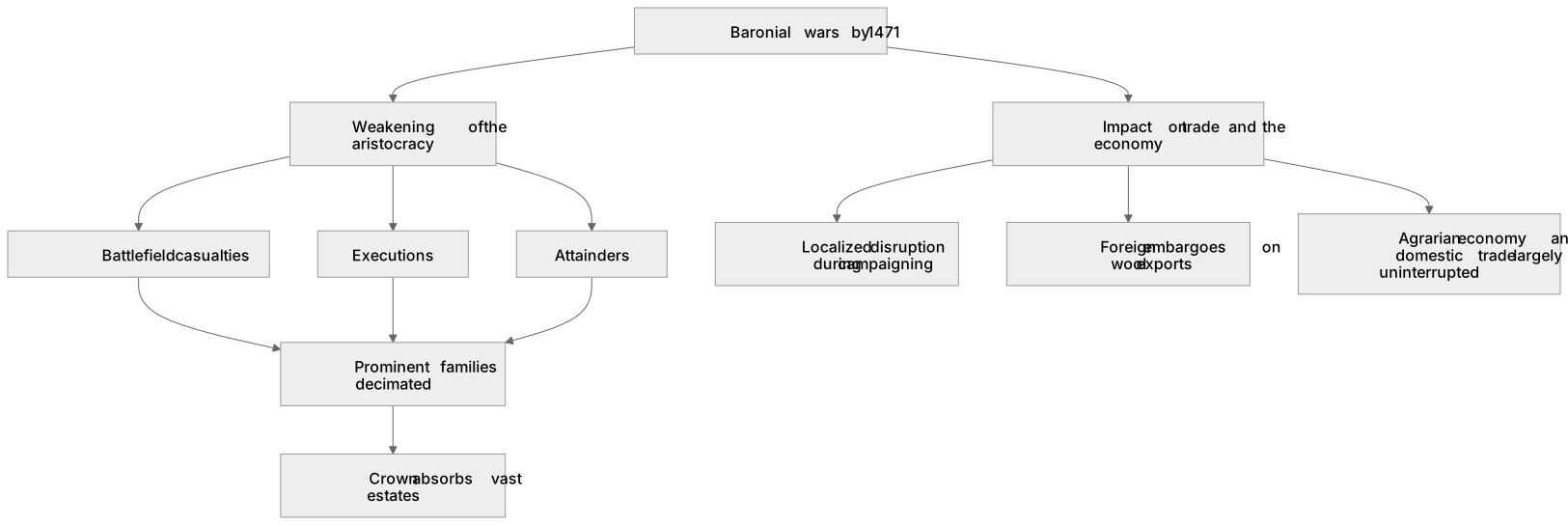
By 1471, the Wars of the Roses had impacted English society, though effects were uneven. The aristocracy experienced significant weakening through battlefield casualties, executions, and attainders, decimating prominent families like the Beauforts and Nevilles. This loss of noble leadership shifted local power dynamics and allowed the Crown to absorb vast estates. Conversely, the impact on trade and the broader economy was less catastrophic than often assumed. While localized disruption occurred during active campaigning, and foreign embargoes occasionally hindered wool exports, the agrarian economy and domestic trade largely continued uninterrupted. The wars were primarily a dynastic struggle among elites rather than a total societal collapse.
What earns the marks
- Assess the demographic and political weakening of the aristocracy through attainders, executions, and deaths in battle by 1471.
- Explain how the Crown benefited financially and territorially from the forfeiture of noble estates following the destruction of key aristocratic families.
- Evaluate the localized and temporary nature of economic disruption caused by the marching and foraging of armies.
- Analyse the resilience of the broader English economy, noting that domestic agriculture and the cloth trade largely functioned normally despite the political instability.
Common mistakes and how to put them right
Assuming the wars caused widespread economic ruin across England.
Put it right: Emphasise that economic disruption was highly localized and temporary, with agriculture largely unaffected.
Stating that the entire nobility was wiped out.
Put it right: Clarify that while specific prominent families (like the Beauforts) were destroyed, the aristocracy as a class survived, albeit weakened and restructured.
Ignoring the role of attainders in weakening the aristocracy.
Put it right: Explicitly mention Acts of Attainder as a legal and financial tool that stripped rebellious nobles of their wealth and power.
Exam tips
- When discussing the economy, differentiate between the localized impact of battles and the broader, more resilient national trends in agriculture and the wool trade.
- Use specific examples of noble families, such as the Nevilles or Percys, to illustrate the weakening of the aristocracy through death and attainder.
- Challenge the traditional Tudor narrative of total anarchy by highlighting the continuity of everyday societal and economic functions during the period.
Try the lesson
The start of the 2B The Wars of the Roses, 1450–1499 – The triumph of the Yorkists, 1461–1471: The impact of the baronial wars on English society by 1471: the weakening of the aristocracy; the impact on trade and the economy lesson, made from checked teaching notes for this specification point.
Have a go first
What was a significant impact of the baronial wars on the English aristocracy by the year 1471?
Listen
By 1471, the Wars of the Roses had impacted English society, though effects were uneven. The aristocracy experienced significant weakening through battlefield casualties, executions, and attainders, decimating prominent families like the Beauforts and Nevilles. This loss of noble leadership shifted local power dynamics and allowed the Crown to absorb vast estates. Conversely, the impact on trade and the broader economy was less catastrophic than often assumed. While localized disruption occurred during active campaigning, and foreign embargoes occasionally hindered wool exports, the agrarian economy and domestic trade largely continued uninterrupted. The wars were primarily a dynastic struggle among elites rather than a total societal collapse. A strong answer earns marks for these points. Assess the demographic and political weakening of the aristocracy through attainders, executions, and deaths in battle by 1471. Explain how the Crown benefited financially and territorially from the forfeiture of noble estates following the destruction of key aristocratic families. Evaluate the localized and temporary nature of economic disruption caused by the marching and foraging of armies. Analyse the resilience of the broader English economy, noting that domestic agriculture and the cloth trade largely functioned normally despite the political instability. A common slip: Assuming the wars caused widespread economic ruin across England. Instead, emphasise that economic disruption was highly localized and temporary, with agriculture largely unaffected. Exam tip: When discussing the economy, differentiate between the localized impact of battles and the broader, more resilient national trends in agriculture and the wool trade.
See it
Key words
Say what each word means before you turn the card.
Social structure and the nobility
Try answering aloud or in your head before turning the card.
Economic continuity and change
Try answering aloud or in your head before turning the card.
The impact of war on civilians
Try answering aloud or in your head before turning the card.
Royal finance and land ownership
Try answering aloud or in your head before turning the card.
See every definition
- Social structure and the nobility
- The aristocracy experienced significant weakening through battlefield casualties, executions, and attainders, decimating prominent families, while the aristocracy as a class survived, albeit weakened and restructured.
- Economic continuity and change
- The impact on trade and the broader economy was less catastrophic than often assumed, as the agrarian economy and domestic trade largely continued uninterrupted.
- The impact of war on civilians
- Economic disruption was highly localized and temporary, caused by the marching and foraging of armies, with agriculture largely unaffected.
- Royal finance and land ownership
- The Crown benefited financially and territorially from the forfeiture of noble estates following the destruction of key aristocratic families.
Label the diagram
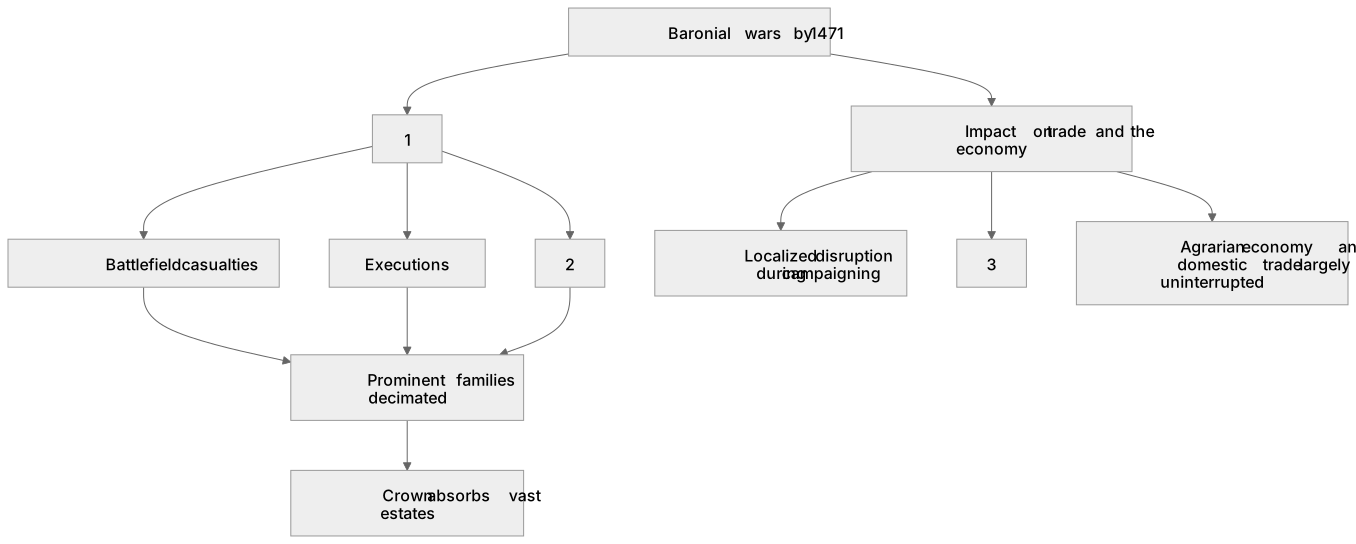
Some boxes have lost their names. Pick the right name for each number.
1Box 1
2Box 2
3Box 3
There is more to this lesson
The full lesson goes on to check your understanding and help you earn the marks. Create a free account to carry on, with your progress saved.
A week of Premium from your first lesson · Then the free plan continues · No card, no charge
Test your understanding of 2B The Wars of the Roses, 1450–1499 – The triumph of the Yorkists, 1461–1471: The impact of the baronial wars on English society by 1471: the weakening of the aristocracy; the impact on trade and the economy
Active recall beats re-reading. Take an instant quiz now to test what you’ve learned and lock it into long-term memory.
A week of Premium from your first lesson · Then the free plan continues · No card, no charge