AQA · A-Level · History
Course version: 7042 · Version from Sept 2017
The crushing of the Lancastrian cause: Barnet and Tewkesbury; the…
Full specification wording
2B The Wars of the Roses, 1450–1499 – The triumph of the Yorkists, 1461–1471: The crushing of the Lancastrian cause: Barnet and Tewkesbury; the destruction of the Lancastrian nobility
Edward IV's return from exile in 1471 culminated in two decisive battles that permanently shattered the Lancastrian cause.
Checked against the AQA 7042 specification (opens in a new tab) on .
- Point 3 of 4
- 4 key terms
Study notes
From the checked teaching notes for this specification point.
The idea
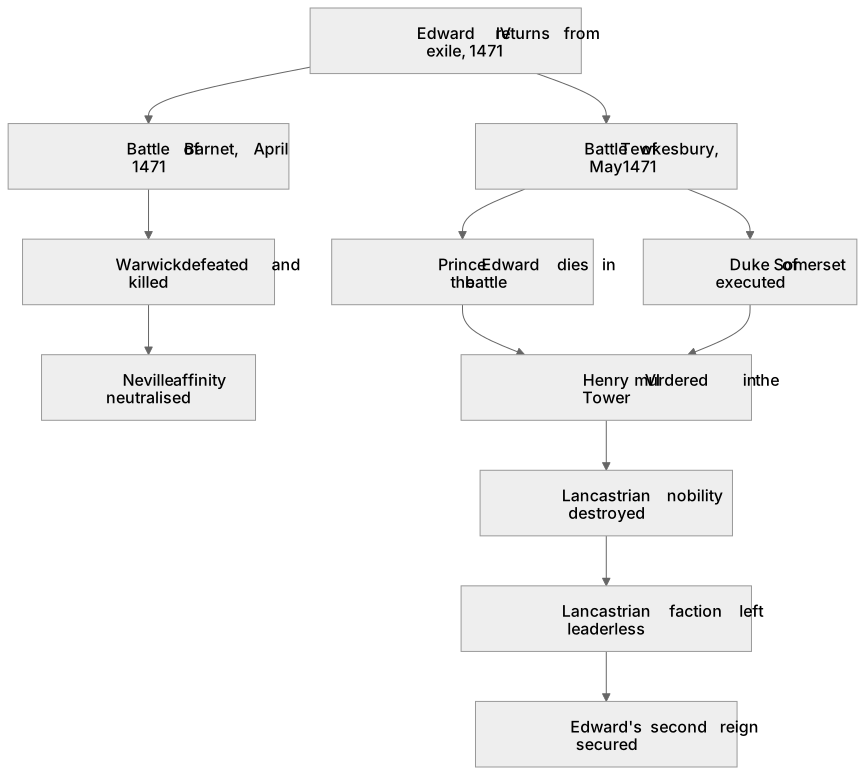
Edward IV's return from exile in 1471 culminated in two decisive battles that permanently shattered the Lancastrian cause. At the Battle of Barnet (April 1471), Edward defeated and killed Richard Neville, Earl of Warwick, removing the 'Kingmaker' and his affinity. Shortly after, at the Battle of Tewkesbury (May 1471), Edward intercepted Margaret of Anjou's forces. The death of Edward, Prince of Wales, during the battle, followed by the execution of the Duke of Somerset and the subsequent murder of Henry VI in the Tower, resulted in the total destruction of the Lancastrian nobility. This systematic elimination of rival claimants and their key aristocratic supporters left the Lancastrian faction leaderless, securing Edward's second reign.
What earns the marks
- Explain the strategic significance of the Battle of Barnet in eliminating Warwick and neutralizing his Neville affinity.
- Analyse the outcome of the Battle of Tewkesbury, specifically the death of the Lancastrian heir, Prince Edward, in destroying dynastic continuity.
- Evaluate the impact of the executions of key Lancastrian nobles, such as the Duke of Somerset, in removing military leadership.
- Assess how the subsequent death of Henry VI in the Tower of London finalised the destruction of the Lancastrian cause by removing its figurehead.
Common mistakes and how to put them right
Confusing the outcomes of the two battles.
Put it right: Warwick was killed at Barnet, whereas Prince Edward was killed at Tewkesbury.
Assuming the Lancastrian cause survived intact after 1471.
Put it right: Recognise that the deaths of Henry VI and his heir meant the direct Lancastrian royal line was entirely extinguished.
Overlooking the role of executions post-Tewkesbury.
Put it right: Include the execution of Somerset and other nobles as a deliberate strategy to destroy the Lancastrian nobility, not just battlefield casualties.
Exam tips
- When evaluating Edward IV's success in 1471, link his battlefield victories directly to the political consequence of eliminating rival claimants.
- Use the deaths of Warwick, Prince Edward, and Henry VI as specific evidence of the complete decapitation of the Lancastrian leadership.
- Contrast the leniency Edward showed in 1461 with his ruthless destruction of the Lancastrian nobility in 1471 to demonstrate his changed approach to kingship.
Try the lesson
The start of the 2B The Wars of the Roses, 1450–1499 – The triumph of the Yorkists, 1461–1471: The crushing of the Lancastrian cause: Barnet and Tewkesbury; the destruction of the Lancastrian nobility lesson, made from checked teaching notes for this specification point.
Have a go first
Which two battles in 1471 resulted in the decisive defeat of the Lancastrian forces and the death of key Lancastrian figures?
Listen
Edward IV's return from exile in 1471 culminated in two decisive battles that permanently shattered the Lancastrian cause. At the Battle of Barnet (April 1471), Edward defeated and killed Richard Neville, Earl of Warwick, removing the 'Kingmaker' and his affinity. Shortly after, at the Battle of Tewkesbury (May 1471), Edward intercepted Margaret of Anjou's forces. The death of Edward, Prince of Wales, during the battle, followed by the execution of the Duke of Somerset and the subsequent murder of Henry VI in the Tower, resulted in the total destruction of the Lancastrian nobility. This systematic elimination of rival claimants and their key aristocratic supporters left the Lancastrian faction leaderless, securing Edward's second reign. A strong answer earns marks for these points. Explain the strategic significance of the Battle of Barnet in eliminating Warwick and neutralizing his Neville affinity. Analyse the outcome of the Battle of Tewkesbury, specifically the death of the Lancastrian heir, Prince Edward, in destroying dynastic continuity. Evaluate the impact of the executions of key Lancastrian nobles, such as the Duke of Somerset, in removing military leadership. Assess how the subsequent death of Henry VI in the Tower of London finalised the destruction of the Lancastrian cause by removing its figurehead. A common slip: Confusing the outcomes of the two battles. Instead, Warwick was killed at Barnet, whereas Prince Edward was killed at Tewkesbury. Exam tip: When evaluating Edward IV's success in 1471, link his battlefield victories directly to the political consequence of eliminating rival claimants.
See it
Key words
Say what each word means before you turn the card.
Dynastic conflict and succession
Try answering aloud or in your head before turning the card.
Military strategy and leadership
Try answering aloud or in your head before turning the card.
The role of the nobility
Try answering aloud or in your head before turning the card.
Political stability and royal authority
Try answering aloud or in your head before turning the card.
See every definition
- Dynastic conflict and succession
- The death of Edward, Prince of Wales, during the battle destroyed Lancastrian dynastic continuity, and the murder of Henry VI removed the figurehead.
- Military strategy and leadership
- Edward intercepted Margaret of Anjou's forces at Tewkesbury, and the executions of key Lancastrian nobles removed military leadership.
- The role of the nobility
- The execution of the Duke of Somerset and other nobles was a deliberate strategy to destroy the Lancastrian nobility.
- Political stability and royal authority
- The systematic elimination of rival claimants and their key aristocratic supporters left the Lancastrian faction leaderless, securing Edward's second reign.
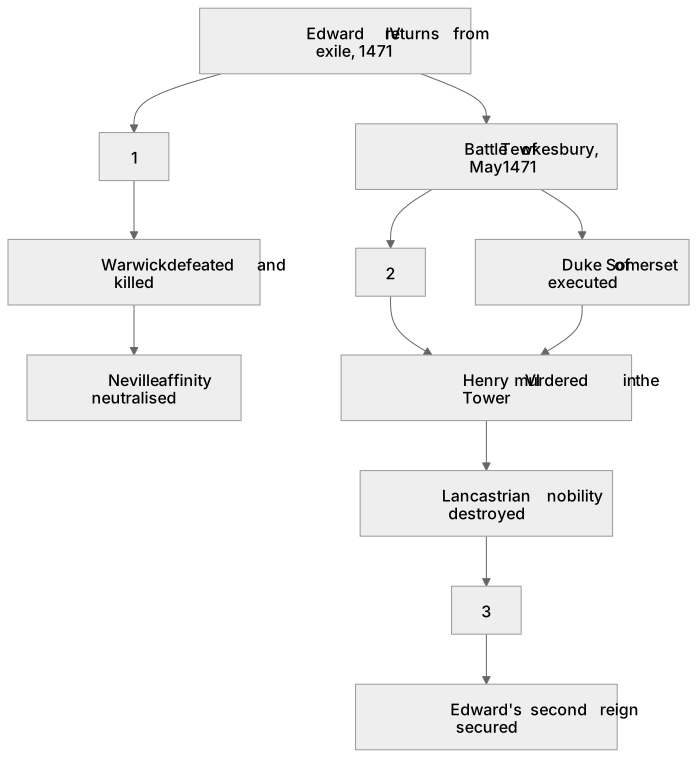
Label the diagram
Some boxes have lost their names. Pick the right name for each number.
1Box 1
2Box 2
3Box 3
There is more to this lesson
The full lesson goes on to check your understanding and help you earn the marks. Create a free account to carry on, with your progress saved.
A week of Premium from your first lesson · Then the free plan continues · No card, no charge
Test your understanding of 2B The Wars of the Roses, 1450–1499 – The triumph of the Yorkists, 1461–1471: The crushing of the Lancastrian cause: Barnet and Tewkesbury; the destruction of the Lancastrian nobility
Active recall beats re-reading. Take an instant quiz now to test what you’ve learned and lock it into long-term memory.
A week of Premium from your first lesson · Then the free plan continues · No card, no charge