AQA · A-Level · History
Course version: 7042 · Version from Sept 2017
The personal rule of Edward IV and the political impact of his marriage to…
Full specification wording
2B The Wars of the Roses, 1450–1499 – The triumph of the Yorkists, 1461–1471: The personal rule of Edward IV and the political impact of his marriage to Elizabeth Woodville
Edward IV’s first reign (1461–1470) was characterised by his attempts to establish a secure personal rule following his usurpation.
Checked against the AQA 7042 specification (opens in a new tab) on .
- Point 1 of 4
Study notes
From the checked teaching notes for this specification point.
The idea
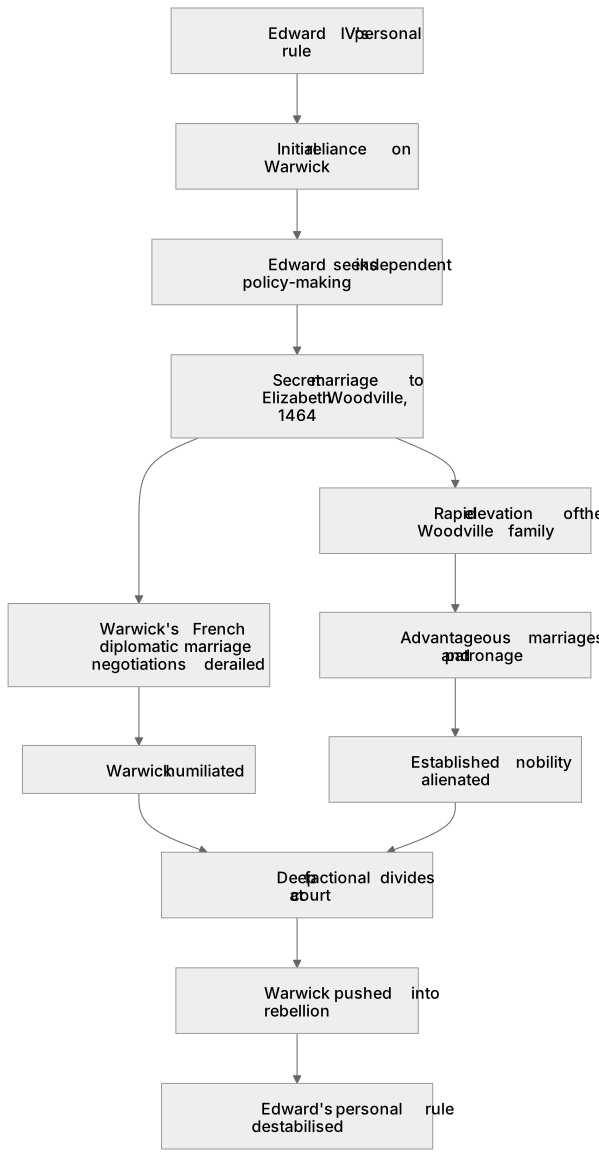
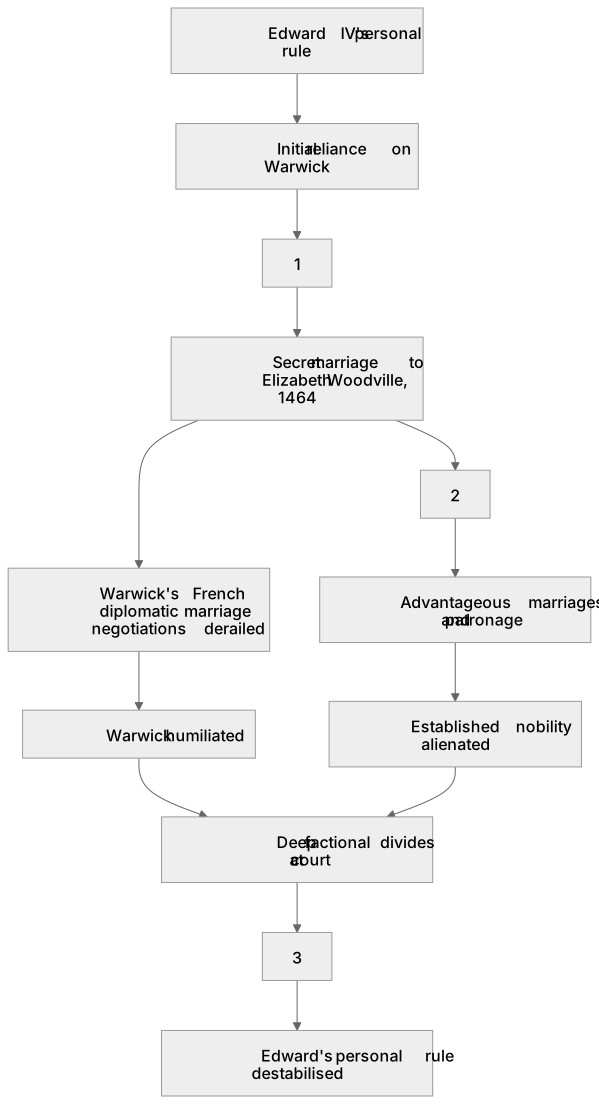
Edward IV’s first reign (1461–1470) was characterised by his attempts to establish a secure personal rule following his usurpation. Initially reliant on powerful magnates like Richard Neville, Earl of Warwick, Edward gradually sought independence in his policy-making. A defining moment was his secret marriage to Elizabeth Woodville in 1464, which profoundly impacted English politics. It derailed Warwick’s French diplomatic marriage negotiations, humiliating the Earl. Furthermore, the rapid elevation of the Woodville family through advantageous marriages and patronage alienated established nobility. This favouritism created deep factional divides at court, ultimately pushing Warwick into rebellion and destabilising Edward’s personal rule.
What earns the marks
- Assess Edward IV's early reliance on the Neville family and his subsequent efforts to assert independent royal authority.
- Evaluate the diplomatic consequences of the Woodville marriage, specifically the collapse of the French alliance negotiated by Warwick.
- Analyse the distribution of royal patronage to the Woodville family, such as Earl Rivers, and its effect on the established nobility.
- Examine how the marriage acted as a catalyst for factionalism, directly contributing to the political instability of the late 1460s.
Common mistakes and how to put them right
Assuming the Woodville marriage was solely a romantic decision.
Put it right: Recognise the political implications and Edward's potential desire to build a faction loyal only to himself.
Stating that the Woodvilles held all the power.
Put it right: Understand that while they received significant patronage and advantageous marriages, Edward remained firmly in control of royal policy.
Confusing Edward's first and second reigns.
Put it right: Ensure analysis of the Woodville marriage's impact focuses on the destabilisation of his first reign (1461-1470) rather than his more secure second reign.
Exam tips
- Link the Woodville marriage directly to the alienation of Warwick to explain the breakdown of Edward's early political consensus.
- Use specific examples of Woodville patronage, such as the marriage of Katherine Woodville to the Duke of Buckingham, to illustrate noble grievances.
- Evaluate whether Edward's personal rule failed due to his own miscalculations or the overmighty nature of his magnates.
Try the lesson
The start of the 2B The Wars of the Roses, 1450–1499 – The triumph of the Yorkists, 1461–1471: The personal rule of Edward IV and the political impact of his marriage to Elizabeth Woodville lesson, made from checked teaching notes for this specification point.
Have a go first
What was the most significant immediate political consequence of Edward IV's secret marriage to Elizabeth Woodville in 1464?
Listen
Edward IV’s first reign (1461–1470) was characterised by his attempts to establish a secure personal rule following his usurpation. Initially reliant on powerful magnates like Richard Neville, Earl of Warwick, Edward gradually sought independence in his policy-making. A defining moment was his secret marriage to Elizabeth Woodville in 1464, which profoundly impacted English politics. It derailed Warwick’s French diplomatic marriage negotiations, humiliating the Earl. Furthermore, the rapid elevation of the Woodville family through advantageous marriages and patronage alienated established nobility. This favouritism created deep factional divides at court, ultimately pushing Warwick into rebellion and destabilising Edward’s personal rule. A strong answer earns marks for these points. Assess Edward IV's early reliance on the Neville family and his subsequent efforts to assert independent royal authority. Evaluate the diplomatic consequences of the Woodville marriage, specifically the collapse of the French alliance negotiated by Warwick. Analyse the distribution of royal patronage to the Woodville family, such as Earl Rivers, and its effect on the established nobility. Examine how the marriage acted as a catalyst for factionalism, directly contributing to the political instability of the late 1460s. A common slip: Assuming the Woodville marriage was solely a romantic decision. Instead, recognise the political implications and Edward's potential desire to build a faction loyal only to himself. Exam tip: Link the Woodville marriage directly to the alienation of Warwick to explain the breakdown of Edward's early political consensus.
See it
Put the events in order
Put these events in the order they happened, earliest first.
- 1. Edward IV's first reign begins after his usurpation
- 2. Edward IV's first reign ends
- 3. Edward secretly marries Elizabeth Woodville
Label the diagram
Some boxes have lost their names. Pick the right name for each number.
1Box 1
2Box 2
3Box 3
There is more to this lesson
The full lesson goes on to check your understanding and help you earn the marks. Create a free account to carry on, with your progress saved.
A week of Premium from your first lesson · Then the free plan continues · No card, no charge
Test your understanding of 2B The Wars of the Roses, 1450–1499 – The triumph of the Yorkists, 1461–1471: The personal rule of Edward IV and the political impact of his marriage to Elizabeth Woodville
Active recall beats re-reading. Take an instant quiz now to test what you’ve learned and lock it into long-term memory.
A week of Premium from your first lesson · Then the free plan continues · No card, no charge