AQA · A-Level · History
Course version: 7042 · Version from Sept 2017
Factional rivalries: Warwick ‘the Kingmaker’; attempts to restore Henry…
Full specification wording
2B The Wars of the Roses, 1450–1499 – The triumph of the Yorkists, 1461–1471: Factional rivalries: Warwick ‘the Kingmaker’; attempts to restore Henry VI; Margaret of Anjou; Edward, Prince of Wales
The late 1460s witnessed intense factional rivalries that culminated in the temporary overthrow of Edward IV.
Checked against the AQA 7042 specification (opens in a new tab) on .
- Point 2 of 4
Study notes
From the checked teaching notes for this specification point.
The idea
The late 1460s witnessed intense factional rivalries that culminated in the temporary overthrow of Edward IV. Richard Neville, Earl of Warwick (‘the Kingmaker’), alienated by Edward’s independence, orchestrated rebellions to regain control. Concurrently, Margaret of Anjou tirelessly campaigned from exile to restore her husband, Henry VI, and secure the succession for their son, Edward, Prince of Wales. The convergence of these rivalries led to the astonishing alliance between former bitter enemies, Warwick and Margaret, brokered by Louis XI of France in 1470. This pact successfully, albeit briefly, restored Henry VI to the throne (the Readeption), demonstrating how dynastic ambition and factional grievance could completely reshape political allegiances.
What earns the marks
- Analyse the motivations behind Warwick's transition from Edward IV's chief supporter to his primary antagonist.
- Evaluate Margaret of Anjou's diplomatic and military efforts to secure foreign backing for the Lancastrian cause.
- Assess the significance of Edward, Prince of Wales, as the focal point for Lancastrian dynastic continuity and loyalty.
- Examine the mechanics and fragility of the 1470 alliance between Warwick and Margaret of Anjou that led to Henry VI's brief restoration.
Common mistakes and how to put them right
Treating Henry VI as an active political player during this period.
Put it right: Recognise that Henry was largely a passive figurehead used by Margaret of Anjou and later Warwick.
Assuming Warwick always intended to restore Henry VI.
Put it right: Note that Warwick initially tried to control Edward IV, then attempted to replace him with George, Duke of Clarence, before finally allying with the Lancastrians.
Underestimating Margaret of Anjou's role.
Put it right: Acknowledge her relentless diplomacy and leadership as the true driving force behind the attempts to restore the Lancastrian dynasty.
Exam tips
- Contrast the political aims of Warwick (personal power) with those of Margaret of Anjou (dynastic survival) to highlight the fragility of their 1470 alliance.
- Use the role of Edward, Prince of Wales, to explain why Margaret of Anjou refused to compromise her son's inheritance, shaping her diplomatic strategy.
- Evaluate the role of foreign intervention, particularly by Louis XI of France, in facilitating the factional realignments of 1470.
Try the lesson
The start of the 2B The Wars of the Roses, 1450–1499 – The triumph of the Yorkists, 1461–1471: Factional rivalries: Warwick ‘the Kingmaker’; attempts to restore Henry VI; Margaret of Anjou; Edward, Prince of Wales lesson, made from checked teaching notes for this specification point.
Have a go first
Why did Richard Neville, Earl of Warwick, shift his allegiance to support the restoration of Henry VI in 1470?
Listen
The late 1460s witnessed intense factional rivalries that culminated in the temporary overthrow of Edward IV. Richard Neville, Earl of Warwick (‘the Kingmaker’), alienated by Edward’s independence, orchestrated rebellions to regain control. Concurrently, Margaret of Anjou tirelessly campaigned from exile to restore her husband, Henry VI, and secure the succession for their son, Edward, Prince of Wales. The convergence of these rivalries led to the astonishing alliance between former bitter enemies, Warwick and Margaret, brokered by Louis XI of France in 1470. This pact successfully, albeit briefly, restored Henry VI to the throne (the Readeption), demonstrating how dynastic ambition and factional grievance could completely reshape political allegiances. A strong answer earns marks for these points. Analyse the motivations behind Warwick's transition from Edward IV's chief supporter to his primary antagonist. Evaluate Margaret of Anjou's diplomatic and military efforts to secure foreign backing for the Lancastrian cause. Assess the significance of Edward, Prince of Wales, as the focal point for Lancastrian dynastic continuity and loyalty. Examine the mechanics and fragility of the 1470 alliance between Warwick and Margaret of Anjou that led to Henry VI's brief restoration. A common slip: Treating Henry VI as an active political player during this period. Instead, recognise that Henry was largely a passive figurehead used by Margaret of Anjou and later Warwick. Exam tip: Contrast the political aims of Warwick (personal power) with those of Margaret of Anjou (dynastic survival) to highlight the fragility of their 1470 alliance.
See it
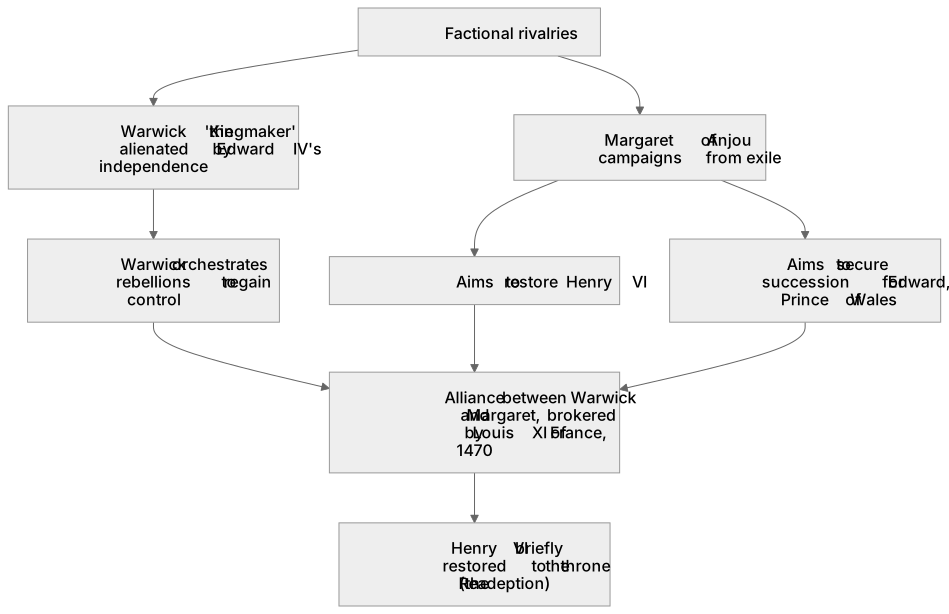
Label the diagram
Some boxes have lost their names. Pick the right name for each number.
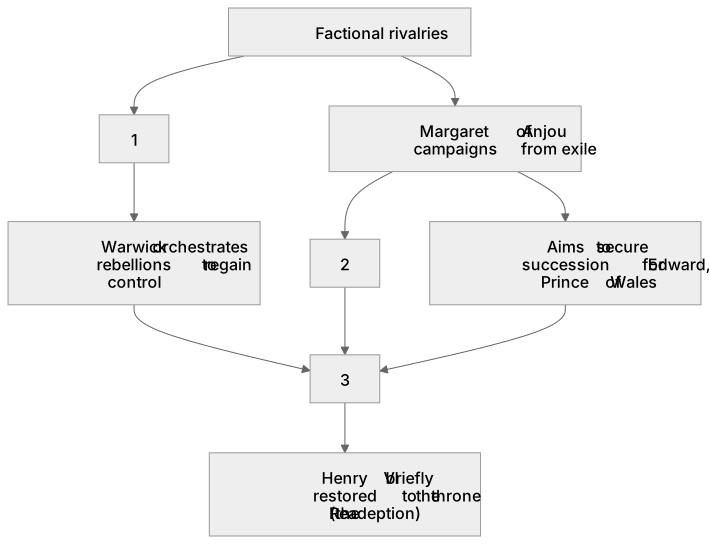
1Box 1
2Box 2
3Box 3
There is more to this lesson
The full lesson goes on to check your understanding and help you earn the marks. Create a free account to carry on, with your progress saved.
A week of Premium from your first lesson · Then the free plan continues · No card, no charge
Test your understanding of 2B The Wars of the Roses, 1450–1499 – The triumph of the Yorkists, 1461–1471: Factional rivalries: Warwick ‘the Kingmaker’; attempts to restore Henry VI; Margaret of Anjou; Edward, Prince of Wales
Active recall beats re-reading. Take an instant quiz now to test what you’ve learned and lock it into long-term memory.
A week of Premium from your first lesson · Then the free plan continues · No card, no charge