AQA · A-Level · History
Course version: 7042 · Version from Sept 2017
Proclamation of Edward IV as King; Yorkist victory at Towton; the…
Full specification wording
2B The Wars of the Roses, 1450–1499 – The War of the Barons, 1459–1461: Proclamation of Edward IV as King; Yorkist victory at Towton; the strengths and weaknesses of the Yorkists by 1461
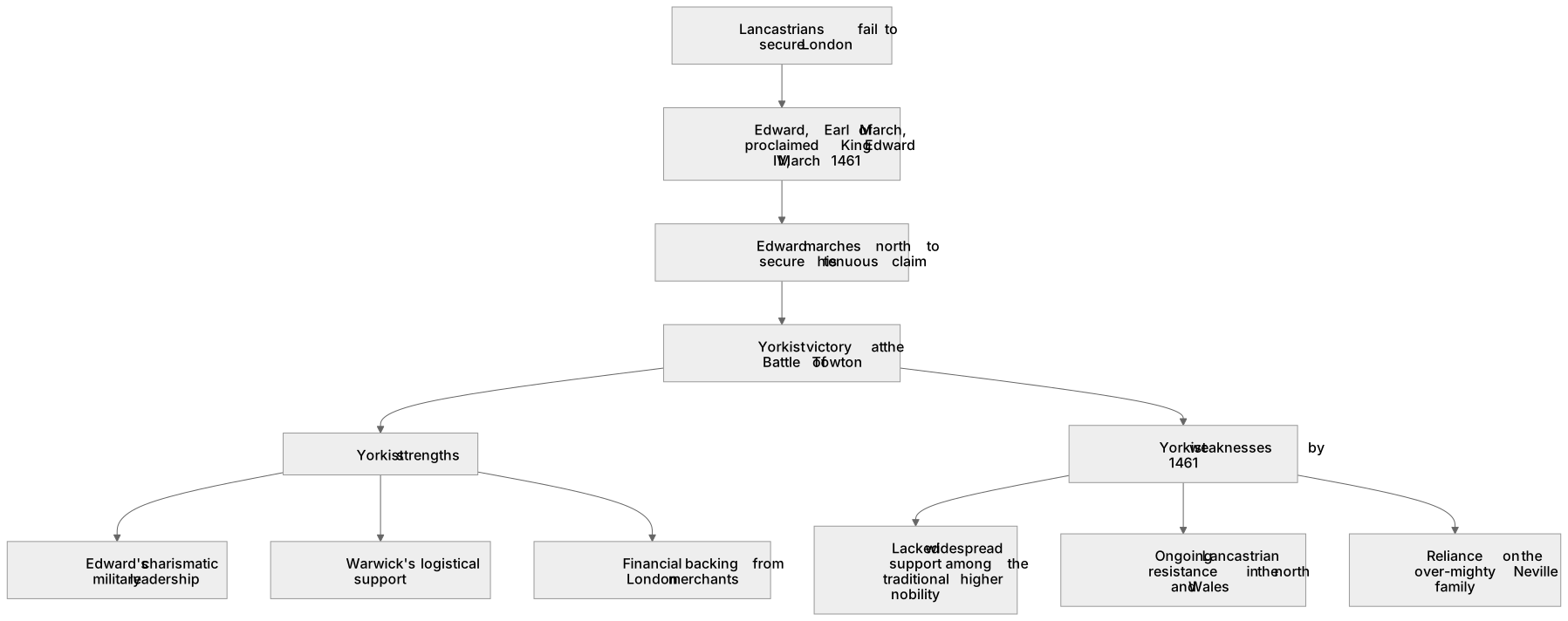
Following the Lancastrian failure to secure London, Edward, Earl of March, capitalised on the capital's Yorkist sympathies and was proclaimed King Edward IV in March 1461.
Checked against the AQA 7042 specification (opens in a new tab) on .
- Point 4 of 4
- 3 key terms
Study notes
From the checked teaching notes for this specification point.
The idea
Following the Lancastrian failure to secure London, Edward, Earl of March, capitalised on the capital's Yorkist sympathies and was proclaimed King Edward IV in March 1461. To secure his tenuous claim, Edward marched north, culminating in the decisive Yorkist victory at the brutal Battle of Towton. This victory demonstrated Yorkist strengths: Edward's charismatic military leadership, Warwick's logistical support, and crucial financial backing from London merchants. However, significant weaknesses remained by 1461. The Yorkist regime lacked widespread support among the traditional higher nobility, faced ongoing Lancastrian resistance in the north and Wales, and relied heavily on the over-mighty Neville family for stability.
What earns the marks
- Analyse the political manoeuvring that led to the proclamation of Edward IV, highlighting the role of London and the justification that Henry VI had breached the Act of Accord.
- Evaluate the factors contributing to the Yorkist victory at Towton, including weather conditions, Edward's leadership, and the late arrival of Norfolk's forces.
- Identify Yorkist strengths by 1461, such as control of the capital, merchant financial support, and the formidable military partnership of Edward and Warwick.
- Assess Yorkist weaknesses by 1461, particularly the survival of Margaret and Henry VI, and the disproportionate reliance on the Neville affinity.
Common mistakes and how to put them right
Stating that Towton completely destroyed the Lancastrian cause.
Put it right: Margaret, Henry, and key supporters escaped to Scotland to continue their resistance.
Assuming Edward IV was crowned before Towton.
Put it right: He was only proclaimed king in March 1461 and formally crowned in June after securing military victory.
Overstating Yorkist noble support.
Put it right: A significant weakness in 1461 was that the majority of the peerage had actually fought for the Lancastrians at Towton.
Exam tips
- Link Edward's proclamation as king directly to the Lancastrian failure to enter London after the Second Battle of St Albans.
- Use the Battle of Towton to illustrate Edward IV's personal strengths as a military commander compared to the passive Henry VI.
- When evaluating Yorkist weaknesses in 1461, focus on the geographical divide, noting that Lancastrian sentiment remained strong in the North and Wales.
Try the lesson
The start of the 2B The Wars of the Roses, 1450–1499 – The War of the Barons, 1459–1461: Proclamation of Edward IV as King; Yorkist victory at Towton; the strengths and weaknesses of the Yorkists by 1461 lesson, made from checked teaching notes for this specification point.
Have a go first
On what primary basis was Edward, Earl of March, proclaimed King Edward IV in London in March 1461?
Listen
Following the Lancastrian failure to secure London, Edward, Earl of March, capitalised on the capital's Yorkist sympathies and was proclaimed King Edward IV in March 1461. To secure his tenuous claim, Edward marched north, culminating in the decisive Yorkist victory at the brutal Battle of Towton. This victory demonstrated Yorkist strengths: Edward's charismatic military leadership, Warwick's logistical support, and crucial financial backing from London merchants. However, significant weaknesses remained by 1461. The Yorkist regime lacked widespread support among the traditional higher nobility, faced ongoing Lancastrian resistance in the north and Wales, and relied heavily on the over-mighty Neville family for stability. A strong answer earns marks for these points. Analyse the political manoeuvring that led to the proclamation of Edward IV, highlighting the role of London and the justification that Henry VI had breached the Act of Accord. Evaluate the factors contributing to the Yorkist victory at Towton, including weather conditions, Edward's leadership, and the late arrival of Norfolk's forces. Identify Yorkist strengths by 1461, such as control of the capital, merchant financial support, and the formidable military partnership of Edward and Warwick. Assess Yorkist weaknesses by 1461, particularly the survival of Margaret and Henry VI, and the disproportionate reliance on the Neville affinity. Exam tip: Link Edward's proclamation as king directly to the Lancastrian failure to enter London after the Second Battle of St Albans.
See it
Key words
Say what each word means before you turn the card.
Military leadership and fortune
Try answering aloud or in your head before turning the card.
Economic and regional power bases
Try answering aloud or in your head before turning the card.
Over-mighty subjects
Try answering aloud or in your head before turning the card.
See every definition
- Military leadership and fortune
- Edward's charismatic military leadership and Warwick's logistical support were Yorkist strengths, demonstrated by the decisive victory at the brutal Battle of Towton.
- Economic and regional power bases
- Crucial financial backing from London merchants and control of the capital were Yorkist strengths by 1461.
- Over-mighty subjects
- The Yorkist regime relied heavily on the over-mighty Neville family for stability, a significant weakness by 1461.
Label the diagram
Some boxes have lost their names. Pick the right name for each number.
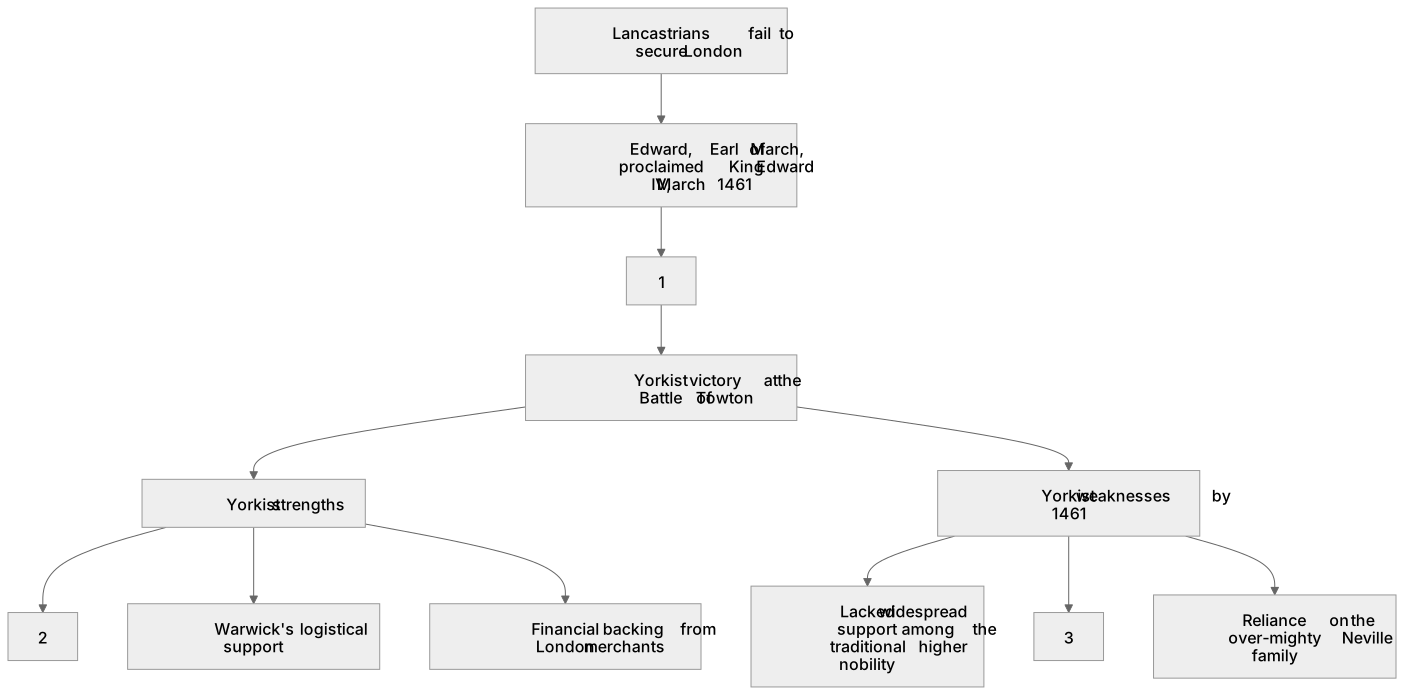
1Box 1
2Box 2
3Box 3
There is more to this lesson
The full lesson goes on to check your understanding and help you earn the marks. Create a free account to carry on, with your progress saved.
A week of Premium from your first lesson · Then the free plan continues · No card, no charge
Test your understanding of 2B The Wars of the Roses, 1450–1499 – The War of the Barons, 1459–1461: Proclamation of Edward IV as King; Yorkist victory at Towton; the strengths and weaknesses of the Yorkists by 1461
Active recall beats re-reading. Take an instant quiz now to test what you’ve learned and lock it into long-term memory.
A week of Premium from your first lesson · Then the free plan continues · No card, no charge