AQA · A-Level · History
Course version: 7042 · Version from Sept 2017
Shifting loyalties and the Lancastrian revival: Wakefield; the second…
Full specification wording
2B The Wars of the Roses, 1450–1499 – The War of the Barons, 1459–1461: Shifting loyalties and the Lancastrian revival: Wakefield; the second Battle of St Albans; the death of York and the restoration of Henry VI
The period 1460-1461 witnessed a dramatic Lancastrian revival driven by shifting noble loyalties following the Act of Accord.
Checked against the AQA 7042 specification (opens in a new tab) on .
- Point 3 of 4
- 4 key terms
Study notes
From the checked teaching notes for this specification point.
The idea
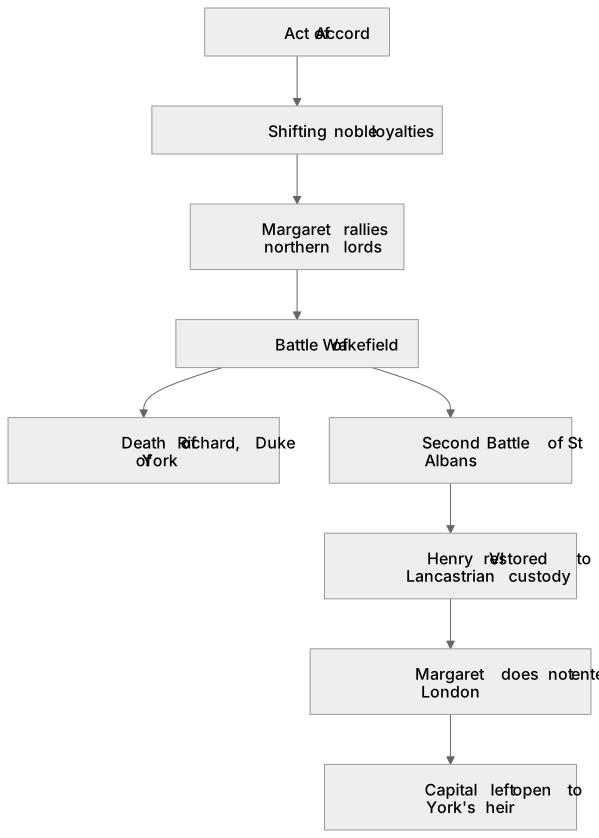
The period 1460-1461 witnessed a dramatic Lancastrian revival driven by shifting noble loyalties following the Act of Accord. Queen Margaret rallied northern lords, leading to the Battle of Wakefield (December 1460), where Richard, Duke of York, was killed, removing the primary Yorkist figurehead. This Lancastrian momentum continued at the Second Battle of St Albans (February 1461), where Warwick's forces were defeated. Crucially, this victory allowed the Lancastrians to recapture and restore Henry VI, who had been a Yorkist prisoner. However, Margaret's decision not to enter London, due to the city's fear of her northern army, proved a fatal strategic error despite these military successes, leaving the capital open to York's heir.
What earns the marks
- Explain the causes of the Lancastrian revival, particularly Margaret of Anjou's successful recruitment of northern nobility and Scottish support.
- Analyse the impact of the Battle of Wakefield, specifically the power vacuum created by the deaths of Richard of York and the Earl of Salisbury.
- Evaluate the significance of the Second Battle of St Albans in securing the physical restoration of Henry VI to Lancastrian custody.
- Assess how shifting loyalties, such as the defection of Lovelace at St Albans, demonstrated the fragile nature of noble allegiances during this phase.
Common mistakes and how to put them right
Confusing the First and Second Battles of St Albans.
Put it right: The first in 1455 was a Yorkist victory, whereas the second in 1461 was a Lancastrian victory resulting in Henry VI's recovery.
Assuming York's death at Wakefield ended the Yorkist cause.
Put it right: It actually transferred leadership to his highly capable son, Edward, Earl of March.
Claiming Henry VI was restored to full independent power.
Put it right: He remained a passive figurehead, simply transferring from Yorkist control to Margaret's control.
Exam tips
- Use the Act of Accord as the catalyst for shifting loyalties, explaining why it alienated nobles and fuelled Margaret's northern revival.
- Contrast the military success of the Lancastrians at Wakefield and St Albans with their political failure to secure London.
- When discussing the death of York, evaluate whether it was a fatal blow to the Yorkists or a necessary step for Edward IV's more ruthless leadership.
Try the lesson
The start of the 2B The Wars of the Roses, 1450–1499 – The War of the Barons, 1459–1461: Shifting loyalties and the Lancastrian revival: Wakefield; the second Battle of St Albans; the death of York and the restoration of Henry VI lesson, made from checked teaching notes for this specification point.
Have a go first
Which significant Yorkist leader was killed at the Battle of Wakefield in December 1460, temporarily halting the Yorkist advance?
Listen
The period 1460-1461 witnessed a dramatic Lancastrian revival driven by shifting noble loyalties following the Act of Accord. Queen Margaret rallied northern lords, leading to the Battle of Wakefield (December 1460), where Richard, Duke of York, was killed, removing the primary Yorkist figurehead. This Lancastrian momentum continued at the Second Battle of St Albans (February 1461), where Warwick's forces were defeated. Crucially, this victory allowed the Lancastrians to recapture and restore Henry VI, who had been a Yorkist prisoner. However, Margaret's decision not to enter London, due to the city's fear of her northern army, proved a fatal strategic error despite these military successes, leaving the capital open to York's heir. A strong answer earns marks for these points. Explain the causes of the Lancastrian revival, particularly Margaret of Anjou's successful recruitment of northern nobility and Scottish support. Analyse the impact of the Battle of Wakefield, specifically the power vacuum created by the deaths of Richard of York and the Earl of Salisbury. Evaluate the significance of the Second Battle of St Albans in securing the physical restoration of Henry VI to Lancastrian custody. Assess how shifting loyalties, such as the defection of Lovelace at St Albans, demonstrated the fragile nature of noble allegiances during this phase. Exam tip: Use the Act of Accord as the catalyst for shifting loyalties, explaining why it alienated nobles and fuelled Margaret's northern revival.
See it
Key words
Say what each word means before you turn the card.
Military conflict and strategy
Try answering aloud or in your head before turning the card.
Noble factionalism and loyalty
Try answering aloud or in your head before turning the card.
The role of queenship and female authority
Try answering aloud or in your head before turning the card.
The authority of the Crown
Try answering aloud or in your head before turning the card.
See every definition
- Military conflict and strategy
- The Lancastrian revival was driven by military success at Wakefield and the Second Battle of St Albans, but Margaret's decision not to enter London proved a fatal strategic error.
- Noble factionalism and loyalty
- Shifting noble loyalties following the Act of Accord fuelled the Lancastrian revival, and the defection of Lovelace at St Albans showed the fragile nature of noble allegiances.
- The role of queenship and female authority
- Queen Margaret rallied northern lords and recruited the northern nobility, and her decision not to enter London proved a fatal strategic error.
- The authority of the Crown
- The victory at the Second Battle of St Albans allowed the Lancastrians to recapture and restore Henry VI, who had been a Yorkist prisoner and remained a passive figurehead.
Label the diagram
Some boxes have lost their names. Pick the right name for each number.
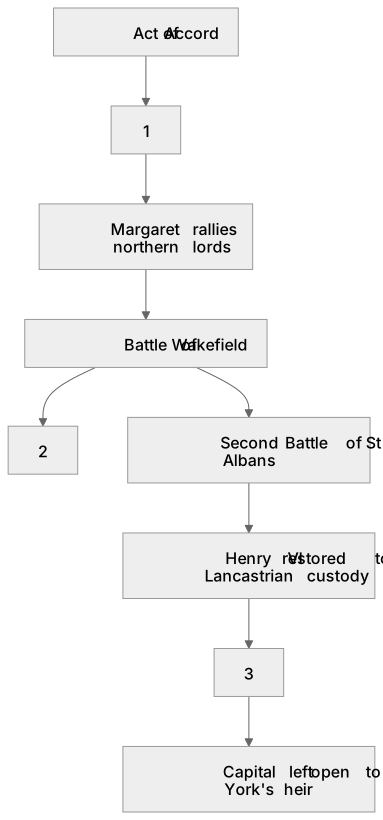
1Box 1
2Box 2
3Box 3
There is more to this lesson
The full lesson goes on to check your understanding and help you earn the marks. Create a free account to carry on, with your progress saved.
A week of Premium from your first lesson · Then the free plan continues · No card, no charge
Test your understanding of 2B The Wars of the Roses, 1450–1499 – The War of the Barons, 1459–1461: Shifting loyalties and the Lancastrian revival: Wakefield; the second Battle of St Albans; the death of York and the restoration of Henry VI
Active recall beats re-reading. Take an instant quiz now to test what you’ve learned and lock it into long-term memory.
A week of Premium from your first lesson · Then the free plan continues · No card, no charge