AQA · A-Level · History
Course version: 7042 · Version from Sept 2017
The renewal of war: York’s flight into exile; the emergence of Warwick…
Full specification wording
2B The Wars of the Roses, 1450–1499 – The War of the Barons, 1459–1461: The renewal of war: York’s flight into exile; the emergence of Warwick ‘the Kingmaker’; the capture of Henry VI at Northampton
The rout at Ludford Bridge in 1459 forced Richard of York to flee to Ireland, while Richard Neville, Earl of Warwick, escaped to Calais.
Checked against the AQA 7042 specification (opens in a new tab) on .
- Point 1 of 4
Study notes
From the checked teaching notes for this specification point.
The idea
The rout at Ludford Bridge in 1459 forced Richard of York to flee to Ireland, while Richard Neville, Earl of Warwick, escaped to Calais. This exile proved temporary, as Warwick used his naval base to launch a propaganda campaign and secure resources. Warwick's strategic return to England in 1460 marked his emergence as 'the Kingmaker', rallying popular support in Kent and London. This culminated in the Battle of Northampton in July 1460, where Yorkist forces decisively defeated the Lancastrians. The capture of Henry VI at Northampton fundamentally shifted the balance of power, allowing York to return from exile and formally claim the throne, escalating the conflict from a factional dispute to a dynastic war.
What earns the marks
- Explain the causes and consequences of the Yorkist defeat at Ludford Bridge, leading to York's flight to Ireland and Warwick's retreat to Calais.
- Analyse how Warwick utilised his position as Captain of Calais to maintain Yorkist resistance, control the Channel, and launch a successful invasion of England in 1460.
- Evaluate the significance of the Battle of Northampton (July 1460), particularly the betrayal by Lord Grey of Ruthin which facilitated the Yorkist victory.
- Assess the political impact of Henry VI's capture at Northampton, which left the Lancastrian government leaderless and paved the way for York's Act of Accord.
Common mistakes and how to put them right
Assuming York and Warwick fled to the same location after Ludford Bridge.
Put it right by specifying York went to Ireland while Warwick, Salisbury, and Edward of March went to Calais.
Claiming York led the Yorkist forces at the Battle of Northampton.
Put it right by noting that Warwick and Edward of March commanded the army, as York was still in Ireland.
Confusing the capture of Henry VI at Northampton with his earlier capture at St Albans.
Put it right by distinguishing the 1460 capture which directly led to York claiming the throne.
Exam tips
- Use Warwick's actions in Calais to demonstrate his growing independent political and military influence before York's return.
- Link the capture of Henry VI at Northampton directly to the escalation of the conflict, as it forced York to finally claim the crown rather than just the protectorship.
- Contrast the Yorkist disaster at Ludford Bridge in 1459 with their rapid recovery by July 1460 to evaluate the underlying weaknesses of the Lancastrian regime.
Try the lesson
The start of the 2B The Wars of the Roses, 1450–1499 – The War of the Barons, 1459–1461: The renewal of war: York’s flight into exile; the emergence of Warwick ‘the Kingmaker’; the capture of Henry VI at Northampton lesson, made from checked teaching notes for this specification point.
Have a go first
Following the Yorkist rout at Ludford Bridge in October 1459, to which location did Richard, Duke of York, flee into exile to rebuild his political and military strength?
Listen
The rout at Ludford Bridge in 1459 forced Richard of York to flee to Ireland, while Richard Neville, Earl of Warwick, escaped to Calais. This exile proved temporary, as Warwick used his naval base to launch a propaganda campaign and secure resources. Warwick's strategic return to England in 1460 marked his emergence as 'the Kingmaker', rallying popular support in Kent and London. This culminated in the Battle of Northampton in July 1460, where Yorkist forces decisively defeated the Lancastrians. The capture of Henry VI at Northampton fundamentally shifted the balance of power, allowing York to return from exile and formally claim the throne, escalating the conflict from a factional dispute to a dynastic war. A strong answer earns marks for these points. Explain the causes and consequences of the Yorkist defeat at Ludford Bridge, leading to York's flight to Ireland and Warwick's retreat to Calais. Analyse how Warwick utilised his position as Captain of Calais to maintain Yorkist resistance, control the Channel, and launch a successful invasion of England in 1460. Evaluate the significance of the Battle of Northampton (July 1460), particularly the betrayal by Lord Grey of Ruthin which facilitated the Yorkist victory. Assess the political impact of Henry VI's capture at Northampton, which left the Lancastrian government leaderless and paved the way for York's Act of Accord. A common slip: Assuming York and Warwick fled to the same location after Ludford Bridge. Instead, specifying York went to Ireland while Warwick, Salisbury, and Edward of March went to Calais. Exam tip: Use Warwick's actions in Calais to demonstrate his growing independent political and military influence before York's return.
See it
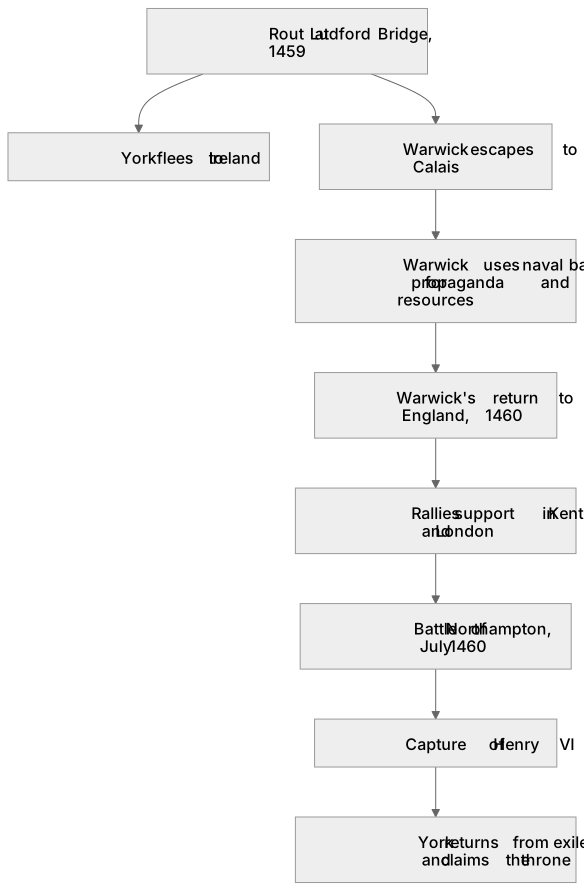
Label the diagram
Some boxes have lost their names. Pick the right name for each number.
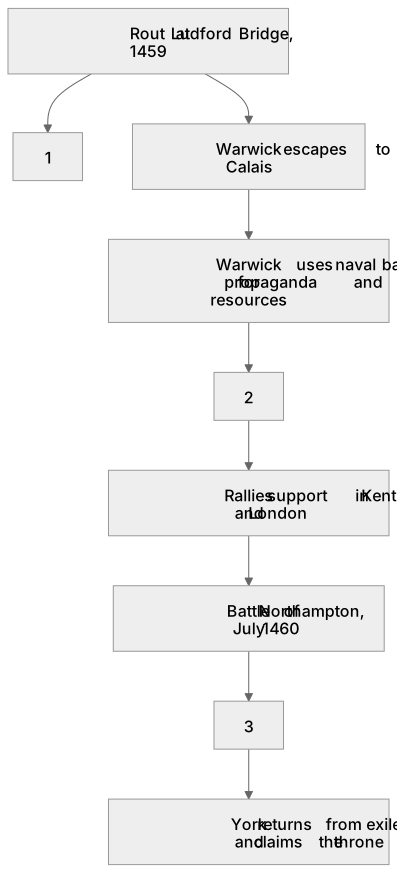
1Box 1
2Box 2
3Box 3
There is more to this lesson
The full lesson goes on to check your understanding and help you earn the marks. Create a free account to carry on, with your progress saved.
A week of Premium from your first lesson · Then the free plan continues · No card, no charge
Test your understanding of 2B The Wars of the Roses, 1450–1499 – The War of the Barons, 1459–1461: The renewal of war: York’s flight into exile; the emergence of Warwick ‘the Kingmaker’; the capture of Henry VI at Northampton
Active recall beats re-reading. Take an instant quiz now to test what you’ve learned and lock it into long-term memory.
A week of Premium from your first lesson · Then the free plan continues · No card, no charge