AQA · A-Level · History
Course version: 7042 · Version from Sept 2017
Filling the political vacuum: the rule of Richard of York as Protector of…
Full specification wording
2B The Wars of the Roses, 1450–1499 – The War of the Barons, 1459–1461: Filling the political vacuum: the rule of Richard of York as Protector of England
Henry VI's severe mental illness in 1453 created a profound political vacuum, necessitating a regency.
Checked against the AQA 7042 specification (opens in a new tab) on .
- Point 2 of 4
- 4 key terms
Study notes
From the checked teaching notes for this specification point.
The idea
Henry VI's severe mental illness in 1453 created a profound political vacuum, necessitating a regency. Richard, Duke of York, was appointed Protector of England in March 1454, despite fierce opposition from Margaret of Anjou. York's First Protectorate attempted to restore law and order, notably intervening in the Percy-Neville feud, and sought to reform royal finances by reducing household expenditure. However, his rule was inherently partisan; he imprisoned his rival, Somerset, and heavily favoured his Neville allies. When Henry VI recovered in early 1455, York's protectorate was dismantled, Somerset was released, and the ensuing political reversal triggered armed conflict at St Albans.
What earns the marks
- Explain how Henry VI's illness in 1453 created a political vacuum that led to York's appointment as Protector of England.
- Evaluate York's attempts to provide good governance, including his efforts to manage royal finances and restore law and order.
- Analyse the partisan nature of York's rule, specifically his imprisonment of the Duke of Somerset and his reliance on the Neville faction.
- Assess the consequences of Henry VI's recovery in 1455, which led to the end of the Protectorate and the escalation of factional tensions.
Common mistakes and how to put them right
Stating that York claimed the throne during his First Protectorate.
Put it right: Clarify that he only claimed the role of Protector and Defender of the Realm to fill the political vacuum caused by Henry VI's illness.
Assuming York had universal support as Protector.
Put it right: Highlight the significant opposition from Margaret of Anjou and the broader Lancastrian nobility who distrusted his motives.
Claiming York executed Somerset during his Protectorate.
Put it right: Note Somerset was only imprisoned in the Tower of London without trial and was released upon Henry's recovery.
Exam tips
- Evaluate whether York's actions as Protector were driven by a genuine desire for good governance or by personal ambition and factional self-interest.
- Use the Percy-Neville feud as a specific example to demonstrate both York's attempts to enforce justice and his inability to remain impartial.
- Discuss how Henry VI's illness and subsequent recovery acted as catalysts for the shifting balance of power and the outbreak of conflict.
Try the lesson
The start of the 2B The Wars of the Roses, 1450–1499 – The War of the Barons, 1459–1461: Filling the political vacuum: the rule of Richard of York as Protector of England lesson, made from checked teaching notes for this specification point.
Have a go first
What was the primary cause that necessitated the appointment of Richard, Duke of York, as Protector of England in 1454?
Listen
Henry VI's severe mental illness in 1453 created a profound political vacuum, necessitating a regency. Richard, Duke of York, was appointed Protector of England in March 1454, despite fierce opposition from Margaret of Anjou. York's First Protectorate attempted to restore law and order, notably intervening in the Percy-Neville feud, and sought to reform royal finances by reducing household expenditure. However, his rule was inherently partisan; he imprisoned his rival, Somerset, and heavily favoured his Neville allies. When Henry VI recovered in early 1455, York's protectorate was dismantled, Somerset was released, and the ensuing political reversal triggered armed conflict at St Albans. A strong answer earns marks for these points. Explain how Henry VI's illness in 1453 created a political vacuum that led to York's appointment as Protector of England. Evaluate York's attempts to provide good governance, including his efforts to manage royal finances and restore law and order. Analyse the partisan nature of York's rule, specifically his imprisonment of the Duke of Somerset and his reliance on the Neville faction. Assess the consequences of Henry VI's recovery in 1455, which led to the end of the Protectorate and the escalation of factional tensions. A common slip: Stating that York claimed the throne during his First Protectorate. Instead, Clarify that he only claimed the role of Protector and Defender of the Realm to fill the political vacuum caused by Henry VI's illness. Exam tip: Evaluate whether York's actions as Protector were driven by a genuine desire for good governance or by personal ambition and factional self-interest.
See it
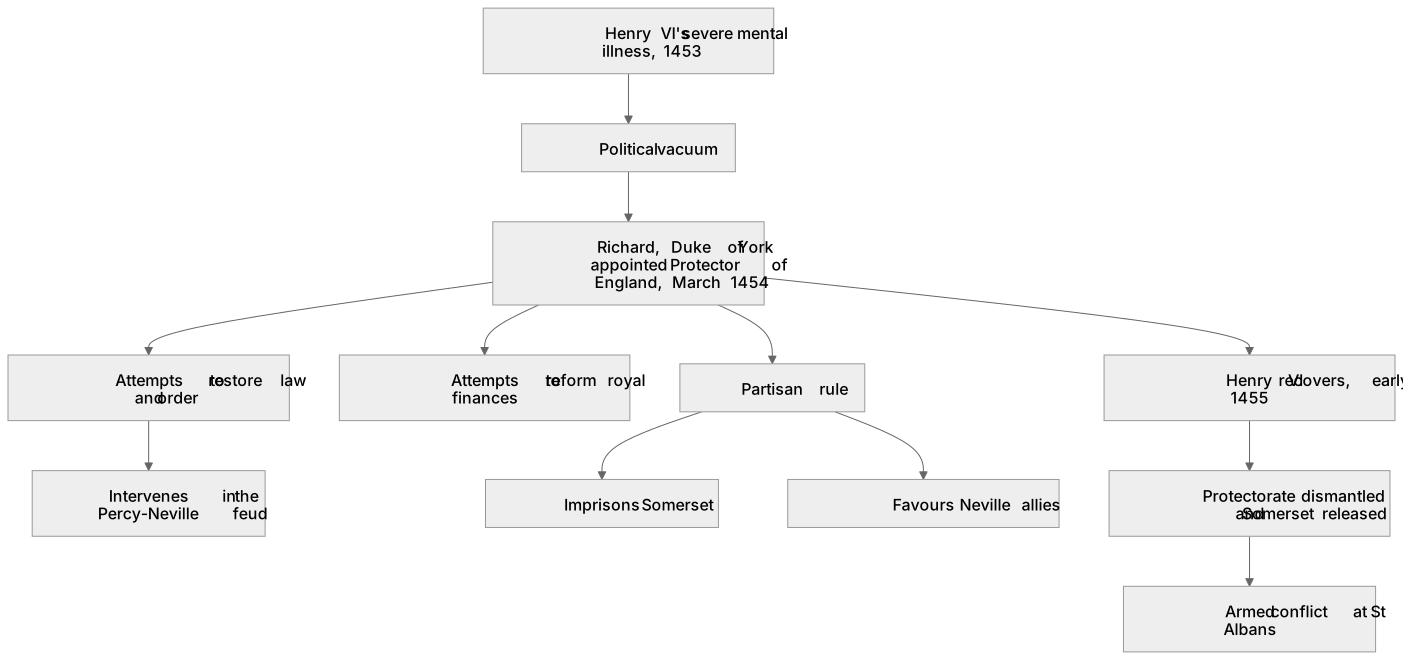
Put the events in order
Put these events in the order they happened, earliest first.
- 1. Henry VI's severe mental illness creates a political vacuum
- 2. Henry VI recovers and the protectorate is dismantled
- 3. Richard, Duke of York, appointed Protector of England
Key words
Say what each word means before you turn the card.
political vacuum
Try answering aloud or in your head before turning the card.
Protector of England
Try answering aloud or in your head before turning the card.
First Protectorate
Try answering aloud or in your head before turning the card.
partisan nature of York's rule
Try answering aloud or in your head before turning the card.
See every definition
- political vacuum
- The profound gap in authority created by Henry VI's severe mental illness in 1453, which necessitated a regency.
- Protector of England
- The role Richard, Duke of York, was appointed to in March 1454 to fill the political vacuum, despite fierce opposition from Margaret of Anjou.
- First Protectorate
- York's rule, which attempted to restore law and order, notably intervening in the Percy-Neville feud, and sought to reform royal finances by reducing household expenditure.
- partisan nature of York's rule
- The inherently partisan character of his rule, shown by imprisoning his rival Somerset and heavily favouring his Neville allies.
Label the diagram
Some boxes have lost their names. Pick the right name for each number.
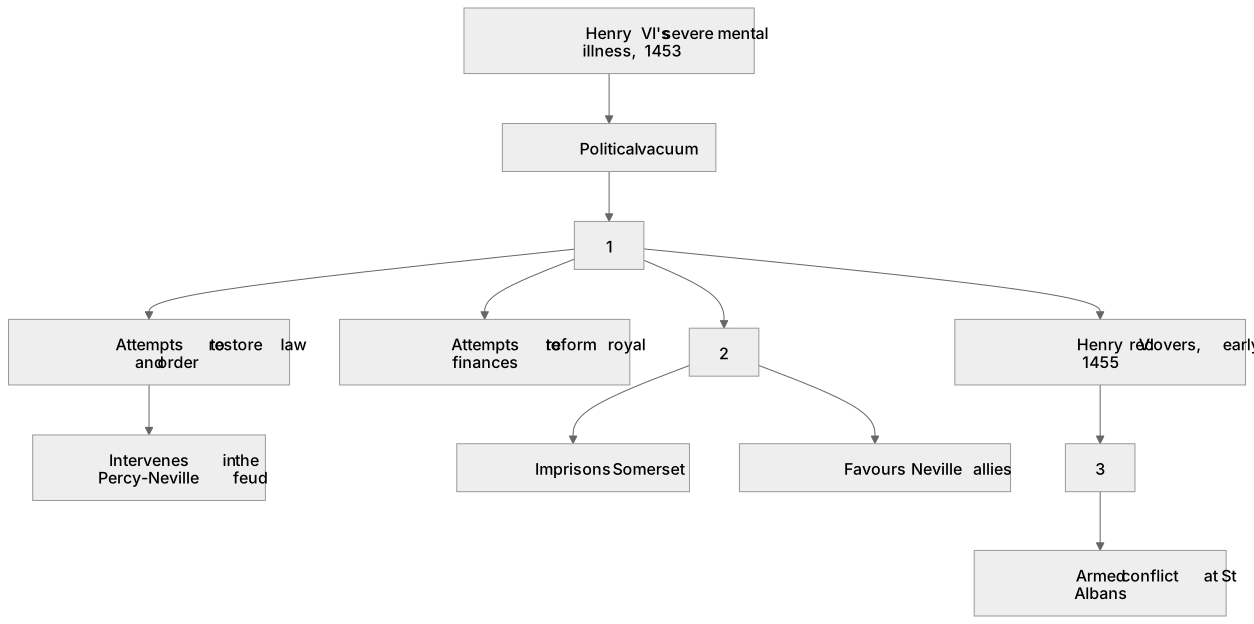
1Box 1
2Box 2
3Box 3
There is more to this lesson
The full lesson goes on to check your understanding and help you earn the marks. Create a free account to carry on, with your progress saved.
A week of Premium from your first lesson · Then the free plan continues · No card, no charge
Test your understanding of 2B The Wars of the Roses, 1450–1499 – The War of the Barons, 1459–1461: Filling the political vacuum: the rule of Richard of York as Protector of England
Active recall beats re-reading. Take an instant quiz now to test what you’ve learned and lock it into long-term memory.
A week of Premium from your first lesson · Then the free plan continues · No card, no charge