AQA · A-Level · History
Course version: 7042 · Version from Sept 2017
Papal revival: Paul III; report into the state of the Church; the Roman…
Full specification wording
2C The Reformation in Europe, c1500–1564 (A-level only) – The Catholic Reformation, 1531–1564: Papal revival: Paul III; report into the state of the Church; the Roman Inquisition; Paul IV and Pius IV
The papal revival transformed the Catholic Church from a defensive institution into a proactive force.
Checked against the AQA 7042 specification (opens in a new tab) on .
- Point 1 of 4
- 4 key terms
Study notes
From the checked teaching notes for this specification point.
The idea
The papal revival transformed the Catholic Church from a defensive institution into a proactive force. Pope Paul III initiated this by commissioning the 1537 report into the state of the Church (Consilium de Emendanda Ecclesia), which frankly exposed clerical abuses and absenteeism, providing a blueprint for reform. He also established the Roman Inquisition in 1542 to systematically root out heresy, particularly in the Italian peninsula. The revival continued under Paul IV, whose uncompromising, anti-Spanish stance and expansion of the Inquisition enforced strict doctrinal purity, albeit through fear. Finally, Pius IV consolidated these efforts by successfully reconvening and concluding the Council of Trent, ensuring the implementation of sweeping administrative and spiritual reforms across the Catholic world.
What earns the marks
- Assess Paul III's role in initiating reform, specifically commissioning the Consilium de Emendanda Ecclesia and establishing the Roman Inquisition.
- Evaluate the impact of the Consilium, noting how it acknowledged internal corruption but was initially suppressed to prevent Protestant exploitation.
- Analyse the function and effectiveness of the Roman Inquisition in suppressing heresy and enforcing orthodoxy within Italy.
- Compare the approaches of Paul IV, who relied on the Inquisition and the Index of Prohibited Books, with Pius IV, who focused on concluding the Council of Trent.
Common mistakes and how to put them right
Confusing the Roman Inquisition with the Spanish Inquisition.
Put it right by specifying that the Roman Inquisition was established in 1542 by Paul III specifically to combat Protestantism in Italy.
Assuming the Consilium de Emendanda Ecclesia led to immediate, widespread reform.
Put it right by noting it was initially shelved because its frank admission of abuses was deemed too damaging if publicised.
Viewing Paul IV and Pius IV as having identical reform strategies.
Put it right by contrasting Paul IV's autocratic, Inquisition-led terror with Pius IV's diplomatic success in concluding the Council of Trent.
Exam tips
- Use the Consilium de Emendanda Ecclesia as concrete evidence of the papacy acknowledging its own institutional failings before the Council of Trent.
- Contrast the methods of Paul III, Paul IV and Pius IV to demonstrate the evolving nature of the papal revival and Catholic Reformation.
- When discussing the Roman Inquisition, evaluate its success in eradicating Italian Protestantism as a key achievement of the papal revival.
Try the lesson
The start of the 2C The Reformation in Europe, c1500–1564 (A-level only) – The Catholic Reformation, 1531–1564: Papal revival: Paul III; report into the state of the Church; the Roman Inquisition; Paul IV and Pius IV lesson, made from checked teaching notes for this specification point.
Have a go first
Which pope commissioned the 1537 report into the state of the Church, known as the *Consilium de Emendanda Ecclesia*, as part of the papal revival?
Listen
The papal revival transformed the Catholic Church from a defensive institution into a proactive force. Pope Paul III initiated this by commissioning the 1537 report into the state of the Church (Consilium de Emendanda Ecclesia), which frankly exposed clerical abuses and absenteeism, providing a blueprint for reform. He also established the Roman Inquisition in 1542 to systematically root out heresy, particularly in the Italian peninsula. The revival continued under Paul IV, whose uncompromising, anti-Spanish stance and expansion of the Inquisition enforced strict doctrinal purity, albeit through fear. Finally, Pius IV consolidated these efforts by successfully reconvening and concluding the Council of Trent, ensuring the implementation of sweeping administrative and spiritual reforms across the Catholic world. A strong answer earns marks for these points. Assess Paul III's role in initiating reform, specifically commissioning the Consilium de Emendanda Ecclesia and establishing the Roman Inquisition. Evaluate the impact of the Consilium, noting how it acknowledged internal corruption but was initially suppressed to prevent Protestant exploitation. Analyse the function and effectiveness of the Roman Inquisition in suppressing heresy and enforcing orthodoxy within Italy. Compare the approaches of Paul IV, who relied on the Inquisition and the Index of Prohibited Books, with Pius IV, who focused on concluding the Council of Trent. A common slip: Confusing the Roman Inquisition with the Spanish Inquisition. Instead, specifying that the Roman Inquisition was established in 1542 by Paul III specifically to combat Protestantism in Italy. Exam tip: Use the Consilium de Emendanda Ecclesia as concrete evidence of the papacy acknowledging its own institutional failings before the Council of Trent.
See it
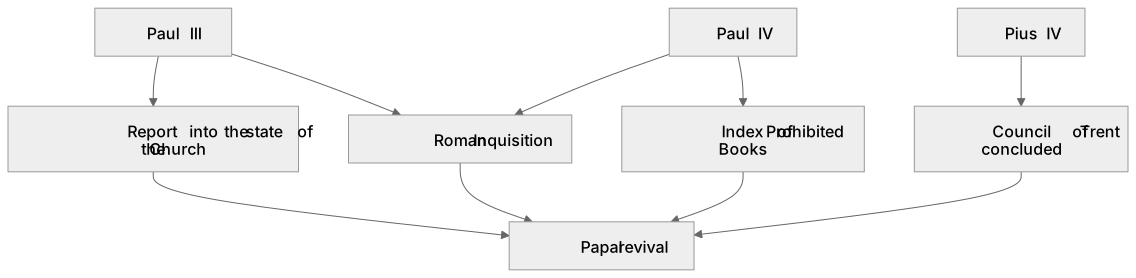
Key words
Say what each word means before you turn the card.
Consilium de Emendanda Ecclesia
Try answering aloud or in your head before turning the card.
Roman Inquisition
Try answering aloud or in your head before turning the card.
Paul IV
Try answering aloud or in your head before turning the card.
Pius IV
Try answering aloud or in your head before turning the card.
See every definition
- Consilium de Emendanda Ecclesia
- The 1537 report into the state of the Church, commissioned by Paul III, which frankly exposed clerical abuses and absenteeism and provided a blueprint for reform.
- Roman Inquisition
- Established in 1542 by Paul III to systematically root out heresy, particularly in the Italian peninsula, and later expanded by Paul IV to enforce strict doctrinal purity.
- Paul IV
- Pursued an uncompromising, anti-Spanish stance and expanded the Inquisition, enforcing strict doctrinal purity through fear.
- Pius IV
- Consolidated the revival by successfully reconvening and concluding the Council of Trent, ensuring sweeping administrative and spiritual reforms across the Catholic world.
Label the diagram
Some boxes have lost their names. Pick the right name for each number.
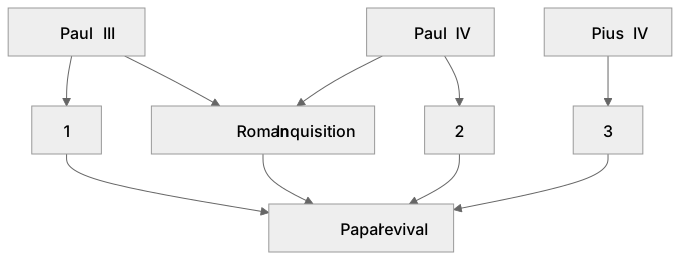
1Box 1
2Box 2
3Box 3
There is more to this lesson
The full lesson goes on to check your understanding and help you earn the marks. Create a free account to carry on, with your progress saved.
A week of Premium from your first lesson · Then the free plan continues · No card, no charge
Test your understanding of 2C The Reformation in Europe, c1500–1564 (A-level only) – The Catholic Reformation, 1531–1564: Papal revival: Paul III; report into the state of the Church; the Roman Inquisition; Paul IV and Pius IV
Active recall beats re-reading. Take an instant quiz now to test what you’ve learned and lock it into long-term memory.
A week of Premium from your first lesson · Then the free plan continues · No card, no charge