AQA · A-Level · History
Course version: 7042 · Version from Sept 2017
Spiritual regeneration: New Religious Orders; Loyola and the Jesuits;…
Full specification wording
2C The Reformation in Europe, c1500–1564 (A-level only) – The Catholic Reformation, 1531–1564: Spiritual regeneration: New Religious Orders; Loyola and the Jesuits; beliefs, discipline and influence
Spiritual regeneration was driven by new religious orders that revitalised Catholic piety and pastoral care.
Checked against the AQA 7042 specification (opens in a new tab) on .
- Point 2 of 4
- 4 key terms
Study notes
From the checked teaching notes for this specification point.
The idea
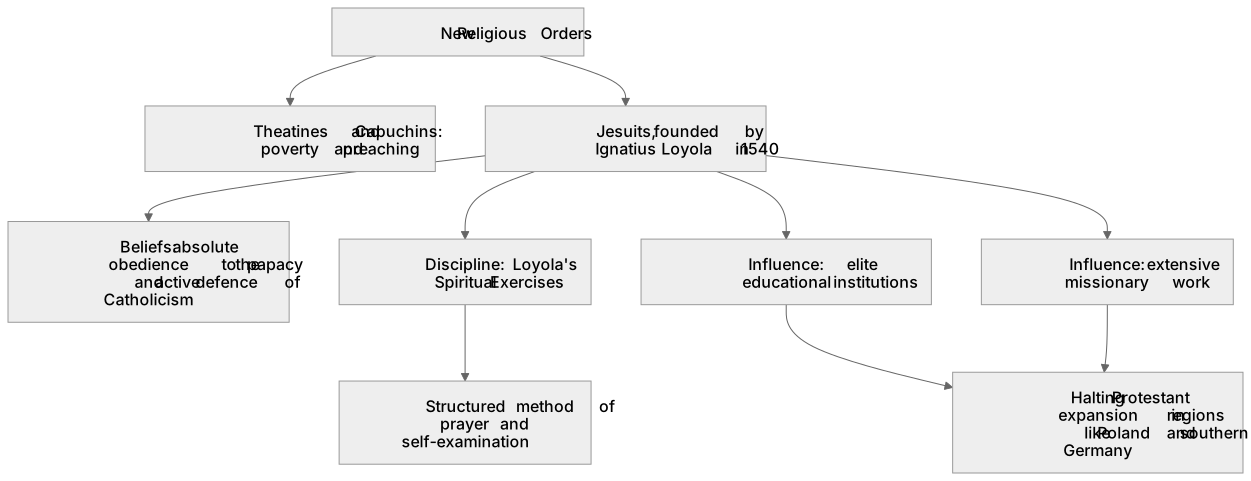
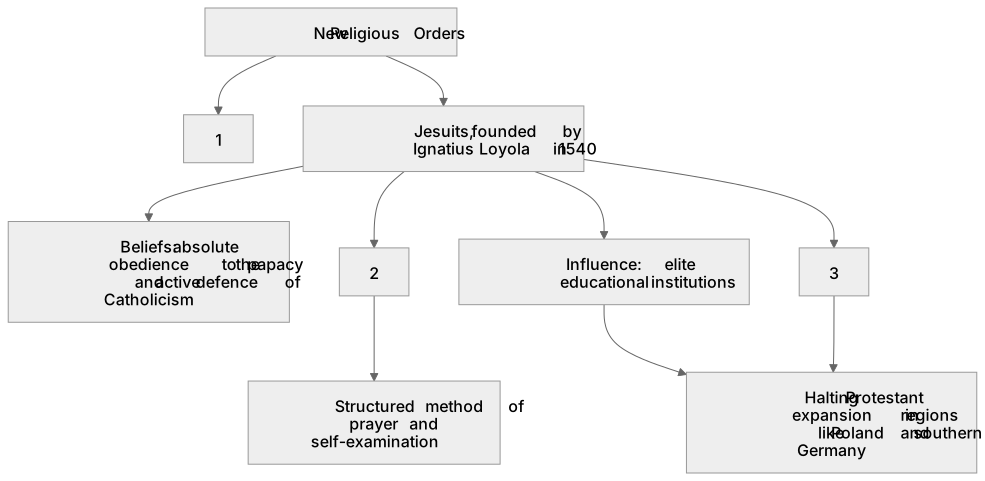
Spiritual regeneration was driven by new religious orders that revitalised Catholic piety and pastoral care. Groups like the Theatines and Capuchins focused on poverty and preaching, but the most significant were the Jesuits, founded by Ignatius Loyola in 1540. Jesuit beliefs centred on absolute obedience to the papacy and the active defence of Catholicism, contrasting with older monastic isolation. Their discipline was rigorously shaped by Loyola's Spiritual Exercises, which provided a structured method of prayer and self-examination. The Jesuits exerted immense influence across Europe and beyond through their dual strategy of establishing elite educational institutions and conducting extensive missionary work, effectively halting Protestant expansion in regions like Poland and southern Germany.
What earns the marks
- Identify the role of early new religious orders, such as the Theatines, Ursulines, and Capuchins, in addressing local spiritual needs and clerical abuses.
- Analyse the foundational beliefs of the Jesuits, particularly their vow of special obedience to the Pope and their commitment to active, worldly engagement.
- Evaluate the importance of Loyola's Spiritual Exercises in instilling rigorous psychological and spiritual discipline among Jesuit recruits.
- Assess the influence of the Jesuits in the Catholic Reformation, focusing on their success in education, advising monarchs, and global missionary work.
Common mistakes and how to put them right
Claiming the Jesuits were founded solely to fight Protestantism.
Put it right by explaining their original mission was spiritual regeneration and missionary work in the Holy Land, which later evolved into anti-Protestant efforts.
Lumping all new religious orders together.
Put it right by distinguishing the Jesuits' focus on elite education and papal obedience from the Capuchins' focus on poverty and preaching to the rural poor.
Stating that the Jesuits were a traditional monastic order.
Put it right by highlighting that they rejected traditional monastic enclosures and choir offices in favour of active engagement in the world.
Exam tips
- Use the Spiritual Exercises as a specific example of how the Jesuits maintained strict internal discipline and ideological unity.
- Link the Jesuits' focus on establishing schools and universities to their long-term influence in securing the loyalty of the European nobility.
- Contrast the proactive spiritual regeneration led by the new orders with the reactive, punitive measures of the Roman Inquisition.
Try the lesson
The start of the 2C The Reformation in Europe, c1500–1564 (A-level only) – The Catholic Reformation, 1531–1564: Spiritual regeneration: New Religious Orders; Loyola and the Jesuits; beliefs, discipline and influence lesson, made from checked teaching notes for this specification point.
Have a go first
Which new religious order, founded by Ignatius of Loyola and officially approved in 1540, played a central role in the spiritual regeneration of the Catholic Church?
Listen
Spiritual regeneration was driven by new religious orders that revitalised Catholic piety and pastoral care. Groups like the Theatines and Capuchins focused on poverty and preaching, but the most significant were the Jesuits, founded by Ignatius Loyola in 1540. Jesuit beliefs centred on absolute obedience to the papacy and the active defence of Catholicism, contrasting with older monastic isolation. Their discipline was rigorously shaped by Loyola's Spiritual Exercises, which provided a structured method of prayer and self-examination. The Jesuits exerted immense influence across Europe and beyond through their dual strategy of establishing elite educational institutions and conducting extensive missionary work, effectively halting Protestant expansion in regions like Poland and southern Germany. A strong answer earns marks for these points. Identify the role of early new religious orders, such as the Theatines, Ursulines, and Capuchins, in addressing local spiritual needs and clerical abuses. Analyse the foundational beliefs of the Jesuits, particularly their vow of special obedience to the Pope and their commitment to active, worldly engagement. Evaluate the importance of Loyola's Spiritual Exercises in instilling rigorous psychological and spiritual discipline among Jesuit recruits. Assess the influence of the Jesuits in the Catholic Reformation, focusing on their success in education, advising monarchs, and global missionary work. A common slip: Claiming the Jesuits were founded solely to fight Protestantism. Instead, explaining their original mission was spiritual regeneration and missionary work in the Holy Land, which later evolved into anti-Protestant efforts. Exam tip: Use the Spiritual Exercises as a specific example of how the Jesuits maintained strict internal discipline and ideological unity.
See it
Key words
Say what each word means before you turn the card.
Spiritual regeneration
Try answering aloud or in your head before turning the card.
Jesuits
Try answering aloud or in your head before turning the card.
Spiritual Exercises
Try answering aloud or in your head before turning the card.
New religious orders
Try answering aloud or in your head before turning the card.
See every definition
- Spiritual regeneration
- A movement driven by new religious orders that revitalised Catholic piety and pastoral care.
- Jesuits
- The most significant new religious order, founded by Ignatius Loyola in 1540, whose beliefs centred on absolute obedience to the papacy and the active defence of Catholicism.
- Spiritual Exercises
- Loyola's work that rigorously shaped Jesuit discipline by providing a structured method of prayer and self-examination.
- New religious orders
- Groups such as the Theatines and Capuchins that focused on poverty and preaching and revitalised Catholic piety and pastoral care.
Label the diagram
Some boxes have lost their names. Pick the right name for each number.
1Box 1
2Box 2
3Box 3
There is more to this lesson
The full lesson goes on to check your understanding and help you earn the marks. Create a free account to carry on, with your progress saved.
A week of Premium from your first lesson · Then the free plan continues · No card, no charge
Test your understanding of 2C The Reformation in Europe, c1500–1564 (A-level only) – The Catholic Reformation, 1531–1564: Spiritual regeneration: New Religious Orders; Loyola and the Jesuits; beliefs, discipline and influence
Active recall beats re-reading. Take an instant quiz now to test what you’ve learned and lock it into long-term memory.
A week of Premium from your first lesson · Then the free plan continues · No card, no charge