AQA · A-Level · History
Course version: 7042 · Version from Sept 2017
The Council of Trent: the three sessions; doctrine and the extent of reform
Full specification wording
2C The Reformation in Europe, c1500–1564 (A-level only) – The Catholic Reformation, 1531–1564: The Council of Trent: the three sessions; doctrine and the extent of reform
The Council of Trent (1545–1563) was the Catholic Church's definitive response to the Protestant Reformation, unfolding across three distinct sessions.
Checked against the AQA 7042 specification (opens in a new tab) on .
- Point 3 of 4
Study notes
From the checked teaching notes for this specification point.
The idea
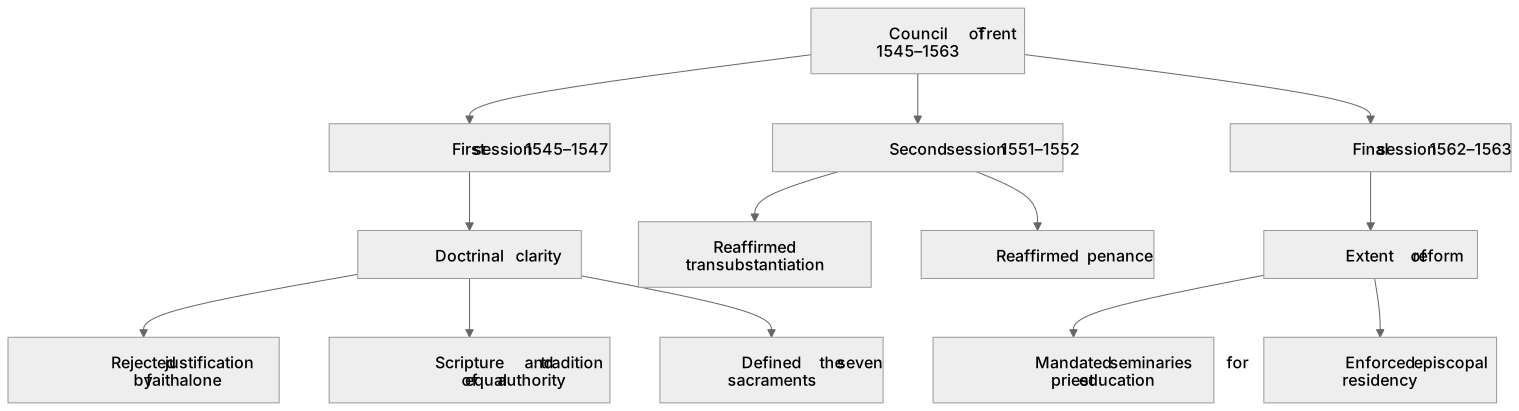
The Council of Trent (1545–1563) was the Catholic Church's definitive response to the Protestant Reformation, unfolding across three distinct sessions. The first session (1545–1547) focused on doctrinal clarity, rejecting justification by faith alone, reaffirming the equal authority of scripture and tradition, and defining the seven sacraments. The second session (1551–1552) reaffirmed transubstantiation and penance. The final session (1562–1563) tackled the extent of reform, addressing clerical abuses by mandating the establishment of seminaries for priest education and enforcing episcopal residency. While Trent rigidly codified Catholic doctrine without compromise, its practical reforms were extensive.
What earns the marks
- Identify the distinct focus and historical context of each of the three sessions of the Council of Trent (1545–1547, 1551–1552, 1562–1563).
- Explain how Trent reaffirmed traditional Catholic doctrine, such as defining the seven sacraments in the first session and transubstantiation in the second.
- Evaluate the extent of reform, particularly the decrees on clerical discipline, the prohibition of absenteeism, and the creation of seminaries in the third session.
- Assess the balance between doctrinal entrenchment (refusing to compromise with Protestantism) and internal moral and administrative reform.
Common mistakes and how to put them right
Claiming the Council of Trent compromised with Protestants on doctrine.
Put it right: Emphasise that Trent rigidly reaffirmed traditional Catholic dogma and rejected Protestant theology entirely.
Treating the Council of Trent as a single continuous event.
Put it right: Distinguish between the three separate sessions, noting the interruptions caused by war, disease, and papal politics.
Misattributing doctrinal decrees to the wrong session.
Put it right: The seven sacraments were defined in the first session (1547), while transubstantiation was reaffirmed in the second session (1551).
Exam tips
- Use specific examples of doctrinal decrees, such as the Decree on Justification, to demonstrate the Church's theological response to Luther.
- When evaluating the extent of reform, contrast the sweeping legislative changes made on paper with the practical challenges of enforcing them across Europe.
- Link the outcomes of the third session, such as the mandate for seminaries, directly to the long-term improvement of parish-level pastoral care.
Try the lesson
The start of the 2C The Reformation in Europe, c1500–1564 (A-level only) – The Catholic Reformation, 1531–1564: The Council of Trent: the three sessions; doctrine and the extent of reform lesson, made from checked teaching notes for this specification point.
Have a go first
Which of the following accurately describes the Catholic Church's doctrinal stance established during the Council of Trent?
Listen
The Council of Trent (1545–1563) was the Catholic Church's definitive response to the Protestant Reformation, unfolding across three distinct sessions. The first session (1545–1547) focused on doctrinal clarity, rejecting justification by faith alone, reaffirming the equal authority of scripture and tradition, and defining the seven sacraments. The second session (1551–1552) reaffirmed transubstantiation and penance. The final session (1562–1563) tackled the extent of reform, addressing clerical abuses by mandating the establishment of seminaries for priest education and enforcing episcopal residency. While Trent rigidly codified Catholic doctrine without compromise, its practical reforms were extensive. A strong answer earns marks for these points. Identify the distinct focus and historical context of each of the three sessions of the Council of Trent (1545–1547, 1551–1552, 1562–1563). Explain how Trent reaffirmed traditional Catholic doctrine, such as defining the seven sacraments in the first session and transubstantiation in the second. Evaluate the extent of reform, particularly the decrees on clerical discipline, the prohibition of absenteeism, and the creation of seminaries in the third session. Assess the balance between doctrinal entrenchment (refusing to compromise with Protestantism) and internal moral and administrative reform. A common slip: Claiming the Council of Trent compromised with Protestants on doctrine. Instead, Emphasise that Trent rigidly reaffirmed traditional Catholic dogma and rejected Protestant theology entirely. Exam tip: Use specific examples of doctrinal decrees, such as the Decree on Justification, to demonstrate the Church's theological response to Luther.
See it
Put the events in order
Put these events in the order they happened, earliest first.
- 1. First session focuses on doctrinal clarity and rejects justification by faith alone
- 2. Final session addresses clerical abuses and mandates seminaries
- 3. Second session reaffirms transubstantiation and penance
Label the diagram
Some boxes have lost their names. Pick the right name for each number.
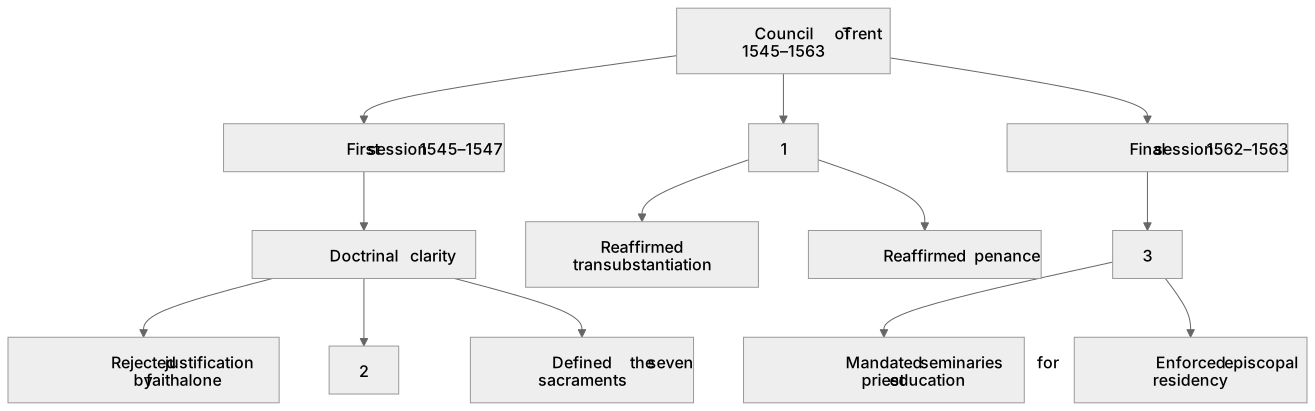
1Box 1
2Box 2
3Box 3
There is more to this lesson
The full lesson goes on to check your understanding and help you earn the marks. Create a free account to carry on, with your progress saved.
A week of Premium from your first lesson · Then the free plan continues · No card, no charge
Test your understanding of 2C The Reformation in Europe, c1500–1564 (A-level only) – The Catholic Reformation, 1531–1564: The Council of Trent: the three sessions; doctrine and the extent of reform
Active recall beats re-reading. Take an instant quiz now to test what you’ve learned and lock it into long-term memory.
A week of Premium from your first lesson · Then the free plan continues · No card, no charge