AQA · A-Level · History
Course version: 7042 · Version from Sept 2017
Disputations; the development of Lutheran thought; publications and the…
Full specification wording
2C The Reformation in Europe, c1500–1564 (A-level only) – The challenge of Luther, 1517–1521: Disputations; the development of Lutheran thought; publications and the influence of printing
Between 1518 and 1520, Luther’s theology evolved rapidly through public disputations and prolific writing.
Checked against the AQA 7042 specification (opens in a new tab) on .
- Point 3 of 4
Study notes
From the checked teaching notes for this specification point.
The idea
Between 1518 and 1520, Luther’s theology evolved rapidly through public disputations and prolific writing. At the 1518 Heidelberg Disputation, an internal Augustinian debate, he introduced his 'theology of the cross'. At the 1519 Leipzig Disputation against Johann Eck, Luther was pushed to clarify his stance, ultimately rejecting papal infallibility. This development of Lutheran thought culminated in his three great 1520 publications, outlining justification by faith and the priesthood of all believers. The influence of printing was revolutionary. By publishing in vernacular German and utilising striking woodcuts, Luther bypassed the Latin-speaking elite. This ensured his radical ideas reached a mass audience.
What earns the marks
- Assess the significance of the Leipzig Disputation (1519) in forcing Luther to publicly deny the supreme authority of the Pope and Church councils.
- Evaluate the theological shifts in Luther's 1520 publications, particularly his reduction of the sacraments from seven to two or three in On the Babylonian Captivity.
- Analyse the influence of printing in disseminating Luther's ideas, noting the importance of broadsheets and visual propaganda for an illiterate populace.
- Examine how Luther's use of the vernacular German language broadened his appeal beyond the clergy to the laity and secular authorities.
Common mistakes and how to put them right
Assuming Luther had a fully formed theology in 1517.
Put it right: Recognise that his thought developed progressively, with the 1519 Leipzig Disputation against Johann Eck being a crucial turning point.
Claiming the printing press alone caused the Reformation.
Put it right: Argue that while printing was a vital catalyst for rapid spread, the pre-existing anti-clericalism and the specific appeal of Luther's message were equally necessary.
Confusing the content of the three 1520 publications.
Put it right: Distinguish them clearly: Address to the Christian Nobility appealed to secular rulers, Babylonian Captivity attacked the sacramental system, and Liberty of a Christian Man explained justification by faith.
Exam tips
- When discussing the spread of Lutheranism, explicitly link the technological advantage of printing to the strategic use of vernacular language and visual woodcuts.
- Use the Leipzig Disputation as a key turning point in essays evaluating when Luther's break with the Catholic Church became inevitable.
- Quote or reference specific arguments from the 1520 publications to demonstrate a precise understanding of how Lutheran thought developed.
Try the lesson
The start of the 2C The Reformation in Europe, c1500–1564 (A-level only) – The challenge of Luther, 1517–1521: Disputations; the development of Lutheran thought; publications and the influence of printing lesson, made from checked teaching notes for this specification point.
Have a go first
During the Leipzig Disputation of 1519, which theologian was Martin Luther's primary opponent, pushing him to clarify his views on papal authority?
Listen
Between 1518 and 1520, Luther’s theology evolved rapidly through public disputations and prolific writing. At the 1518 Heidelberg Disputation, an internal Augustinian debate, he introduced his 'theology of the cross'. At the 1519 Leipzig Disputation against Johann Eck, Luther was pushed to clarify his stance, ultimately rejecting papal infallibility. This development of Lutheran thought culminated in his three great 1520 publications, outlining justification by faith and the priesthood of all believers. The influence of printing was revolutionary. By publishing in vernacular German and utilising striking woodcuts, Luther bypassed the Latin-speaking elite. This ensured his radical ideas reached a mass audience. A strong answer earns marks for these points. Assess the significance of the Leipzig Disputation (1519) in forcing Luther to publicly deny the supreme authority of the Pope and Church councils. Evaluate the theological shifts in Luther's 1520 publications, particularly his reduction of the sacraments from seven to two or three in On the Babylonian Captivity. Analyse the influence of printing in disseminating Luther's ideas, noting the importance of broadsheets and visual propaganda for an illiterate populace. Examine how Luther's use of the vernacular German language broadened his appeal beyond the clergy to the laity and secular authorities. A common slip: Assuming Luther had a fully formed theology in 1517. Instead, Recognise that his thought developed progressively, with the 1519 Leipzig Disputation against Johann Eck being a crucial turning point. Exam tip: When discussing the spread of Lutheranism, explicitly link the technological advantage of printing to the strategic use of vernacular language and visual woodcuts.
See it
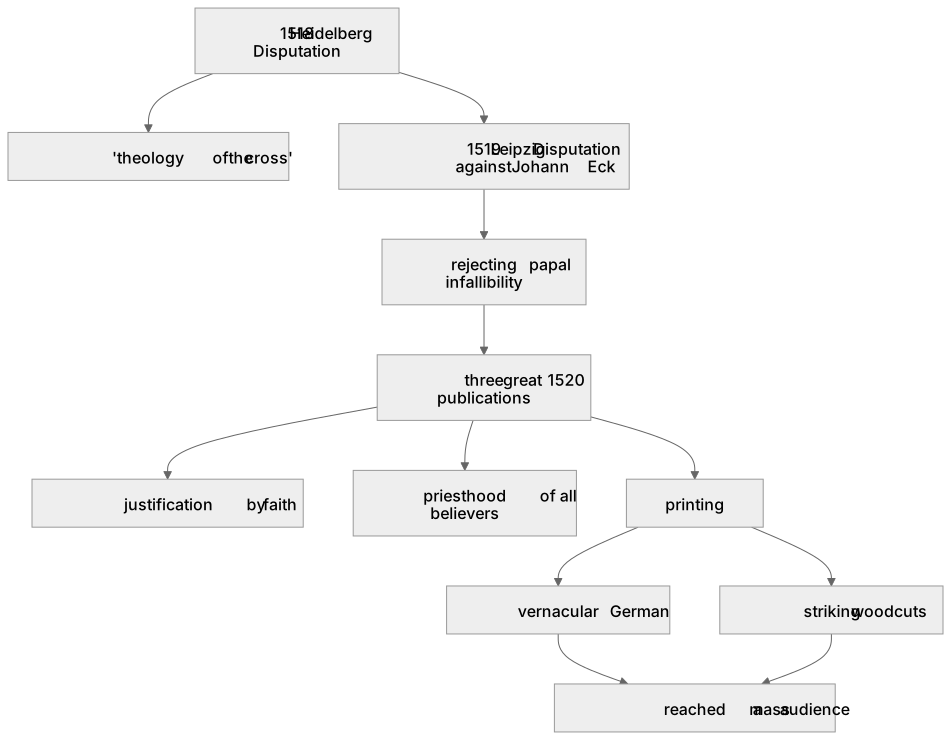
Put the events in order
Put these events in the order they happened, earliest first.
- 1. Heidelberg Disputation introduces the theology of the cross
- 2. Luther's three great publications outline justification by faith
- 3. Leipzig Disputation against Johann Eck clarifies Luther's stance
Label the diagram
Some boxes have lost their names. Pick the right name for each number.
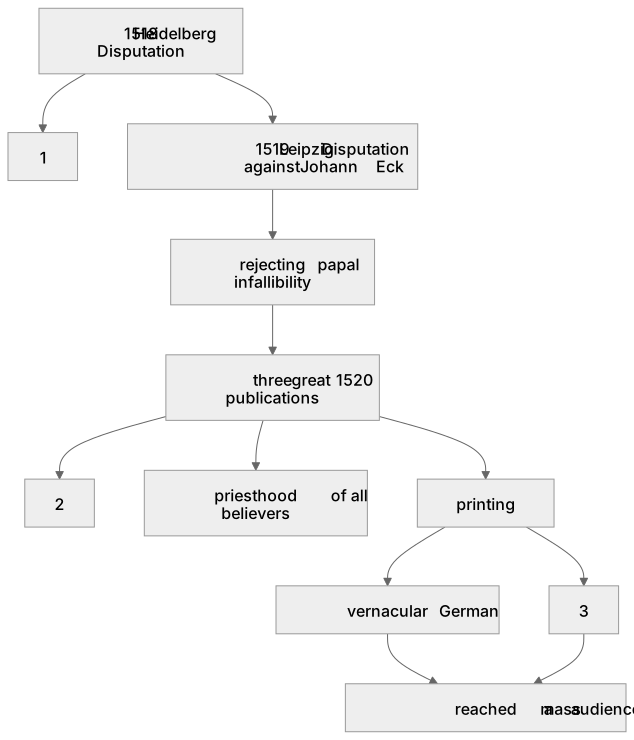
1Box 1
2Box 2
3Box 3
There is more to this lesson
The full lesson goes on to check your understanding and help you earn the marks. Create a free account to carry on, with your progress saved.
A week of Premium from your first lesson · Then the free plan continues · No card, no charge
Test your understanding of 2C The Reformation in Europe, c1500–1564 (A-level only) – The challenge of Luther, 1517–1521: Disputations; the development of Lutheran thought; publications and the influence of printing
Active recall beats re-reading. Take an instant quiz now to test what you’ve learned and lock it into long-term memory.
A week of Premium from your first lesson · Then the free plan continues · No card, no charge