AQA · A-Level · History
Course version: 7042 · Version from Sept 2017
Excommunication and Diet of Worms: attitude of Catholic Church hierarchy;…
Full specification wording
2C The Reformation in Europe, c1500–1564 (A-level only) – The challenge of Luther, 1517–1521: Excommunication and Diet of Worms: attitude of Catholic Church hierarchy; Emperor and Princes; the imperial edict and the protection of Frederick the Wise
Following his refusal to recant, Pope Leo X issued the bull Decet Romanum Pontificem in 1521, confirming Luther’s excommunication.
Checked against the AQA 7042 specification (opens in a new tab) on .
- Point 4 of 4
- 4 key terms
Study notes
From the checked teaching notes for this specification point.
The idea
Following his refusal to recant, Pope Leo X issued the bull Decet Romanum Pontificem in 1521, confirming Luther’s excommunication. The Catholic Church hierarchy, represented by Aleander, demanded immediate secular punishment. However, Emperor Charles V, balancing his devout Catholicism with the need to appease the German Princes, summoned Luther to the Diet of Worms (1521) under a safe conduct. When Luther famously stood by his conscience, Charles issued the Edict of Worms, declaring Luther an outlaw and banning his literature. Despite this imperial edict, the fragmented nature of the Empire allowed Elector Frederick the Wise to stage a kidnapping, providing Luther with crucial protection at Wartburg Castle, thwarting imperial authority.
What earns the marks
- Analyse the motivations of the Catholic Church hierarchy, particularly Pope Leo X and Girolamo Aleander, in their uncompromising pursuit of Luther's excommunication.
- Evaluate Emperor Charles V's dilemma at the Diet of Worms, balancing his role as defender of the Catholic faith against the political necessity of maintaining the support of the German Princes.
- Assess the terms and immediate impact of the Edict of Worms (1521), noting its failure to be universally enforced across the Holy Roman Empire.
- Examine the political and personal reasons behind Frederick the Wise's decision to protect Luther at the Wartburg, highlighting the limits of imperial power.
Common mistakes and how to put them right
Stating that Charles V wanted to execute Luther immediately at Worms.
Put it right: Acknowledge that Charles V respected the safe conduct he had granted, allowing Luther to leave before the Edict of Worms took effect.
Assuming Frederick the Wise protected Luther because he was a committed Lutheran.
Put it right: Recognise that Frederick's motives were complex, driven by territorial pride, a desire to protect his university, and a sense of justice, rather than purely adopting Protestant theology.
Believing the Edict of Worms successfully suppressed Lutheranism.
Put it right: Emphasise that the Edict was largely ineffective because many German princes refused to enforce it within their own territories.
Exam tips
- Contrast the uncompromising attitude of the papal representatives with the more pragmatic, politically constrained approach of Emperor Charles V at the Diet of Worms.
- Use Frederick the Wise's protection of Luther as a primary example of how the decentralised political structure of the Holy Roman Empire facilitated the survival of the Reformation.
- When evaluating the threat Luther posed in 1521, consider both his theological challenge to the Church hierarchy and his political challenge to imperial authority.
Try the lesson
The start of the 2C The Reformation in Europe, c1500–1564 (A-level only) – The challenge of Luther, 1517–1521: Excommunication and Diet of Worms: attitude of Catholic Church hierarchy; Emperor and Princes; the imperial edict and the protection of Frederick the Wise lesson, made from checked teaching notes for this specification point.
Have a go first
Following the Diet of Worms in 1521, how did Elector Frederick the Wise ensure Martin Luther's physical safety?
Listen
Following his refusal to recant, Pope Leo X issued the bull Decet Romanum Pontificem in 1521, confirming Luther’s excommunication. The Catholic Church hierarchy, represented by Aleander, demanded immediate secular punishment. However, Emperor Charles V, balancing his devout Catholicism with the need to appease the German Princes, summoned Luther to the Diet of Worms (1521) under a safe conduct. When Luther famously stood by his conscience, Charles issued the Edict of Worms, declaring Luther an outlaw and banning his literature. Despite this imperial edict, the fragmented nature of the Empire allowed Elector Frederick the Wise to stage a kidnapping, providing Luther with crucial protection at Wartburg Castle, thwarting imperial authority. A strong answer earns marks for these points. Analyse the motivations of the Catholic Church hierarchy, particularly Pope Leo X and Girolamo Aleander, in their uncompromising pursuit of Luther's excommunication. Evaluate Emperor Charles V's dilemma at the Diet of Worms, balancing his role as defender of the Catholic faith against the political necessity of maintaining the support of the German Princes. Assess the terms and immediate impact of the Edict of Worms (1521), noting its failure to be universally enforced across the Holy Roman Empire. Examine the political and personal reasons behind Frederick the Wise's decision to protect Luther at the Wartburg, highlighting the limits of imperial power. A common slip: Stating that Charles V wanted to execute Luther immediately at Worms. Instead, Acknowledge that Charles V respected the safe conduct he had granted, allowing Luther to leave before the Edict of Worms took effect. Exam tip: Contrast the uncompromising attitude of the papal representatives with the more pragmatic, politically constrained approach of Emperor Charles V at the Diet of Worms.
See it
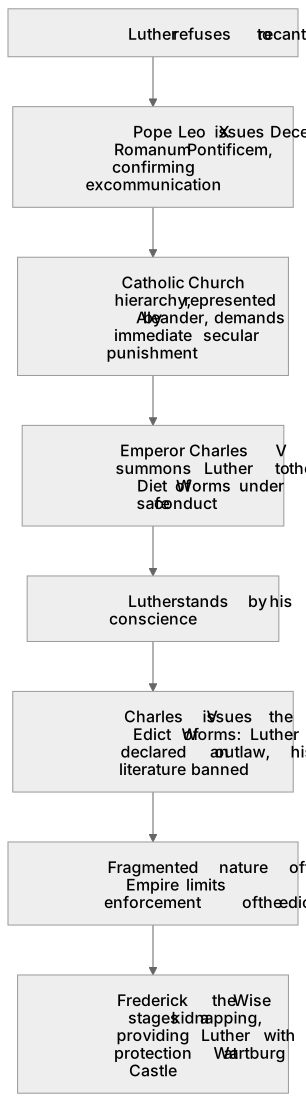
Put it in order
Put these steps in the order they happen.
- 1. Luther stands by his conscience
- 2. Frederick the Wise stages a kidnapping, providing Luther with protection at Wartburg Castle
- 3. Charles V issues the Edict of Worms: Luther declared an outlaw, his literature banned
- 4. Luther refuses to recant
- 5. Pope Leo X issues Decet Romanum Pontificem, confirming excommunication
- 6. Fragmented nature of the Empire limits enforcement of the edict
- 7. Catholic Church hierarchy, represented by Aleander, demands immediate secular punishment
- 8. Emperor Charles V summons Luther to the Diet of Worms under a safe conduct
Key words
Say what each word means before you turn the card.
Papal authority
Try answering aloud or in your head before turning the card.
Imperial politics
Try answering aloud or in your head before turning the card.
Decentralisation
Try answering aloud or in your head before turning the card.
Secular versus Religious power
Try answering aloud or in your head before turning the card.
See every definition
- Papal authority
- The power exercised by Pope Leo X, who issued the bull confirming Luther's excommunication after his refusal to recant.
- Imperial politics
- The balancing by Emperor Charles V of his devout Catholicism against the need to appease the German Princes, leading him to summon Luther under a safe conduct.
- Decentralisation
- The fragmented nature of the Empire, which allowed Elector Frederick the Wise to stage a kidnapping and thwart imperial authority.
- Secular versus Religious power
- The tension between the Catholic Church hierarchy, which demanded immediate secular punishment, and the Emperor, who was constrained by political necessity.
Label the diagram
Some boxes have lost their names. Pick the right name for each number.
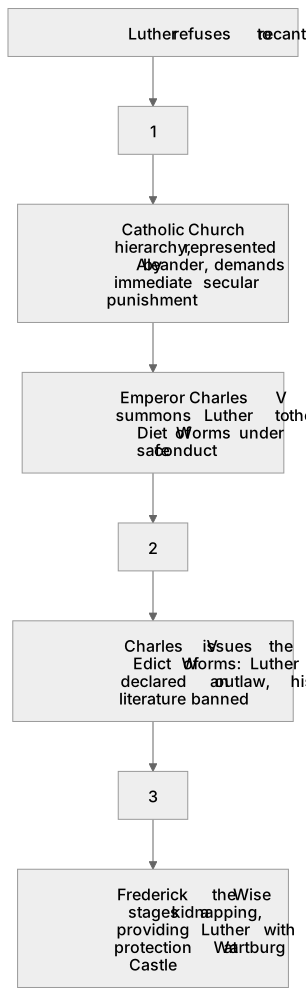
1Box 1
2Box 2
3Box 3
There is more to this lesson
The full lesson goes on to check your understanding and help you earn the marks. Create a free account to carry on, with your progress saved.
A week of Premium from your first lesson · Then the free plan continues · No card, no charge
Test your understanding of 2C The Reformation in Europe, c1500–1564 (A-level only) – The challenge of Luther, 1517–1521: Excommunication and Diet of Worms: attitude of Catholic Church hierarchy; Emperor and Princes; the imperial edict and the protection of Frederick the Wise
Active recall beats re-reading. Take an instant quiz now to test what you’ve learned and lock it into long-term memory.
A week of Premium from your first lesson · Then the free plan continues · No card, no charge