AQA · A-Level · History
Course version: 7042 · Version from Sept 2017
Church finances, indulgences, popular piety and the extent of demand for…
Full specification wording
2C The Reformation in Europe, c1500–1564 (A-level only) – The condition of the Church, c1500–1517: Church finances, indulgences, popular piety and the extent of demand for reform
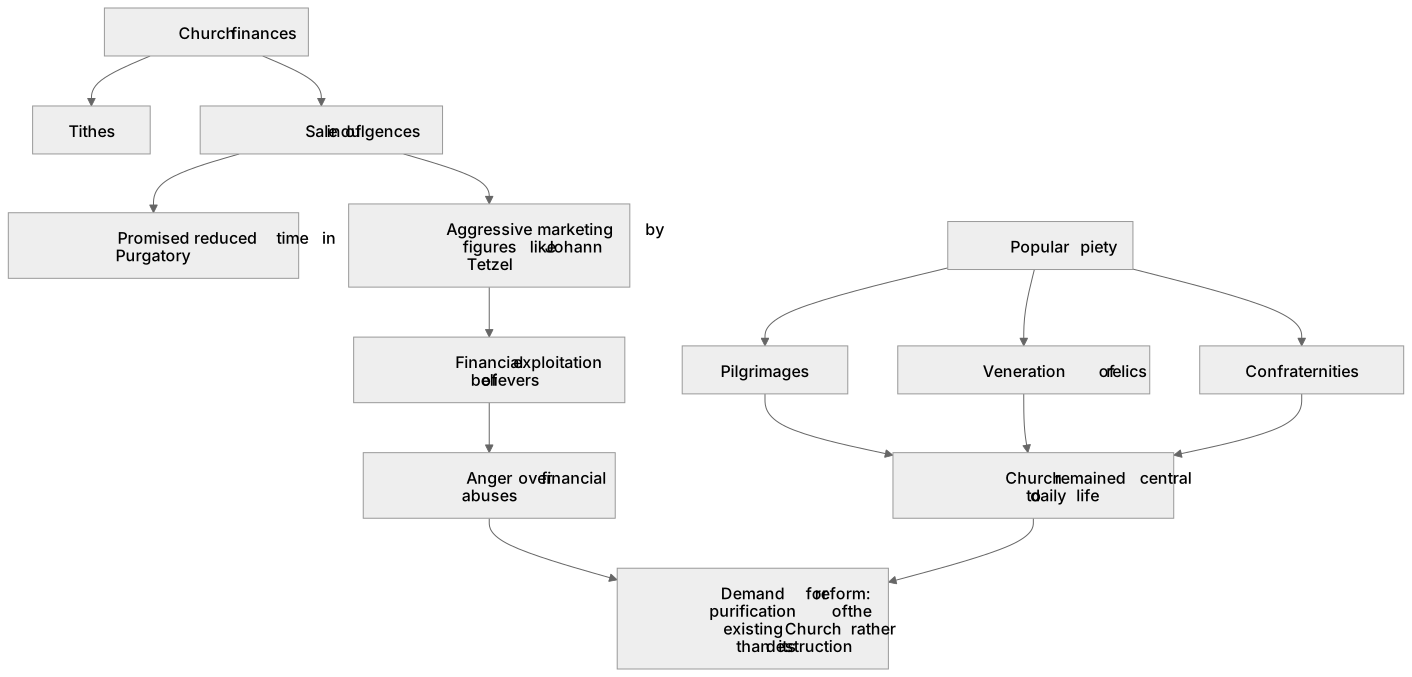
Pre-Reformation Church finances relied heavily on tithes and the controversial sale of indulgences, which promised reduced time in Purgatory.
Checked against the AQA 7042 specification (opens in a new tab) on .
- Point 4 of 4
- 2 key terms
Study notes
From the checked teaching notes for this specification point.
The idea
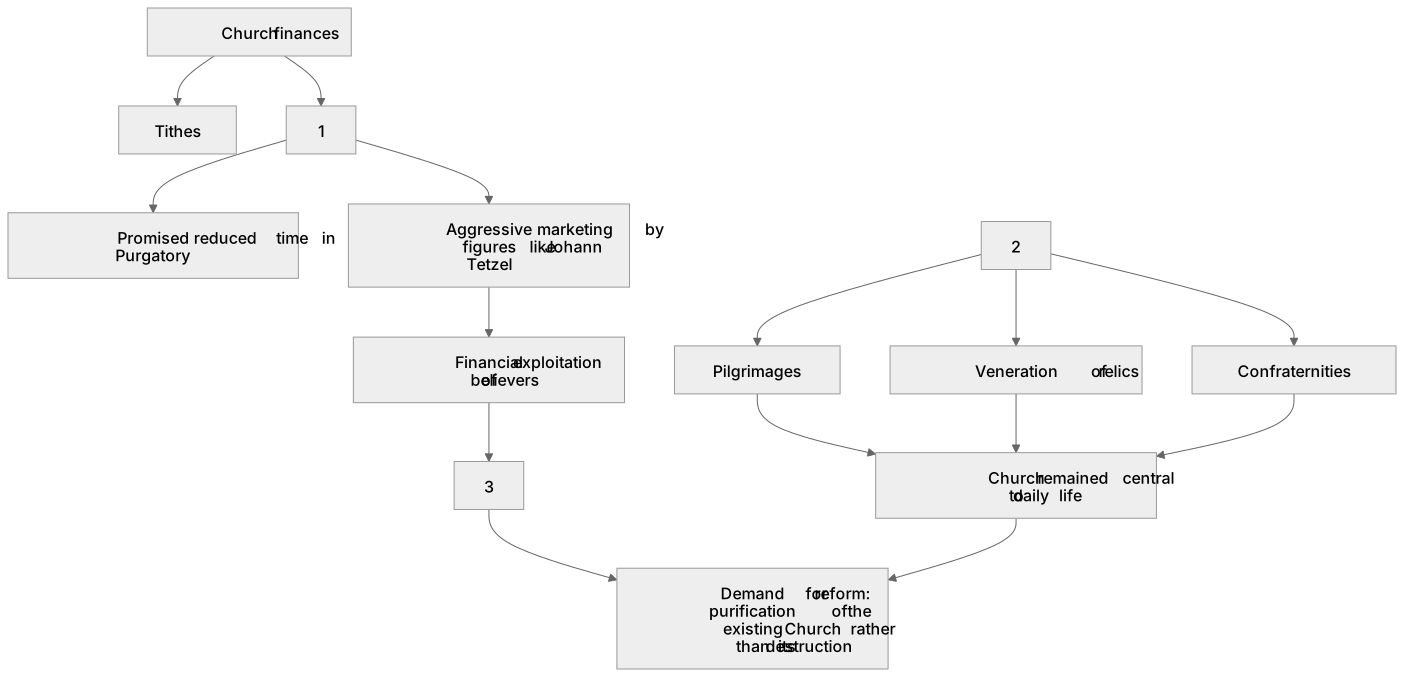
Pre-Reformation Church finances relied heavily on tithes and the controversial sale of indulgences, which promised reduced time in Purgatory. The aggressive marketing of indulgences by figures like Johann Tetzel highlighted the financial exploitation of believers. However, this period also witnessed intense popular piety; ordinary people enthusiastically participated in pilgrimages, venerated relics, and joined confraternities. This vibrant devotion suggests the Church remained central to daily life. Consequently, the extent of demand for reform was complex: while financial abuses provoked significant anger, deep-rooted popular piety indicates that most Europeans sought purification of the existing Church rather than its destruction.
What earns the marks
- Explain the mechanisms of Church finances, including tithes, annates, and the theological and financial basis of indulgences.
- Evaluate the impact of indulgence sales on public perception, using examples like the funding of St Peter's Basilica.
- Provide evidence of strong popular piety, such as the proliferation of confraternities, pilgrimages, and the cult of saints.
- Assess the extent of the demand for reform by contrasting the anger over financial abuses with the continued enthusiasm for traditional Catholic practices.
Common mistakes and how to put them right
Assuming the sale of indulgences was universally unpopular before 1517.
Put it right: Note that many ordinary people willingly bought indulgences as an expression of their piety and anxiety about salvation.
Equating the demand for reform with a desire for a new religion.
Put it right: Emphasise that pre-1517 reformers wanted to fix the financial and moral abuses within the Catholic Church, not leave it.
Viewing popular piety and Church corruption as mutually exclusive.
Put it right: Explain that intense religious devotion coexisted with, and was sometimes exploited by, the corrupt financial practices of the Church.
Exam tips
- Use the concept of Purgatory to explain why indulgences were so financially successful and deeply connected to popular piety.
- When discussing the extent of demand for reform, ensure you present a balanced argument that acknowledges both widespread abuses and vibrant traditional devotion.
- Link Church finances directly to the political and architectural ambitions of the Renaissance Papacy to provide context for the abuses.
Try the lesson
The start of the 2C The Reformation in Europe, c1500–1564 (A-level only) – The condition of the Church, c1500–1517: Church finances, indulgences, popular piety and the extent of demand for reform lesson, made from checked teaching notes for this specification point.
Have a go first
In the context of early sixteenth-century Church finances, what was the primary purpose of the sale of indulgences?
Listen
Pre-Reformation Church finances relied heavily on tithes and the controversial sale of indulgences, which promised reduced time in Purgatory. The aggressive marketing of indulgences by figures like Johann Tetzel highlighted the financial exploitation of believers. However, this period also witnessed intense popular piety; ordinary people enthusiastically participated in pilgrimages, venerated relics, and joined confraternities. This vibrant devotion suggests the Church remained central to daily life. Consequently, the extent of demand for reform was complex: while financial abuses provoked significant anger, deep-rooted popular piety indicates that most Europeans sought purification of the existing Church rather than its destruction. A strong answer earns marks for these points. Explain the mechanisms of Church finances, including tithes, annates, and the theological and financial basis of indulgences. Evaluate the impact of indulgence sales on public perception, using examples like the funding of St Peter's Basilica. Provide evidence of strong popular piety, such as the proliferation of confraternities, pilgrimages, and the cult of saints. Assess the extent of the demand for reform by contrasting the anger over financial abuses with the continued enthusiasm for traditional Catholic practices. A common slip: Assuming the sale of indulgences was universally unpopular before 1517. Instead, Note that many ordinary people willingly bought indulgences as an expression of their piety and anxiety about salvation. Exam tip: Use the concept of Purgatory to explain why indulgences were so financially successful and deeply connected to popular piety.
See it
Key words
Say what each word means before you turn the card.
Everyday religious experience and devotion
Try answering aloud or in your head before turning the card.
The tension between institutional abuse and popular faith
Try answering aloud or in your head before turning the card.
See every definition
- Everyday religious experience and devotion
- Intense popular piety in which ordinary people enthusiastically participated in pilgrimages, venerated relics, and joined confraternities, suggesting the Church remained central to daily life.
- The tension between institutional abuse and popular faith
- Financial abuses provoked significant anger, yet deep-rooted popular piety indicates that most Europeans sought purification of the existing Church rather than its destruction.
Label the diagram
Some boxes have lost their names. Pick the right name for each number.
1Box 1
2Box 2
3Box 3
There is more to this lesson
The full lesson goes on to check your understanding and help you earn the marks. Create a free account to carry on, with your progress saved.
A week of Premium from your first lesson · Then the free plan continues · No card, no charge
Test your understanding of 2C The Reformation in Europe, c1500–1564 (A-level only) – The condition of the Church, c1500–1517: Church finances, indulgences, popular piety and the extent of demand for reform
Active recall beats re-reading. Take an instant quiz now to test what you’ve learned and lock it into long-term memory.
A week of Premium from your first lesson · Then the free plan continues · No card, no charge