AQA · A-Level · History
Course version: 7042 · Version from Sept 2017
The revolt of the Imperial Knights and the peasants' war: causes and…
Full specification wording
2C The Reformation in Europe, c1500–1564 (A-level only) – The Protestant challenge, 1521–1531: The revolt of the Imperial Knights and the peasants' war: causes and outcomes; part played by Lutheranism and Luther's reaction; Luther's pamphlets of 1525; imperial diets, princes and cities; Lutheran-Catholic negotiations including the 1530 Augsburg Confession
The 1522-23 Knights' Revolt, led by von Hutten and von Sickingen, sought to secularise church lands, claiming Lutheran inspiration, but was crushed by princes.
Checked against the AQA 7042 specification (opens in a new tab) on .
- Point 3 of 4
Study notes
From the checked teaching notes for this specification point.
The idea
The 1522-23 Knights' Revolt, led by von Hutten and von Sickingen, sought to secularise church lands, claiming Lutheran inspiration, but was crushed by princes. Similarly, the 1524-25 Peasants' War stemmed from socio-economic grievances fused with Lutheran ideas of 'spiritual equality' (e.g., the Twelve Articles). Luther vehemently opposed the rebellion in his 1525 pamphlet Against the Murderous, Thieving Hordes of Peasants, aligning himself with magisterial authority. This secured the support of princes and cities, formalised at the Diets of Speyer (1526, 1529), where the term 'Protestant' emerged. Attempts at reconciliation culminated in the 1530 Diet of Augsburg; Melanchthon presented the Augsburg Confession, a moderate statement of Lutheran theology, but Catholic rejection solidified the religious divide.
What earns the marks
- Explain the socio-economic and religious causes of the Knights' Revolt and Peasants' War, noting how rebels misinterpreted Luther's concept of the 'priesthood of all believers'.
- Analyse Luther's conservative reaction to social upheaval, specifically his reliance on secular princes to maintain order as articulated in his 1525 pamphlets.
- Evaluate the shifting political landscape at the Imperial Diets, particularly how the 1526 Diet of Speyer temporarily allowed princes to determine the religion of their territories.
- Assess the significance of the 1530 Augsburg Confession as both a theological olive branch drafted by Melanchthon and the definitive failure of Lutheran-Catholic negotiations.
Common mistakes and how to put them right
Assuming Luther supported the Peasants' War because they cited his teachings.
Put it right: Emphasise that Luther fiercely condemned the peasants in 1525, arguing that spiritual equality did not equate to social or political equality.
Confusing the outcomes of the Diets of Speyer in 1526 and 1529.
Put it right: Distinguish that 1526 granted temporary religious autonomy to princes, whereas 1529 revoked this, prompting the 'Protestation' that gave Protestants their name.
Stating Luther wrote the Augsburg Confession.
Put it right: Specify that Philip Melanchthon drafted the Augsburg Confession, as Luther was an outlaw and could not attend the Diet.
Exam tips
- When discussing the survival of Lutheranism, link Luther's condemnation of the peasants directly to his subsequent protection by secular princes.
- Use the Twelve Articles of the Swabian Peasantry to demonstrate how socio-economic grievances were intertwined with evangelical language.
- Contrast the aggressive military approach of the Imperial Knights with the diplomatic negotiations attempted at the Diet of Augsburg to show the evolving Protestant strategy.
Try the lesson
The start of the 2C The Reformation in Europe, c1500–1564 (A-level only) – The Protestant challenge, 1521–1531: The revolt of the Imperial Knights and the peasants' war: causes and outcomes; part played by Lutheranism and Luther's reaction; Luther's pamphlets of 1525; imperial diets, princes and cities; Lutheran-Catholic negotiations including the 1530 Augsburg Confession lesson, made from checked teaching notes for this specification point.
Have a go first
Which pamphlet did Martin Luther publish in 1525 in direct response to the escalating violence of the Peasants' War?
Listen
The 1522-23 Knights' Revolt, led by von Hutten and von Sickingen, sought to secularise church lands, claiming Lutheran inspiration, but was crushed by princes. Similarly, the 1524-25 Peasants' War stemmed from socio-economic grievances fused with Lutheran ideas of 'spiritual equality' (e.g., the Twelve Articles). Luther vehemently opposed the rebellion in his 1525 pamphlet Against the Murderous, Thieving Hordes of Peasants, aligning himself with magisterial authority. This secured the support of princes and cities, formalised at the Diets of Speyer (1526, 1529), where the term 'Protestant' emerged. Attempts at reconciliation culminated in the 1530 Diet of Augsburg; Melanchthon presented the Augsburg Confession, a moderate statement of Lutheran theology, but Catholic rejection solidified the religious divide. A strong answer earns marks for these points. Explain the socio-economic and religious causes of the Knights' Revolt and Peasants' War, noting how rebels misinterpreted Luther's concept of the 'priesthood of all believers'. Analyse Luther's conservative reaction to social upheaval, specifically his reliance on secular princes to maintain order as articulated in his 1525 pamphlets. Evaluate the shifting political landscape at the Imperial Diets, particularly how the 1526 Diet of Speyer temporarily allowed princes to determine the religion of their territories. Assess the significance of the 1530 Augsburg Confession as both a theological olive branch drafted by Melanchthon and the definitive failure of Lutheran-Catholic negotiations. A common slip: Assuming Luther supported the Peasants' War because they cited his teachings. Instead, Emphasise that Luther fiercely condemned the peasants in 1525, arguing that spiritual equality did not equate to social or political equality. Exam tip: When discussing the survival of Lutheranism, link Luther's condemnation of the peasants directly to his subsequent protection by secular princes.
See it
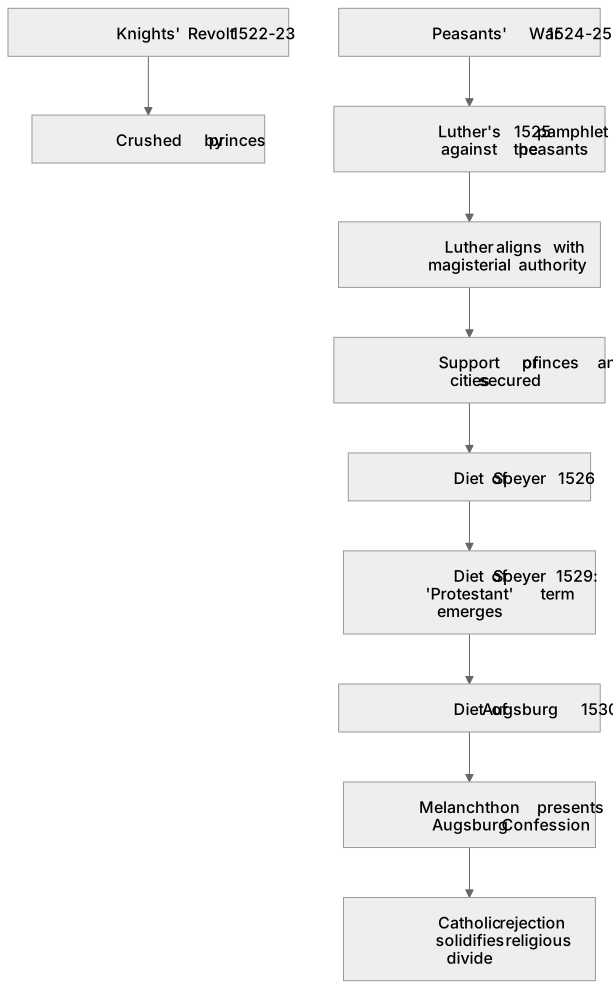
Put the events in order
Put these events in the order they happened, earliest first.
- 1. Luther's pamphlet against the rebellious peasants
- 2. Diet of Speyer allowed princes to determine religion
- 3. Diet of Speyer revoked religious autonomy, prompting the Protestation
- 4. Peasants' War stemming from socio-economic grievances and Lutheran ideas
- 5. Knights' Revolt led by von Hutten and von Sickingen
- 6. Augsburg Confession presented by Melanchthon at the Diet
Label the diagram
Some boxes have lost their names. Pick the right name for each number.
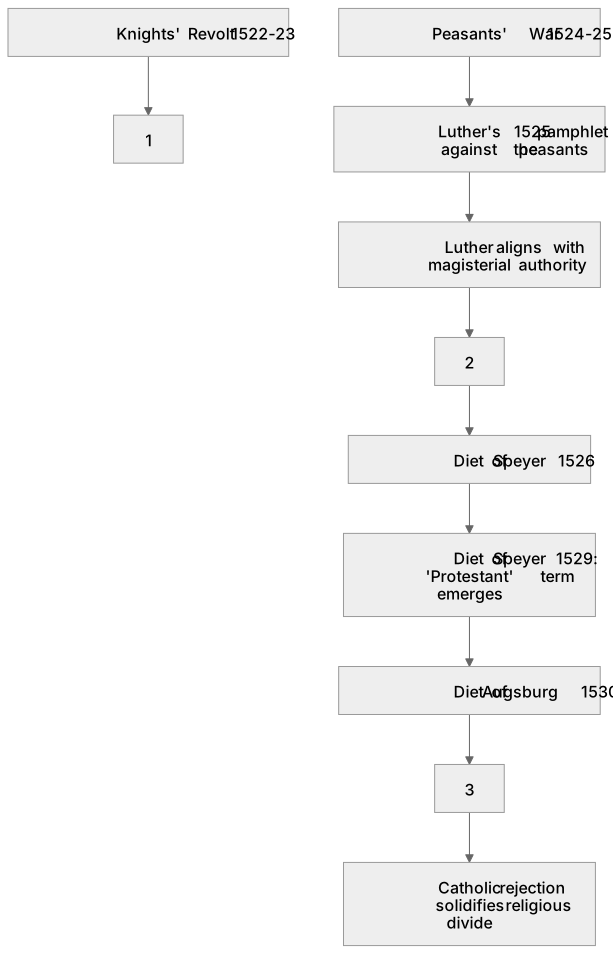
1Box 1
2Box 2
3Box 3
There is more to this lesson
The full lesson goes on to check your understanding and help you earn the marks. Create a free account to carry on, with your progress saved.
A week of Premium from your first lesson · Then the free plan continues · No card, no charge
Test your understanding of 2C The Reformation in Europe, c1500–1564 (A-level only) – The Protestant challenge, 1521–1531: The revolt of the Imperial Knights and the peasants' war: causes and outcomes; part played by Lutheranism and Luther's reaction; Luther's pamphlets of 1525; imperial diets, princes and cities; Lutheran-Catholic negotiations including the 1530 Augsburg Confession
Active recall beats re-reading. Take an instant quiz now to test what you’ve learned and lock it into long-term memory.
A week of Premium from your first lesson · Then the free plan continues · No card, no charge