AQA · A-Level · History
Course version: 7042 · Version from Sept 2017
The development of protestant doctrine: Luther, Melancthon and Zwingli
Full specification wording
2C The Reformation in Europe, c1500–1564 (A-level only) – The Protestant challenge, 1521–1531: The development of protestant doctrine: Luther, Melancthon and Zwingli
The development of Protestant doctrine was not monolithic but shaped by distinct theological voices.
Checked against the AQA 7042 specification (opens in a new tab) on .
- Point 2 of 4
- 4 key terms
Study notes
From the checked teaching notes for this specification point.
The idea
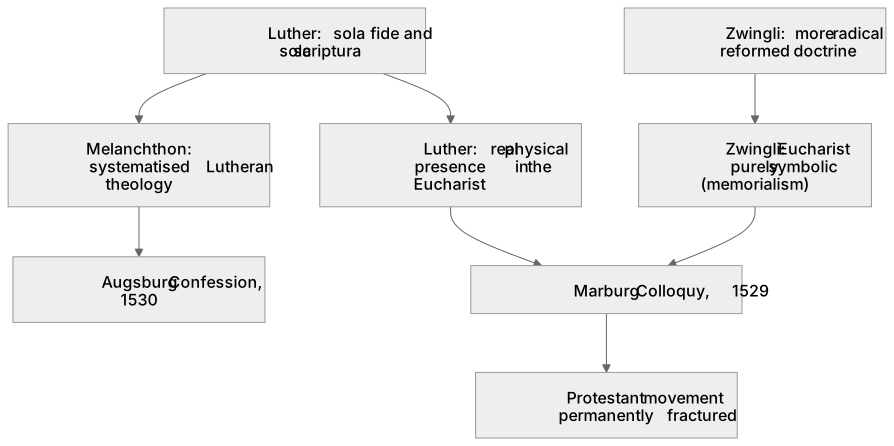
The development of Protestant doctrine was not monolithic but shaped by distinct theological voices. Luther established the foundational tenets of sola fide (justification by faith) and sola scriptura, while retaining a belief in the real physical presence of Christ in the Eucharist. Philip Melanchthon systematised these ideas, most notably drafting the Augsburg Confession in 1530, which provided a structured, diplomatic articulation of Lutheran theology. In Switzerland, Huldrych Zwingli developed a more radical reformed doctrine. He argued that the Eucharist was purely symbolic (memorialism), a fundamental disagreement that permanently fractured the Protestant movement at the Marburg Colloquy in 1529.
What earns the marks
- Identify Luther's core doctrinal contributions, particularly justification by faith alone and the supreme authority of scripture.
- Explain Melanchthon's role as the systematiser of Lutheranism, focusing on his authorship of the Loci Communes and the Augsburg Confession.
- Analyse Zwingli's distinct theological developments in Zurich, particularly his strict scriptural literalism regarding church practices.
- Evaluate the significance of the Marburg Colloquy (1529) in demonstrating the irreconcilable doctrinal split over the Eucharist between Luther and Zwingli.
Common mistakes and how to put them right
Claiming Luther believed in transubstantiation.
Put it right: Luther believed in the real presence, explicitly rejecting the Catholic doctrine of transubstantiation.
Treating Melanchthon merely as Luther's assistant.
Put it right: Melanchthon was a crucial theologian in his own right who systematised Lutheran doctrine for political presentation.
Stating Zwingli and Luther agreed on all major points except the Pope.
Put it right: Their fundamental disagreement over the Eucharist prevented a unified Protestant military alliance.
Exam tips
- Use the 1530 Augsburg Confession as key evidence of how Melanchthon attempted to present a moderate, systematised version of Protestant doctrine.
- Contrast Luther's and Zwingli's interpretations of the phrase 'This is my body' to illustrate the practical impact of doctrinal differences on Protestant unity.
- Highlight Melanchthon's humanist background to explain his more conciliatory and structured approach to theology compared to Luther's combative style.
Try the lesson
The start of the 2C The Reformation in Europe, c1500–1564 (A-level only) – The Protestant challenge, 1521–1531: The development of protestant doctrine: Luther, Melancthon and Zwingli lesson, made from checked teaching notes for this specification point.
Have a go first
At the Marburg Colloquy of 1529, on which key doctrinal issue did Martin Luther and Huldrych Zwingli fundamentally disagree?
Listen
The development of Protestant doctrine was not monolithic but shaped by distinct theological voices. Luther established the foundational tenets of sola fide (justification by faith) and sola scriptura, while retaining a belief in the real physical presence of Christ in the Eucharist. Philip Melanchthon systematised these ideas, most notably drafting the Augsburg Confession in 1530, which provided a structured, diplomatic articulation of Lutheran theology. In Switzerland, Huldrych Zwingli developed a more radical reformed doctrine. He argued that the Eucharist was purely symbolic (memorialism), a fundamental disagreement that permanently fractured the Protestant movement at the Marburg Colloquy in 1529. A strong answer earns marks for these points. Identify Luther's core doctrinal contributions, particularly justification by faith alone and the supreme authority of scripture. Explain Melanchthon's role as the systematiser of Lutheranism, focusing on his authorship of the Loci Communes and the Augsburg Confession. Analyse Zwingli's distinct theological developments in Zurich, particularly his strict scriptural literalism regarding church practices. Evaluate the significance of the Marburg Colloquy (1529) in demonstrating the irreconcilable doctrinal split over the Eucharist between Luther and Zwingli. Exam tip: Use the 1530 Augsburg Confession as key evidence of how Melanchthon attempted to present a moderate, systematised version of Protestant doctrine.
See it
Key words
Say what each word means before you turn the card.
Theological Divergence
Try answering aloud or in your head before turning the card.
Systematisation of Belief
Try answering aloud or in your head before turning the card.
The Eucharist Controversy
Try answering aloud or in your head before turning the card.
Protestant Disunity
Try answering aloud or in your head before turning the card.
See every definition
- Theological Divergence
- The development of Protestant doctrine was shaped by distinct theological voices rather than being monolithic.
- Systematisation of Belief
- Melanchthon systematised Lutheran ideas, most notably drafting the Augsburg Confession in 1530 as a structured, diplomatic articulation of Lutheran theology.
- The Eucharist Controversy
- Luther retained a belief in the real physical presence of Christ in the Eucharist, while Zwingli argued that it was purely symbolic.
- Protestant Disunity
- A fundamental disagreement permanently fractured the Protestant movement at the Marburg Colloquy in 1529.
Label the diagram
Some boxes have lost their names. Pick the right name for each number.
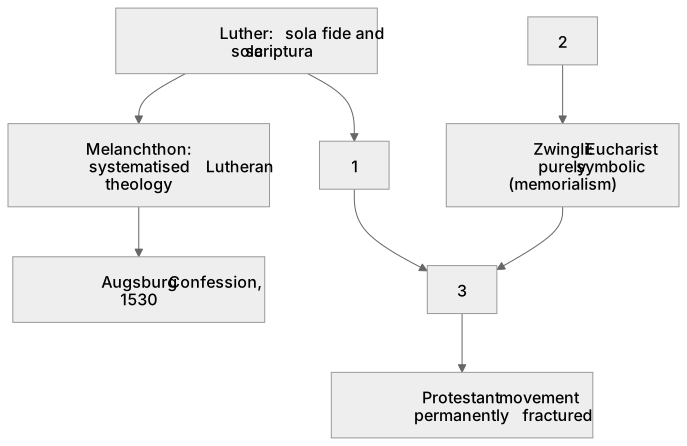
1Box 1
2Box 2
3Box 3
There is more to this lesson
The full lesson goes on to check your understanding and help you earn the marks. Create a free account to carry on, with your progress saved.
A week of Premium from your first lesson · Then the free plan continues · No card, no charge
Test your understanding of 2C The Reformation in Europe, c1500–1564 (A-level only) – The Protestant challenge, 1521–1531: The development of protestant doctrine: Luther, Melancthon and Zwingli
Active recall beats re-reading. Take an instant quiz now to test what you’ve learned and lock it into long-term memory.
A week of Premium from your first lesson · Then the free plan continues · No card, no charge