AQA · A-Level · History
Course version: 7042 · Version from Sept 2017
The spread of radical reformation: Carstadt and the Zwickau prophets;…
Full specification wording
2C The Reformation in Europe, c1500–1564 (A-level only) – The Protestant challenge, 1521–1531: The spread of radical reformation: Carstadt and the Zwickau prophets; Luther's relations with radicals and humanists
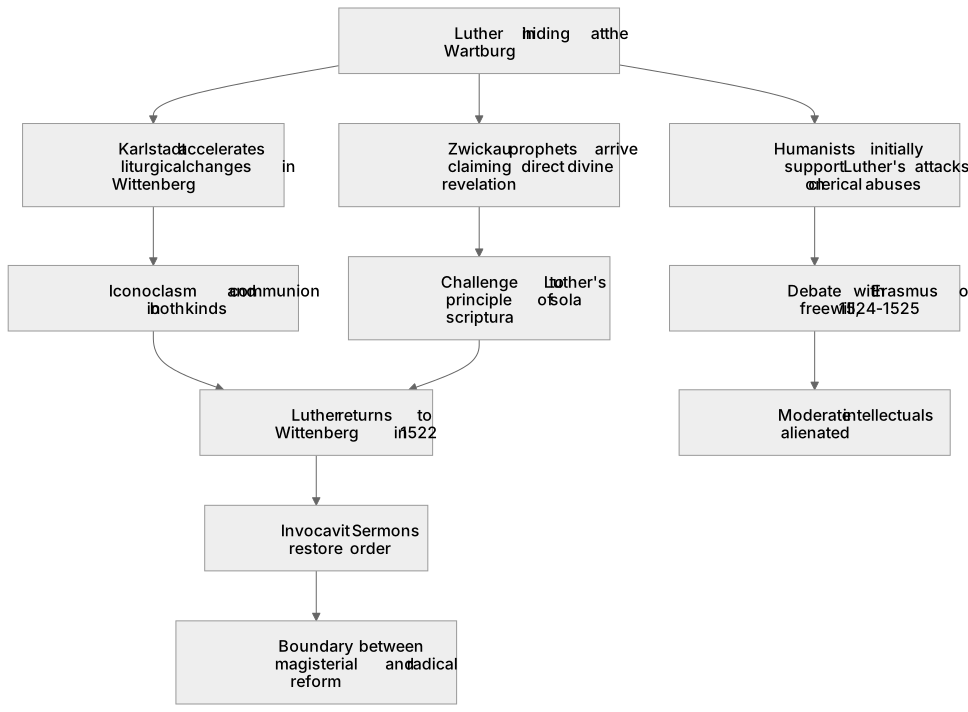
While Luther was in hiding at the Wartburg, the Reformation in Wittenberg radicalised under Andreas Karlstadt, who accelerated liturgical changes, promoted iconoclasm, and married.
Checked against the AQA 7042 specification (opens in a new tab) on .
- Point 1 of 4
Study notes
From the checked teaching notes for this specification point.
The idea
While Luther was in hiding at the Wartburg, the Reformation in Wittenberg radicalised under Andreas Karlstadt, who accelerated liturgical changes, promoted iconoclasm, and married. The arrival of the Zwickau prophets, claiming direct divine revelation over scripture, further destabilised the movement. Luther returned in 1522 to restore order, decisively rejecting these radicals in his Invocavit Sermons. This established a clear boundary between magisterial and radical reform. Simultaneously, Luther’s relationship with humanists fractured. While early humanists supported his attacks on clerical abuses, his debate with Erasmus over free will in 1524–1525 alienated moderate intellectuals, cementing the theological rigidity of early Lutheranism.
What earns the marks
- Explain Karlstadt's role in accelerating reform in Wittenberg, including communion in both kinds and iconoclasm, during Luther's absence.
- Analyse the threat posed by the Zwickau prophets' claim to direct spiritual revelation, which challenged Luther's foundational principle of sola scriptura.
- Evaluate Luther's response to the radicals, specifically his 1522 return to Wittenberg and the conservative restoration outlined in his Invocavit Sermons.
- Assess the breakdown in relations between Luther and humanists, focusing on the 1524-1525 debate with Erasmus over the bondage of the will.
Common mistakes and how to put them right
Confusing Karlstadt with Thomas Müntzer.
Put it right: Karlstadt led the Wittenberg radicalisation, whereas Müntzer was a key figure in the later Peasants' War.
Assuming humanists universally opposed Luther from the start.
Put it right: Early on, many humanists supported his critique of church corruption before theological differences emerged.
Stating the Zwickau prophets believed in sola scriptura.
Put it right: They actually claimed direct divine inspiration, which directly contradicted Luther's reliance on scripture.
Exam tips
- Use the Invocavit Sermons as concrete evidence of Luther's conservative approach to social and liturgical order.
- Contrast Luther's reliance on scripture with the Zwickau prophets' reliance on direct revelation to explain why Luther viewed them as a dangerous threat.
- When discussing humanists, explicitly mention the 1524 debate with Erasmus over free will as the definitive turning point in their relationship.
Try the lesson
The start of the 2C The Reformation in Europe, c1500–1564 (A-level only) – The Protestant challenge, 1521–1531: The spread of radical reformation: Carstadt and the Zwickau prophets; Luther's relations with radicals and humanists lesson, made from checked teaching notes for this specification point.
Have a go first
What was Martin Luther's primary response to the radical reforms introduced by Andreas Karlstadt and the Zwickau prophets in Wittenberg in 1522?
Listen
While Luther was in hiding at the Wartburg, the Reformation in Wittenberg radicalised under Andreas Karlstadt, who accelerated liturgical changes, promoted iconoclasm, and married. The arrival of the Zwickau prophets, claiming direct divine revelation over scripture, further destabilised the movement. Luther returned in 1522 to restore order, decisively rejecting these radicals in his Invocavit Sermons. This established a clear boundary between magisterial and radical reform. Simultaneously, Luther’s relationship with humanists fractured. While early humanists supported his attacks on clerical abuses, his debate with Erasmus over free will in 1524–1525 alienated moderate intellectuals, cementing the theological rigidity of early Lutheranism. A strong answer earns marks for these points. Explain Karlstadt's role in accelerating reform in Wittenberg, including communion in both kinds and iconoclasm, during Luther's absence. Analyse the threat posed by the Zwickau prophets' claim to direct spiritual revelation, which challenged Luther's foundational principle of sola scriptura. Evaluate Luther's response to the radicals, specifically his 1522 return to Wittenberg and the conservative restoration outlined in his Invocavit Sermons. Assess the breakdown in relations between Luther and humanists, focusing on the 1524-1525 debate with Erasmus over the bondage of the will. Exam tip: Use the Invocavit Sermons as concrete evidence of Luther's conservative approach to social and liturgical order.
See it
Label the diagram
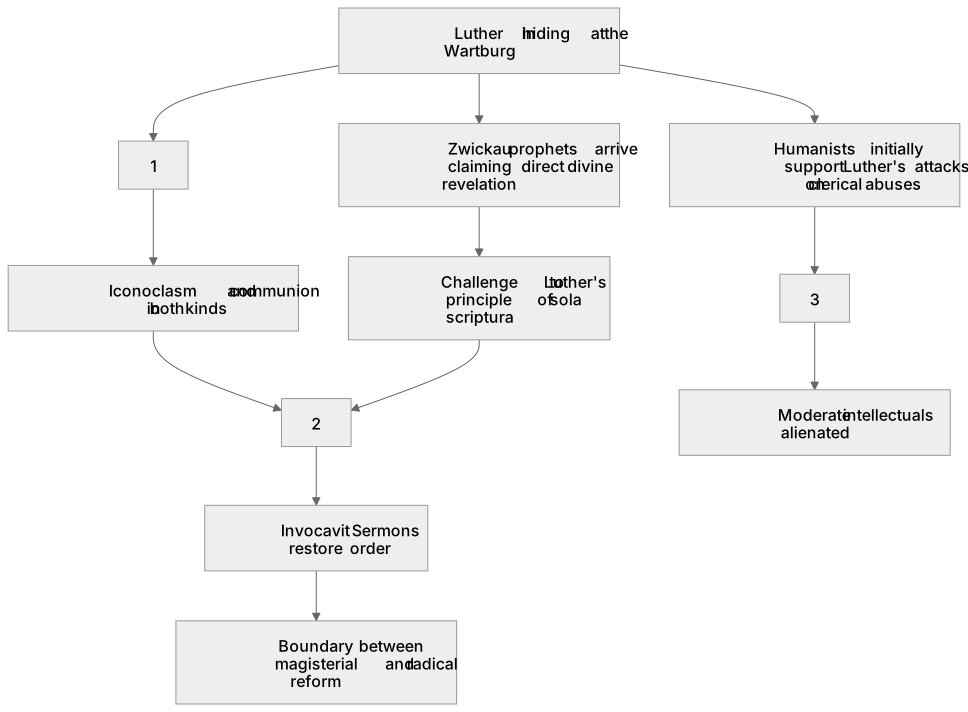
Some boxes have lost their names. Pick the right name for each number.
1Box 1
2Box 2
3Box 3
There is more to this lesson
The full lesson goes on to check your understanding and help you earn the marks. Create a free account to carry on, with your progress saved.
A week of Premium from your first lesson · Then the free plan continues · No card, no charge
Test your understanding of 2C The Reformation in Europe, c1500–1564 (A-level only) – The Protestant challenge, 1521–1531: The spread of radical reformation: Carstadt and the Zwickau prophets; Luther's relations with radicals and humanists
Active recall beats re-reading. Take an instant quiz now to test what you’ve learned and lock it into long-term memory.
A week of Premium from your first lesson · Then the free plan continues · No card, no charge