AQA · A-Level · History
Course version: 7042 · Version from Sept 2017
Religious War in Germany; the death of Luther; the Peace of Augsburg and…
Full specification wording
2C The Reformation in Europe, c1500–1564 (A-level only) – The second wave of Protestant Reform, 1541–1564: Religious War in Germany; the death of Luther; the Peace of Augsburg and the abdication of Charles V; principles and problems of the Peace of Augsburg
Following Luther’s death in 1546, the fragile truce in Germany collapsed into the Schmalkaldic War.
Checked against the AQA 7042 specification (opens in a new tab) on .
- Point 4 of 4
Study notes
From the checked teaching notes for this specification point.
The idea
Following Luther’s death in 1546, the fragile truce in Germany collapsed into the Schmalkaldic War. Despite Charles V’s military victory at Mühlberg, he failed to enforce religious uniformity, leading to the 1555 Peace of Augsburg. This treaty established the principle of 'cuius regio, eius religio', allowing princes to dictate their territory's religion. Exhausted by the failure of his imperial vision, Charles V abdicated in 1556. However, Augsburg created severe long-term problems: it explicitly excluded Calvinists, sowing seeds for future conflict, and the 'ecclesiastical reservation' clause, intended to protect Catholic lands if a prince converted, was frequently ignored, undermining the treaty's stability.
What earns the marks
- Analyse the causes and outcomes of the Schmalkaldic War, noting that military victory for Charles V did not translate into lasting religious settlement.
- Explain the significance of Luther's death in 1546 as a catalyst for the outbreak of open religious warfare in the Holy Roman Empire.
- Evaluate the core principle of 'cuius regio, eius religio' established at the Peace of Augsburg and its impact on princely power.
- Assess the inherent problems of the Peace of Augsburg, specifically the exclusion of Calvinism and the contentious 'reservatum ecclesiasticum' (ecclesiastical reservation).
- Examine the motivations behind Charles V's abdication, linking it to the failure of his lifelong goal to maintain a unified Catholic empire.
Common mistakes and how to put them right
Claiming the Peace of Augsburg established individual religious freedom.
Put it right by stating it only granted religious choice to the princes, not their subjects.
Stating that the Peace of Augsburg resolved all religious tensions in Germany.
Put it right by highlighting that the exclusion of Calvinists created new, volatile divisions.
Assuming Charles V abdicated solely due to ill health.
Put it right by emphasising his political and ideological defeat following the Peace of Augsburg.
Exam tips
- Memorise the Latin phrase 'cuius regio, eius religio' and explicitly define it in your essays to demonstrate precise historical knowledge.
- Link the problems of the Peace of Augsburg directly to the outbreak of later conflicts, showing an understanding of long-term consequences.
- Contrast Charles V's military success at Mühlberg with his ultimate political failure to enforce the Augsburg Interim.
Try the lesson
The start of the 2C The Reformation in Europe, c1500–1564 (A-level only) – The second wave of Protestant Reform, 1541–1564: Religious War in Germany; the death of Luther; the Peace of Augsburg and the abdication of Charles V; principles and problems of the Peace of Augsburg lesson, made from checked teaching notes for this specification point.
Have a go first
What was the central principle established by the Peace of Augsburg in 1555 regarding religious settlement in the Holy Roman Empire?
Listen
Following Luther’s death in 1546, the fragile truce in Germany collapsed into the Schmalkaldic War. Despite Charles V’s military victory at Mühlberg, he failed to enforce religious uniformity, leading to the 1555 Peace of Augsburg. This treaty established the principle of 'cuius regio, eius religio', allowing princes to dictate their territory's religion. Exhausted by the failure of his imperial vision, Charles V abdicated in 1556. However, Augsburg created severe long-term problems: it explicitly excluded Calvinists, sowing seeds for future conflict, and the 'ecclesiastical reservation' clause, intended to protect Catholic lands if a prince converted, was frequently ignored, undermining the treaty's stability. A strong answer earns marks for these points. Analyse the causes and outcomes of the Schmalkaldic War, noting that military victory for Charles V did not translate into lasting religious settlement. Explain the significance of Luther's death in 1546 as a catalyst for the outbreak of open religious warfare in the Holy Roman Empire. Evaluate the core principle of 'cuius regio, eius religio' established at the Peace of Augsburg and its impact on princely power. Assess the inherent problems of the Peace of Augsburg, specifically the exclusion of Calvinism and the contentious 'reservatum ecclesiasticum' (ecclesiastical reservation). A common slip: Claiming the Peace of Augsburg established individual religious freedom. Instead, stating it only granted religious choice to the princes, not their subjects. Exam tip: Memorise the Latin phrase 'cuius regio, eius religio' and explicitly define it in your essays to demonstrate precise historical knowledge.
See it
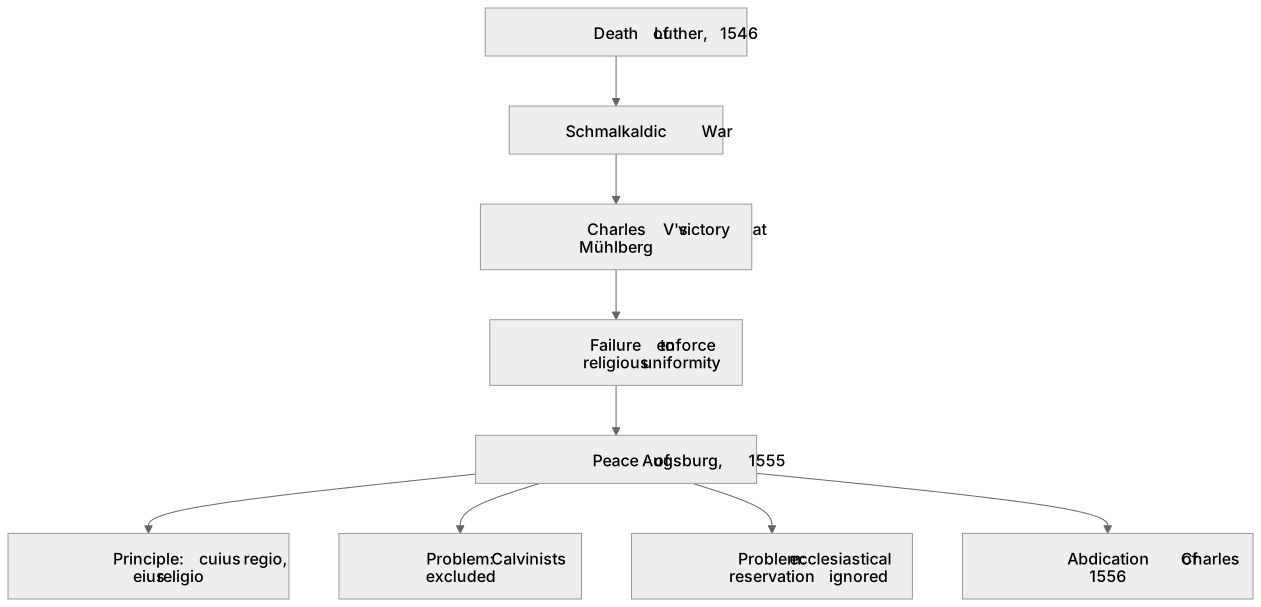
Put the events in order
Put these events in the order they happened, earliest first.
- 1. Luther's death acts as a catalyst for religious warfare
- 2. Charles V abdicates after his imperial vision fails
- 3. Peace of Augsburg establishes princely religious choice
Label the diagram
Some boxes have lost their names. Pick the right name for each number.
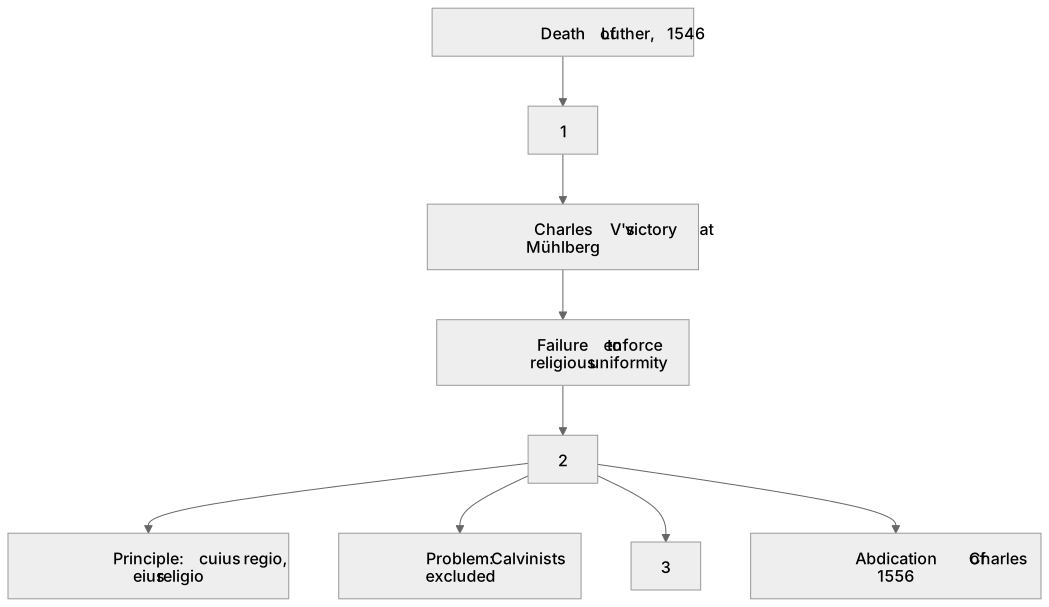
1Box 1
2Box 2
3Box 3
There is more to this lesson
The full lesson goes on to check your understanding and help you earn the marks. Create a free account to carry on, with your progress saved.
A week of Premium from your first lesson · Then the free plan continues · No card, no charge
Test your understanding of 2C The Reformation in Europe, c1500–1564 (A-level only) – The second wave of Protestant Reform, 1541–1564: Religious War in Germany; the death of Luther; the Peace of Augsburg and the abdication of Charles V; principles and problems of the Peace of Augsburg
Active recall beats re-reading. Take an instant quiz now to test what you’ve learned and lock it into long-term memory.
A week of Premium from your first lesson · Then the free plan continues · No card, no charge