AQA · A-Level · History
Course version: 7042 · Version from Sept 2017
The crisis over the succession 1553: attempts to avoid the succession of…
Full specification wording
2D Religious conflict and the Church in England, c1529– c1570 – A more Protestant Nation, 1547–1553 (A-level only): The crisis over the succession 1553: attempts to avoid the succession of Mary; the fall of Northumberland and Mary’s accession
The 1553 succession crisis emerged from Edward VI's declining health and his drive to preserve Protestantism.
Checked against the AQA 7042 specification (opens in a new tab) on .
- Point 4 of 4
- 4 key terms
Study notes
From the checked teaching notes for this specification point.
The idea
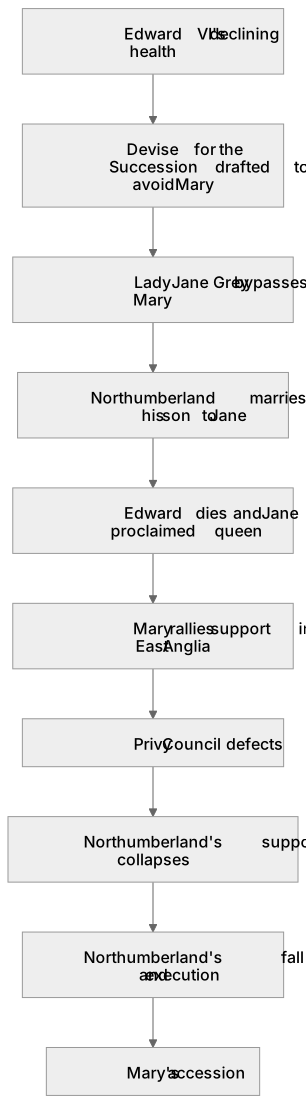
The 1553 succession crisis emerged from Edward VI's declining health and his drive to preserve Protestantism. To avoid the succession of his Catholic half-sister Mary, Edward drafted the 'Devise for the Succession', bypassing her for his Protestant cousin, Lady Jane Grey. The Duke of Northumberland orchestrated this, marrying his son to Jane. After Edward died, Jane was proclaimed queen. However, Mary acted decisively, rallying support in East Anglia based on her legitimate Tudor claim. Northumberland's support collapsed as the Privy Council defected. His fall and execution paved the way for Mary's triumphant accession, proving that dynastic legitimacy ultimately outweighed religious ideology for the English political nation in 1553.
What earns the marks
- Explain the motivations behind the 'Devise for the Succession', distinguishing between Edward VI's religious zeal and Northumberland's political ambitions.
- Evaluate the reasons for the failure of the plot to install Lady Jane Grey, focusing on Mary's decisive actions and the lack of popular support for Northumberland.
- Analyse the significance of Mary's successful accession in demonstrating the paramount importance of Tudor dynastic legitimacy over religious affiliation.
- Assess the role of the Privy Council and regional nobility in the rapid collapse of Northumberland's authority during the crisis.
Common mistakes and how to put them right
Stating that Northumberland was the sole author of the 'Devise for the Succession'.
Put it right: Edward VI was the primary driving force behind the Devise to protect his Protestant legacy, though Northumberland facilitated it.
Assuming Mary's successful accession was purely due to Catholic support.
Put it right: Mary garnered widespread support from both Catholics and Protestants who believed in her legitimate, legal right to the throne under Henry VIII's will.
Claiming Lady Jane Grey ruled for exactly nine days without opposition.
Put it right: Mary immediately contested the succession, and Jane's authority was never fully established or accepted outside of London.
Exam tips
- Use the term 'Devise for the Succession' explicitly when discussing the legal and political mechanisms used to attempt to bypass Mary.
- Contrast Mary's proactive flight to Framlingham Castle with Northumberland's hesitation to highlight the importance of leadership during the crisis.
- Discuss how the events of 1553 reveal the limits of a leading minister's power when disconnected from the legitimate monarch.
Try the lesson
The start of the 2D Religious conflict and the Church in England, c1529– c1570 – A more Protestant Nation, 1547–1553 (A-level only): The crisis over the succession 1553: attempts to avoid the succession of Mary; the fall of Northumberland and Mary’s accession lesson, made from checked teaching notes for this specification point.
Have a go first
In 1553, Edward VI and the Duke of Northumberland attempted to alter the succession to prevent Mary Tudor from taking the throne. Who was named as Edward's heir in the 'Devise for the Succession'?
Listen
The 1553 succession crisis emerged from Edward VI's declining health and his drive to preserve Protestantism. To avoid the succession of his Catholic half-sister Mary, Edward drafted the 'Devise for the Succession', bypassing her for his Protestant cousin, Lady Jane Grey. The Duke of Northumberland orchestrated this, marrying his son to Jane. After Edward died, Jane was proclaimed queen. However, Mary acted decisively, rallying support in East Anglia based on her legitimate Tudor claim. Northumberland's support collapsed as the Privy Council defected. His fall and execution paved the way for Mary's triumphant accession, proving that dynastic legitimacy ultimately outweighed religious ideology for the English political nation in 1553. A strong answer earns marks for these points. Explain the motivations behind the 'Devise for the Succession', distinguishing between Edward VI's religious zeal and Northumberland's political ambitions. Evaluate the reasons for the failure of the plot to install Lady Jane Grey, focusing on Mary's decisive actions and the lack of popular support for Northumberland. Analyse the significance of Mary's successful accession in demonstrating the paramount importance of Tudor dynastic legitimacy over religious affiliation. Assess the role of the Privy Council and regional nobility in the rapid collapse of Northumberland's authority during the crisis. A common slip: Stating that Northumberland was the sole author of the 'Devise for the Succession'. Instead, Edward VI was the primary driving force behind the Devise to protect his Protestant legacy, though Northumberland facilitated it. Exam tip: Use the term 'Devise for the Succession' explicitly when discussing the legal and political mechanisms used to attempt to bypass Mary.
See it
Key words
Say what each word means before you turn the card.
Dynastic legitimacy versus religious ideology
Try answering aloud or in your head before turning the card.
The power and vulnerability of the nobility
Try answering aloud or in your head before turning the card.
The role of popular support in securing the Crown
Try answering aloud or in your head before turning the card.
Tudor succession and constitutional crisis
Try answering aloud or in your head before turning the card.
See every definition
- Dynastic legitimacy versus religious ideology
- The 1553 crisis proved that dynastic legitimacy ultimately outweighed religious ideology for the English political nation.
- The power and vulnerability of the nobility
- Northumberland's support collapsed as the Privy Council defected, revealing the limits of a leading minister's power when disconnected from the legitimate monarch.
- The role of popular support in securing the Crown
- Mary acted decisively, rallying support in East Anglia based on her legitimate Tudor claim, while Northumberland lacked popular support.
- Tudor succession and constitutional crisis
- The 1553 succession crisis emerged from Edward VI's declining health and his drive to preserve Protestantism, with the 'Devise for the Succession' drafted to avoid the succession of Mary.
Label the diagram
Some boxes have lost their names. Pick the right name for each number.
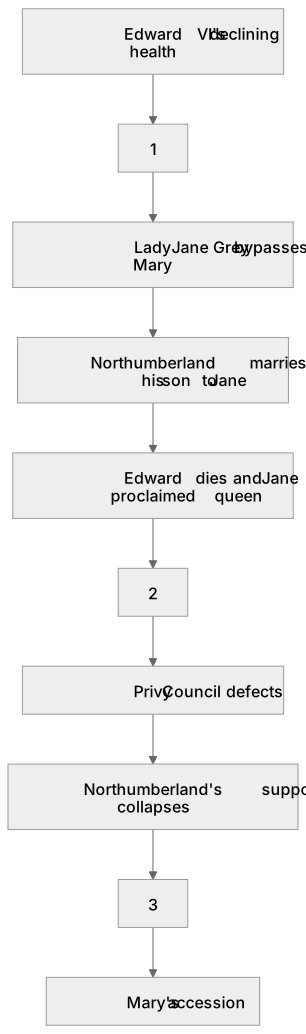
1Box 1
2Box 2
3Box 3
There is more to this lesson
The full lesson goes on to check your understanding and help you earn the marks. Create a free account to carry on, with your progress saved.
A week of Premium from your first lesson · Then the free plan continues · No card, no charge
Test your understanding of 2D Religious conflict and the Church in England, c1529– c1570 – A more Protestant Nation, 1547–1553 (A-level only): The crisis over the succession 1553: attempts to avoid the succession of Mary; the fall of Northumberland and Mary’s accession
Active recall beats re-reading. Take an instant quiz now to test what you’ve learned and lock it into long-term memory.
A week of Premium from your first lesson · Then the free plan continues · No card, no charge