AQA · A-Level · History
Course version: 7042 · Version from Sept 2017
Opposition and conformity: the Western Rebellion; Kett’s Rebellion; the…
Full specification wording
2D Religious conflict and the Church in England, c1529– c1570 – A more Protestant Nation, 1547–1553 (A-level only): Opposition and conformity: the Western Rebellion; Kett’s Rebellion; the influence of reformers and acceptance of religious changes; the Church by 1553
In 1549, Edward VI's regime faced severe unrest.
Checked against the AQA 7042 specification (opens in a new tab) on .
- Point 3 of 4
- 4 key terms
Study notes
From the checked teaching notes for this specification point.
The idea
In 1549, Edward VI's regime faced severe unrest. The Western Rebellion was driven by religious conservatism, opposing the new Book of Common Prayer, alongside economic grievances. Conversely, Kett's Rebellion in East Anglia was sparked by enclosures, with rebels actually demanding more radical Protestant reforms. Despite these uprisings, conformity was widespread. Influential reformers like Cranmer and Bucer accelerated Protestant changes, culminating in the 1552 Prayer Book. By 1553, the English Church was structurally and doctrinally Protestant. However, acceptance of these religious changes varied greatly; while London embraced Protestantism, traditional practices persisted covertly in the North and West, revealing a deeply divided nation.
What earns the marks
- Identify the distinct causes of the 1549 rebellions, contrasting the religious motives of the Western Rebellion with the socio-economic drivers of Kett's Rebellion.
- Evaluate the extent of conformity to Edwardian religious policies, noting that outward compliance often masked inward conservatism.
- Assess the influence of continental reformers, such as Martin Bucer and Peter Martyr, on Thomas Cranmer and the doctrinal shift in the 1552 Book of Common Prayer.
- Analyse the state of the Church by 1553, recognising that while officially Protestant in doctrine and liturgy, popular acceptance remained geographically and socially fragmented.
Common mistakes and how to put them right
Assuming Kett's Rebellion was a Catholic uprising.
Put it right: Kett's rebels were largely sympathetic to Protestantism and demanded more competent, reformist clergy.
Treating the 1549 rebellions as a unified movement against the Crown.
Put it right: The rebellions were distinct, geographically separate, and driven by different primary grievances.
Claiming England was a fully Protestant nation by 1553.
Put it right: While the Church's official doctrine was Protestant, popular belief was mixed, with strong Catholic survivalism in regions like Lancashire and Cornwall.
Exam tips
- Compare the demands of the Western and Kett's rebels using their respective articles to demonstrate a nuanced understanding of their motives.
- Use specific examples of Edwardian legislation, such as the 1552 Act of Uniformity, to illustrate the official state of the Church by 1553.
- When discussing the acceptance of religious changes, differentiate between the rapid Protestantisation of London and the slower, reluctant conformity of the provinces.
Try the lesson
The start of the 2D Religious conflict and the Church in England, c1529– c1570 – A more Protestant Nation, 1547–1553 (A-level only): Opposition and conformity: the Western Rebellion; Kett’s Rebellion; the influence of reformers and acceptance of religious changes; the Church by 1553 lesson, made from checked teaching notes for this specification point.
Have a go first
Which of the following was the primary religious catalyst for the outbreak of the Western Rebellion in 1549?
Listen
In 1549, Edward VI's regime faced severe unrest. The Western Rebellion was driven by religious conservatism, opposing the new Book of Common Prayer, alongside economic grievances. Conversely, Kett's Rebellion in East Anglia was sparked by enclosures, with rebels actually demanding more radical Protestant reforms. Despite these uprisings, conformity was widespread. Influential reformers like Cranmer and Bucer accelerated Protestant changes, culminating in the 1552 Prayer Book. By 1553, the English Church was structurally and doctrinally Protestant. However, acceptance of these religious changes varied greatly; while London embraced Protestantism, traditional practices persisted covertly in the North and West, revealing a deeply divided nation. A strong answer earns marks for these points. Identify the distinct causes of the 1549 rebellions, contrasting the religious motives of the Western Rebellion with the socio-economic drivers of Kett's Rebellion. Evaluate the extent of conformity to Edwardian religious policies, noting that outward compliance often masked inward conservatism. Assess the influence of continental reformers, such as Martin Bucer and Peter Martyr, on Thomas Cranmer and the doctrinal shift in the 1552 Book of Common Prayer. Analyse the state of the Church by 1553, recognising that while officially Protestant in doctrine and liturgy, popular acceptance remained geographically and socially fragmented. A common slip: Assuming Kett's Rebellion was a Catholic uprising. Instead, Kett's rebels were largely sympathetic to Protestantism and demanded more competent, reformist clergy. Exam tip: Compare the demands of the Western and Kett's rebels using their respective articles to demonstrate a nuanced understanding of their motives.
See it
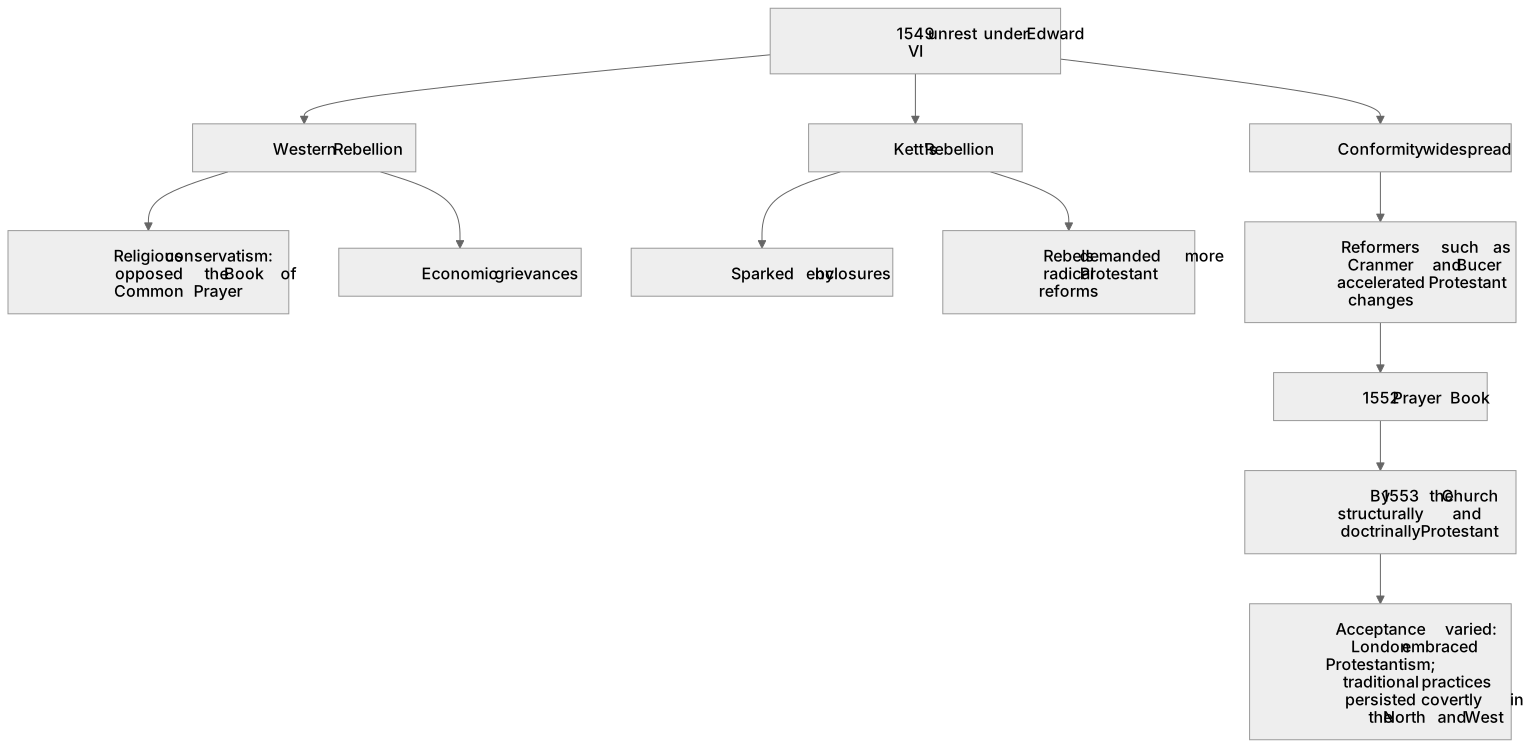
Key words
Say what each word means before you turn the card.
Religious transformation and doctrinal shift
Try answering aloud or in your head before turning the card.
Popular rebellion and socio-economic grievances
Try answering aloud or in your head before turning the card.
Regionalism and the limits of central authority
Try answering aloud or in your head before turning the card.
The influence of European Protestantism
Try answering aloud or in your head before turning the card.
See every definition
- Religious transformation and doctrinal shift
- Influential reformers accelerated Protestant changes, culminating in the 1552 Prayer Book, so that by 1553 the English Church was structurally and doctrinally Protestant.
- Popular rebellion and socio-economic grievances
- In 1549 Edward VI's regime faced severe unrest, with the Western Rebellion driven by religious conservatism alongside economic grievances and Kett's Rebellion sparked by enclosures.
- Regionalism and the limits of central authority
- Acceptance of religious changes varied greatly, as London embraced Protestantism while traditional practices persisted covertly in the North and West, revealing a deeply divided nation.
- The influence of European Protestantism
- Influential reformers such as Cranmer and Bucer accelerated Protestant changes, shaping the doctrinal shift that culminated in the 1552 Prayer Book.
Label the diagram
Some boxes have lost their names. Pick the right name for each number.
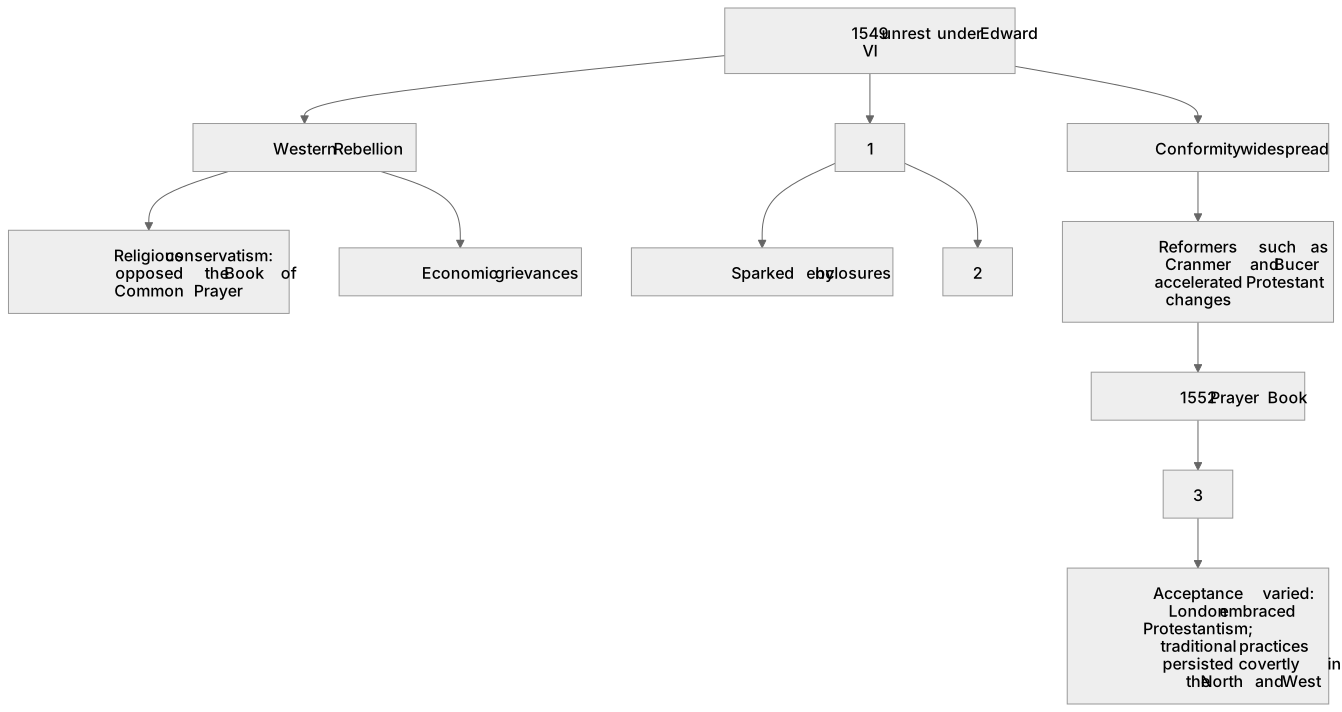
1Box 1
2Box 2
3Box 3
There is more to this lesson
The full lesson goes on to check your understanding and help you earn the marks. Create a free account to carry on, with your progress saved.
A week of Premium from your first lesson · Then the free plan continues · No card, no charge
Test your understanding of 2D Religious conflict and the Church in England, c1529– c1570 – A more Protestant Nation, 1547–1553 (A-level only): Opposition and conformity: the Western Rebellion; Kett’s Rebellion; the influence of reformers and acceptance of religious changes; the Church by 1553
Active recall beats re-reading. Take an instant quiz now to test what you’ve learned and lock it into long-term memory.
A week of Premium from your first lesson · Then the free plan continues · No card, no charge