AQA · A-Level · History
Course version: 7042 · Version from Sept 2017
The Protestant Party and the King: the aims, beliefs and role of Somerset…
Full specification wording
2D Religious conflict and the Church in England, c1529– c1570 – A more Protestant Nation, 1547–1553 (A-level only): The Protestant Party and the King: the aims, beliefs and role of Somerset and the overturning of Henry’s will; the aims, beliefs and role of Northumberland as Protector
In 1547, the Protestant faction dominated the Regency Council for the young Edward VI.
Checked against the AQA 7042 specification (opens in a new tab) on .
- Point 1 of 4
Study notes
From the checked teaching notes for this specification point.
The idea
In 1547, the Protestant faction dominated the Regency Council for the young Edward VI. Edward Seymour, Duke of Somerset, overturned Henry VIII's will—which stipulated a balanced council—by seizing power as Lord Protector. Somerset held moderately Protestant beliefs, aiming to cautiously advance reform while maintaining stability, exemplified by repealing the Treason Act. Following Somerset's fall in 1549, John Dudley, Duke of Northumberland, assumed control. Though he rejected the formal title of Protector, he functioned as one. Northumberland's aims were driven by political survival, but he aligned with radical Protestants, pushing for decisive doctrinal shifts to secure Edward's favour and consolidate the Protestant Party's dominance.
What earns the marks
- Explain how Somerset manipulated the Regency Council to overturn Henry VIII's will and establish himself as Lord Protector.
- Assess Somerset's moderate Protestant aims and his cautious legislative approach, such as the 1547 Treason Act repeal.
- Evaluate Northumberland's rise to power and his pragmatic alignment with radical Protestantism to secure Edward VI's support.
- Compare the differing roles and leadership styles of Somerset and Northumberland in managing the Protestant Party and the King.
Common mistakes and how to put them right
Claiming Northumberland held the official title of Lord Protector.
Put it right: State that Northumberland was Lord President of the Council, though he exercised protectorate powers.
Assuming Somerset and Northumberland had identical religious beliefs.
Put it right: Distinguish between Somerset's moderate, cautious Protestantism and Northumberland's politically driven alignment with radical reformers.
Stating Henry VIII's will named Somerset as Lord Protector.
Put it right: Explain that Henry's will established a balanced Regency Council of 16 executors, which Somerset subsequently overturned.
Exam tips
- Analyse the extent to which Edward VI's own strong Protestant beliefs influenced the policies of both Somerset and Northumberland.
- Use the overturning of Henry VIII's will as key evidence of factional politics dominating the early years of Edward's reign.
- When evaluating Northumberland, balance his reputation for political pragmatism with the tangible radical religious reforms enacted under his leadership.
Try the lesson
The start of the 2D Religious conflict and the Church in England, c1529– c1570 – A more Protestant Nation, 1547–1553 (A-level only): The Protestant Party and the King: the aims, beliefs and role of Somerset and the overturning of Henry’s will; the aims, beliefs and role of Northumberland as Protector lesson, made from checked teaching notes for this specification point.
Have a go first
How did Edward Seymour (later Duke of Somerset) primarily overturn the provisions of Henry VIII's will shortly after the King's death in 1547?
Listen
In 1547, the Protestant faction dominated the Regency Council for the young Edward VI. Edward Seymour, Duke of Somerset, overturned Henry VIII's will—which stipulated a balanced council—by seizing power as Lord Protector. Somerset held moderately Protestant beliefs, aiming to cautiously advance reform while maintaining stability, exemplified by repealing the Treason Act. Following Somerset's fall in 1549, John Dudley, Duke of Northumberland, assumed control. Though he rejected the formal title of Protector, he functioned as one. Northumberland's aims were driven by political survival, but he aligned with radical Protestants, pushing for decisive doctrinal shifts to secure Edward's favour and consolidate the Protestant Party's dominance. A strong answer earns marks for these points. Explain how Somerset manipulated the Regency Council to overturn Henry VIII's will and establish himself as Lord Protector. Assess Somerset's moderate Protestant aims and his cautious legislative approach, such as the 1547 Treason Act repeal. Evaluate Northumberland's rise to power and his pragmatic alignment with radical Protestantism to secure Edward VI's support. Compare the differing roles and leadership styles of Somerset and Northumberland in managing the Protestant Party and the King. A common slip: Claiming Northumberland held the official title of Lord Protector. Instead, State that Northumberland was Lord President of the Council, though he exercised protectorate powers. Exam tip: Analyse the extent to which Edward VI's own strong Protestant beliefs influenced the policies of both Somerset and Northumberland.
See it
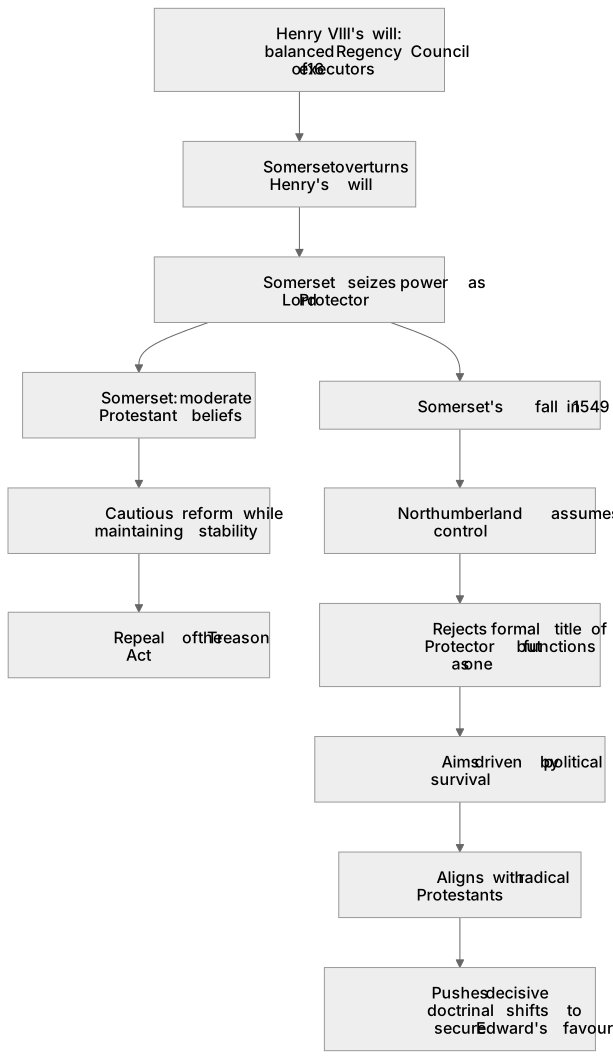
Label the diagram
Some boxes have lost their names. Pick the right name for each number.
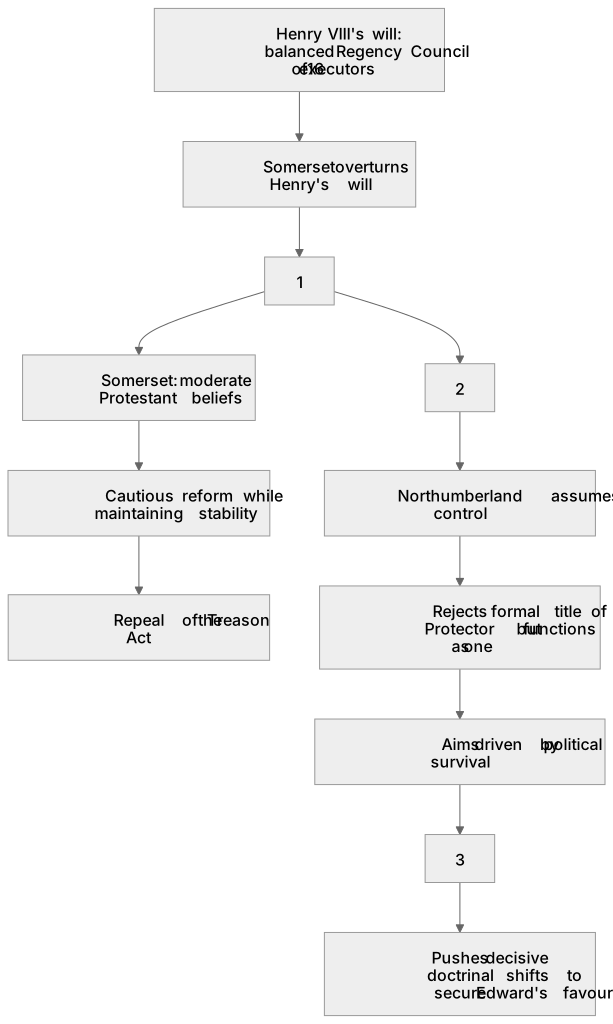
1Box 1
2Box 2
3Box 3
There is more to this lesson
The full lesson goes on to check your understanding and help you earn the marks. Create a free account to carry on, with your progress saved.
A week of Premium from your first lesson · Then the free plan continues · No card, no charge
Test your understanding of 2D Religious conflict and the Church in England, c1529– c1570 – A more Protestant Nation, 1547–1553 (A-level only): The Protestant Party and the King: the aims, beliefs and role of Somerset and the overturning of Henry’s will; the aims, beliefs and role of Northumberland as Protector
Active recall beats re-reading. Take an instant quiz now to test what you’ve learned and lock it into long-term memory.
A week of Premium from your first lesson · Then the free plan continues · No card, no charge