AQA · A-Level · History
Course version: 7042 · Version from Sept 2017
The Dissolution of the Monasteries: political, religious, social and…
Full specification wording
2D Religious conflict and the Church in England, c1529– c1570 – Change and reaction, 1536–1547: The Dissolution of the Monasteries: political, religious, social and economic causes and consequences; the Pilgrimage of Grace
The Dissolution of the Monasteries (1536–1540) was driven by multiple causes: politically, Henry sought to eliminate institutions loyal to the Pope; religiously, reformers condemned monastic…
Checked against the AQA 7042 specification (opens in a new tab) on .
- Point 2 of 4
Study notes
From the checked teaching notes for this specification point.
The idea
The Dissolution of the Monasteries (1536–1540) was driven by multiple causes: politically, Henry sought to eliminate institutions loyal to the Pope; religiously, reformers condemned monastic corruption and superstition; economically, the Crown needed wealth to fund foreign wars; and socially, the gentry desired monastic lands. The consequences were profound: politically, it centralised Crown power; religiously, it removed Catholic strongholds; economically, it enriched the Crown and gentry; and socially, it destroyed local charity and education networks. This upheaval triggered the Pilgrimage of Grace (1536), a massive northern rebellion motivated by religious conservatism, economic grievances, and opposition to Cromwell's policies, which Henry brutally suppressed.
What earns the marks
- Analyse the political and religious causes of the Dissolution, including the desire to sever papal loyalties and the reformist critique of monastic corruption highlighted by the Valor Ecclesiasticus.
- Evaluate the economic and social causes, focusing on Henry's need for revenue to fund coastal defences and the gentry's appetite for land acquisition.
- Assess the multifaceted consequences of the Dissolution, such as the transfer of wealth to the Crown and gentry, the loss of social welfare provided by monasteries, and the eradication of monastic culture.
- Examine the Pilgrimage of Grace as a reaction to the Dissolution, detailing its religious, economic, and political motives, and evaluating the threat it posed to Henry VIII's regime.
Common mistakes and how to put them right
Stating that the Dissolution was solely caused by religious reform.
Put it right: Emphasise that economic motives, specifically Henry's need for money to fund foreign policy, were arguably the primary driver.
Describing the Pilgrimage of Grace as a purely religious uprising.
Put it right: Acknowledge the religious motives but also include economic grievances, such as taxation and poor harvests, and political opposition to Cromwell.
Claiming the Dissolution only had negative social consequences.
Put it right: Note that while the poor lost charitable support, the gentry and emerging middle classes benefited significantly from purchasing monastic lands.
Exam tips
- Structure essays on the causes or consequences of the Dissolution thematically, explicitly addressing political, religious, social, and economic factors as required by the specification.
- Use the Pilgrimage of Grace as key evidence when evaluating the social and religious consequences of the early stages of the Dissolution.
- Memorise specific details from the Pilgrimage of Grace, such as the Pontefract Articles, to demonstrate the complex blend of rebel grievances.
Try the lesson
The start of the 2D Religious conflict and the Church in England, c1529– c1570 – Change and reaction, 1536–1547: The Dissolution of the Monasteries: political, religious, social and economic causes and consequences; the Pilgrimage of Grace lesson, made from checked teaching notes for this specification point.
Have a go first
Which of the following was a primary economic consequence of the Dissolution of the Monasteries for the English Crown?
Listen
The Dissolution of the Monasteries (1536–1540) was driven by multiple causes: politically, Henry sought to eliminate institutions loyal to the Pope; religiously, reformers condemned monastic corruption and superstition; economically, the Crown needed wealth to fund foreign wars; and socially, the gentry desired monastic lands. The consequences were profound: politically, it centralised Crown power; religiously, it removed Catholic strongholds; economically, it enriched the Crown and gentry; and socially, it destroyed local charity and education networks. This upheaval triggered the Pilgrimage of Grace (1536), a massive northern rebellion motivated by religious conservatism, economic grievances, and opposition to Cromwell's policies, which Henry brutally suppressed. A strong answer earns marks for these points. Analyse the political and religious causes of the Dissolution, including the desire to sever papal loyalties and the reformist critique of monastic corruption highlighted by the Valor Ecclesiasticus. Evaluate the economic and social causes, focusing on Henry's need for revenue to fund coastal defences and the gentry's appetite for land acquisition. Assess the multifaceted consequences of the Dissolution, such as the transfer of wealth to the Crown and gentry, the loss of social welfare provided by monasteries, and the eradication of monastic culture. Examine the Pilgrimage of Grace as a reaction to the Dissolution, detailing its religious, economic, and political motives, and evaluating the threat it posed to Henry VIII's regime. A common slip: Stating that the Dissolution was solely caused by religious reform. Instead, Emphasise that economic motives, specifically Henry's need for money to fund foreign policy, were arguably the primary driver. Exam tip: Structure essays on the causes or consequences of the Dissolution thematically, explicitly addressing political, religious, social, and economic factors as required by the specification.
See it
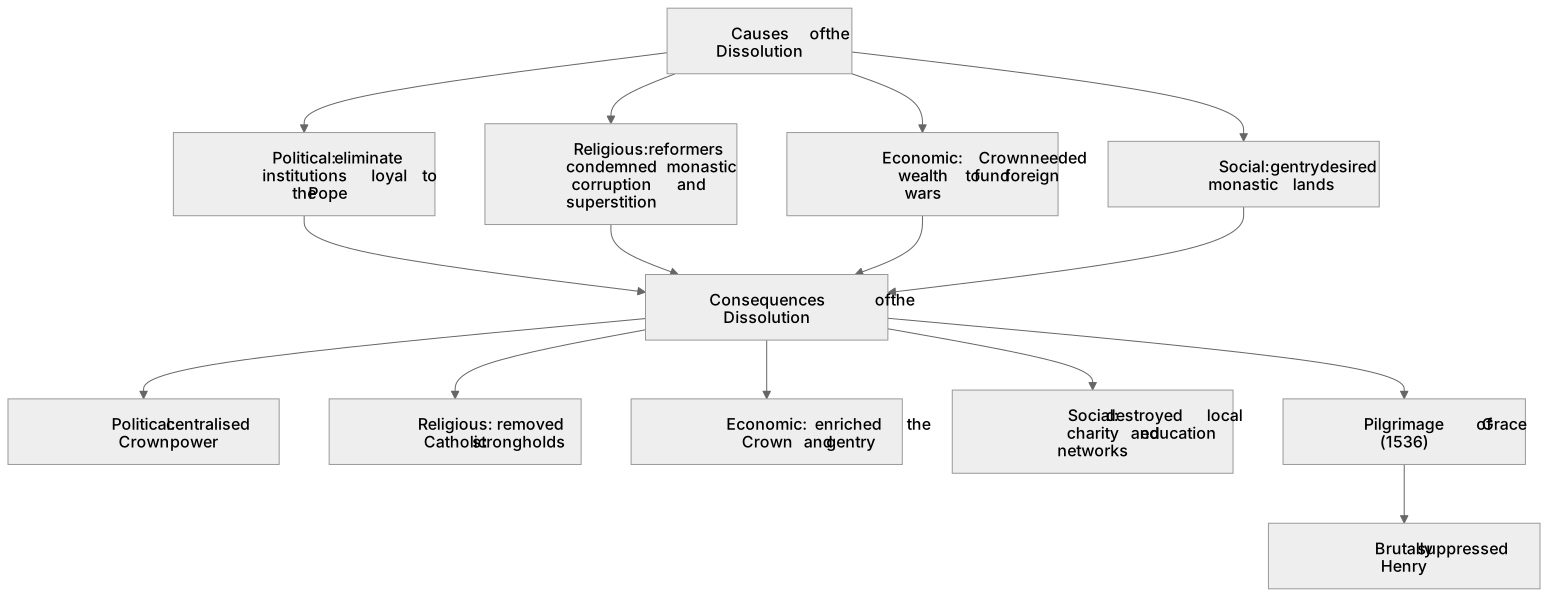
Label the diagram
Some boxes have lost their names. Pick the right name for each number.
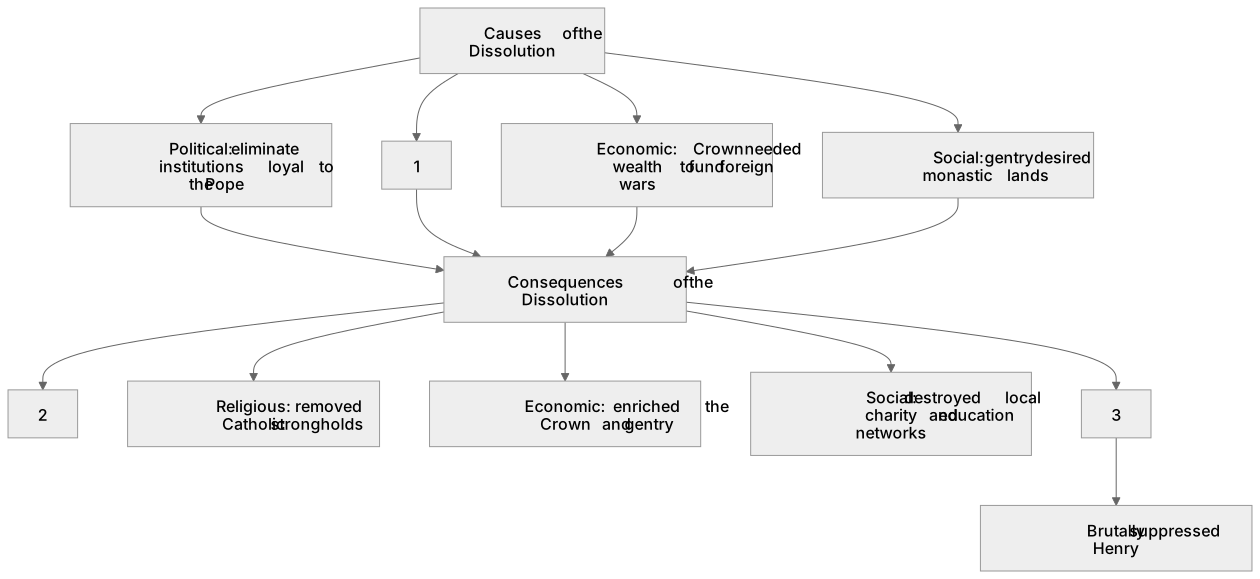
1Box 1
2Box 2
3Box 3
There is more to this lesson
The full lesson goes on to check your understanding and help you earn the marks. Create a free account to carry on, with your progress saved.
A week of Premium from your first lesson · Then the free plan continues · No card, no charge
Test your understanding of 2D Religious conflict and the Church in England, c1529– c1570 – Change and reaction, 1536–1547: The Dissolution of the Monasteries: political, religious, social and economic causes and consequences; the Pilgrimage of Grace
Active recall beats re-reading. Take an instant quiz now to test what you’ve learned and lock it into long-term memory.
A week of Premium from your first lesson · Then the free plan continues · No card, no charge