AQA · A-Level · History
Course version: 7042 · Version from Sept 2017
The reformist and conservative factions: aims, influence and the reaction…
Full specification wording
2D Religious conflict and the Church in England, c1529– c1570 – Change and reaction, 1536–1547: The reformist and conservative factions: aims, influence and the reaction of the King; the impact of foreign affairs on changes to the Church
Between 1536 and 1547, Henry VIII's court was divided between reformists, led by Cromwell and Cranmer, who aimed to introduce Protestant theology, and conservatives, led by Norfolk and Gardiner,…
Checked against the AQA 7042 specification (opens in a new tab) on .
- Point 1 of 4
Study notes
From the checked teaching notes for this specification point.
The idea
Between 1536 and 1547, Henry VIII's court was divided between reformists, led by Cromwell and Cranmer, who aimed to introduce Protestant theology, and conservatives, led by Norfolk and Gardiner, who sought to maintain traditional Catholic doctrine without the Pope. Their influence fluctuated; reformists secured the Ten Articles (1536) and the English Bible, while conservatives orchestrated the Act of Six Articles (1539) and Cromwell's fall. Henry reacted by balancing these factions to maintain his supremacy, refusing to be dominated by either. Foreign affairs heavily impacted Church changes: the threat of a Catholic crusade following the 1538 Truce of Nice prompted Henry to revert to conservative doctrine to appease European Catholic powers, demonstrating how diplomacy dictated domestic religious policy.
What earns the marks
- Identify the key figures and aims of the reformist faction (Cromwell, Cranmer, Protestant doctrine) and the conservative faction (Norfolk, Gardiner, Catholic doctrine without papal authority).
- Evaluate the fluctuating influence of both factions, noting reformist successes like the 1536 Injunctions and conservative victories like the 1539 Act of Six Articles.
- Analyse Henry VIII's reaction to factionalism, demonstrating how he manipulated rivalries to assert his Royal Supremacy and avoid being controlled by any single group.
Common mistakes and how to put them right
Assuming Henry VIII was a passive victim of factional manipulation.
Put it right: Argue that Henry actively managed and balanced factions to maintain his own authority and Royal Supremacy.
Confusing the conservative faction's aims with a desire to return to papal authority.
Put it right: Specify that conservatives wanted to retain Catholic doctrine, such as transubstantiation, but fully supported Henry's Royal Supremacy over the Pope.
Ignoring the role of foreign policy in domestic religious changes.
Put it right: Explicitly link diplomatic events, such as the 1538 Truce of Nice, to domestic religious shifts like the conservative Act of Six Articles.
Exam tips
- Use specific legislative examples, such as the Ten Articles or the Act of Six Articles, to demonstrate the shifting influence of the reformist and conservative factions.
- When evaluating Henry's reaction to factions, discuss the executions of both Cromwell (reformist) and Catherine Howard (conservative) as evidence of his balancing act.
- Always connect changes in the Church to the broader European context, showing how the fear of Catholic isolation drove Henry's religious conservatism in the late 1530s.
Try the lesson
The start of the 2D Religious conflict and the Church in England, c1529– c1570 – Change and reaction, 1536–1547: The reformist and conservative factions: aims, influence and the reaction of the King; the impact of foreign affairs on changes to the Church lesson, made from checked teaching notes for this specification point.
Have a go first
Which of the following best describes the primary aim of the conservative faction at the court of Henry VIII during the late 1530s and 1540s?
Listen
Between 1536 and 1547, Henry VIII's court was divided between reformists, led by Cromwell and Cranmer, who aimed to introduce Protestant theology, and conservatives, led by Norfolk and Gardiner, who sought to maintain traditional Catholic doctrine without the Pope. Their influence fluctuated; reformists secured the Ten Articles (1536) and the English Bible, while conservatives orchestrated the Act of Six Articles (1539) and Cromwell's fall. Henry reacted by balancing these factions to maintain his supremacy, refusing to be dominated by either. Foreign affairs heavily impacted Church changes: the threat of a Catholic crusade following the 1538 Truce of Nice prompted Henry to revert to conservative doctrine to appease European Catholic powers, demonstrating how diplomacy dictated domestic religious policy. A strong answer earns marks for these points. Identify the key figures and aims of the reformist faction (Cromwell, Cranmer, Protestant doctrine) and the conservative faction (Norfolk, Gardiner, Catholic doctrine without papal authority). Evaluate the fluctuating influence of both factions, noting reformist successes like the 1536 Injunctions and conservative victories like the 1539 Act of Six Articles. Analyse Henry VIII's reaction to factionalism, demonstrating how he manipulated rivalries to assert his Royal Supremacy and avoid being controlled by any single group. Assess the impact of foreign affairs on religious policy, specifically how the threat of a Franco-Imperial alliance following the Truce of Nice forced Henry to adopt conservative religious stances to deter a Catholic invasion. A common slip: Assuming Henry VIII was a passive victim of factional manipulation. Instead, Argue that Henry actively managed and balanced factions to maintain his own authority and Royal Supremacy. Exam tip: Use specific legislative examples, such as the Ten Articles or the Act of Six Articles, to demonstrate the shifting influence of the reformist and conservative factions.
See it
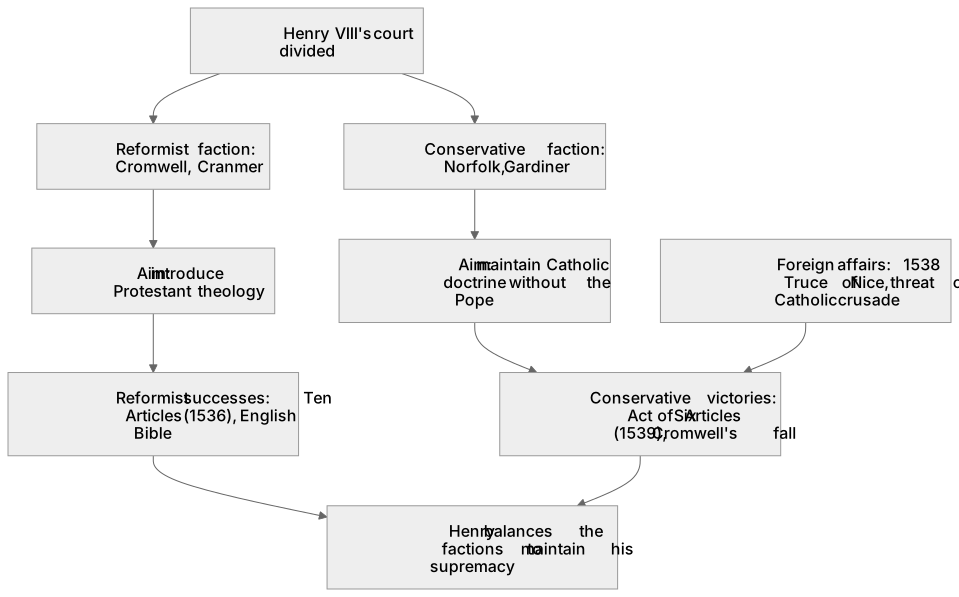
Put the events in order
Put these events in the order they happened, earliest first.
- 1. Reformists secured the Ten Articles
- 2. Conservatives orchestrated the Act of Six Articles
- 3. Truce of Nice prompted reversion to conservative doctrine
Label the diagram
Some boxes have lost their names. Pick the right name for each number.
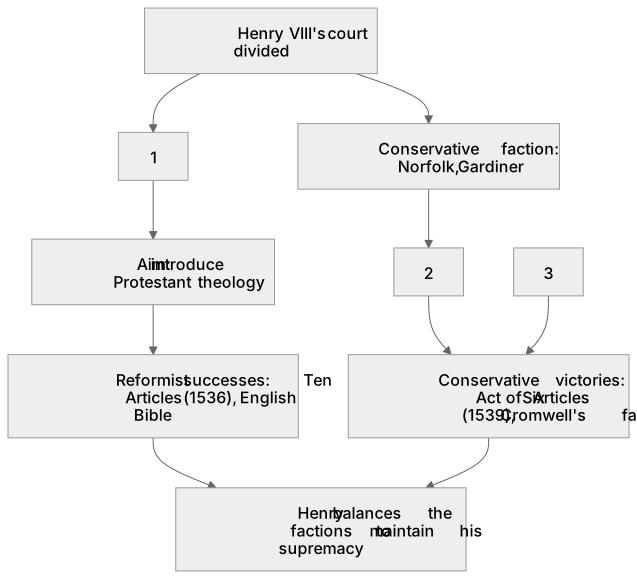
1Box 1
2Box 2
3Box 3
There is more to this lesson
The full lesson goes on to check your understanding and help you earn the marks. Create a free account to carry on, with your progress saved.
A week of Premium from your first lesson · Then the free plan continues · No card, no charge
Test your understanding of 2D Religious conflict and the Church in England, c1529– c1570 – Change and reaction, 1536–1547: The reformist and conservative factions: aims, influence and the reaction of the King; the impact of foreign affairs on changes to the Church
Active recall beats re-reading. Take an instant quiz now to test what you’ve learned and lock it into long-term memory.
A week of Premium from your first lesson · Then the free plan continues · No card, no charge