AQA · A-Level · History
Course version: 7042 · Version from Sept 2017
The doctrinal and political position of the Reformation by 1536: the…
Full specification wording
2D Religious conflict and the Church in England, c1529– c1570 – The break from Rome, c1529–1536: The doctrinal and political position of the Reformation by 1536: the degree of change and continuity in faith, belief and organisation of the Church
By 1536, the English Reformation had altered the political organisation of the Church while leaving much of its traditional faith and belief intact.
Checked against the AQA 7042 specification (opens in a new tab) on .
- Point 4 of 4
- 4 key terms
Study notes
From the checked teaching notes for this specification point.
The idea
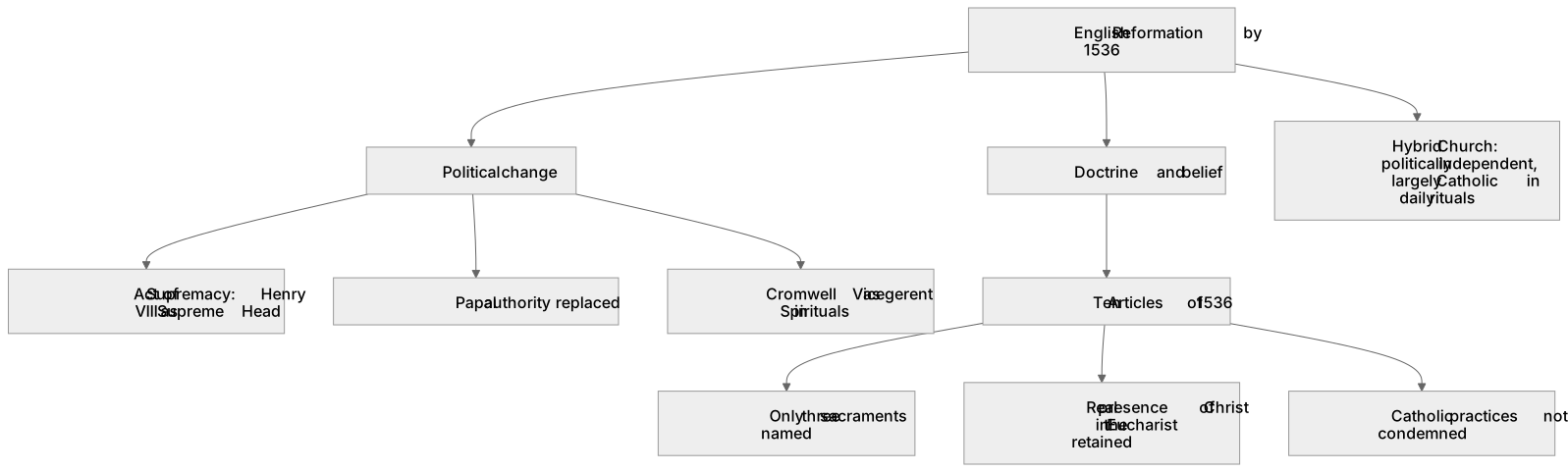
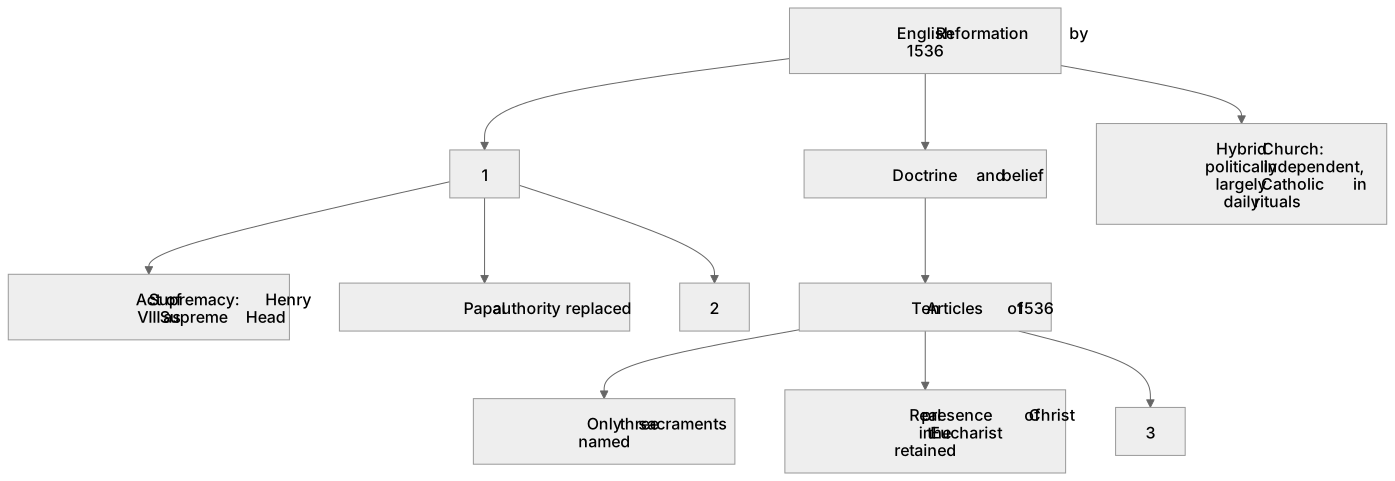
By 1536, the English Reformation had altered the political organisation of the Church while leaving much of its traditional faith and belief intact. Politically, the break from Rome was complete: the Act of Supremacy established Henry VIII as Supreme Head, replacing Papal authority. However, doctrinal change was cautious. The Ten Articles of 1536 showed reformist influence by only naming three sacraments, yet they retained the real presence of Christ in the Eucharist and did not condemn Catholic practices like praying to saints. This created a hybrid Church that was politically independent from Rome but largely Catholic in its daily rituals, reflecting a high degree of continuity in ordinary belief alongside radical structural change.
What earns the marks
- Distinguish between the radical political changes, such as the Royal Supremacy, and the limited doctrinal changes in faith and belief by 1536.
- Evaluate the significance of the Ten Articles of 1536 as a compromise document that omitted four sacraments but retained the Real Presence.
- Assess the structural changes to the organisation of the Church, notably the removal of Papal jurisdiction and the appointment of Cromwell as Vicegerent in Spirituals.
- Analyse the continuity of traditional Catholic practices at the parish level, demonstrating that ordinary belief remained largely unchanged by 1536.
Common mistakes and how to put them right
Stating that England became a fully Protestant country by 1536.
Put it right: Emphasise that while the Church was politically separated from Rome, its doctrine remained predominantly Catholic.
Confusing the Ten Articles of 1536 with later doctrinal settlements like the Six Articles or the Elizabethan Settlement.
Put it right: Specifically link the Ten Articles to the ambiguous, transitional theology of 1536.
Ignoring the distinction between the organisation of the Church and its doctrine.
Put it right: Clearly separate structural changes, like the Act of Supremacy, from theological continuity, like the retention of the Eucharist.
Exam tips
- Use the phrase 'Catholicism without the Pope' to effectively summarise the political and doctrinal position of the Church in 1536.
- When evaluating the degree of change, contrast the top-down political revolution with the continuity of grassroots religious practice.
- Cite the Ten Articles of 1536 as your primary evidence for the ambiguous state of faith and belief at this specific point in time.
Try the lesson
The start of the 2D Religious conflict and the Church in England, c1529– c1570 – The break from Rome, c1529–1536: The doctrinal and political position of the Reformation by 1536: the degree of change and continuity in faith, belief and organisation of the Church lesson, made from checked teaching notes for this specification point.
Have a go first
Which formulary of faith, issued in 1536, outlined the first official doctrinal changes of the English Church by reducing the recognised sacraments from seven to three?
Listen
By 1536, the English Reformation had altered the political organisation of the Church while leaving much of its traditional faith and belief intact. Politically, the break from Rome was complete: the Act of Supremacy established Henry VIII as Supreme Head, replacing Papal authority. However, doctrinal change was cautious. The Ten Articles of 1536 showed reformist influence by only naming three sacraments, yet they retained the real presence of Christ in the Eucharist and did not condemn Catholic practices like praying to saints. This created a hybrid Church that was politically independent from Rome but largely Catholic in its daily rituals, reflecting a high degree of continuity in ordinary belief alongside radical structural change. A strong answer earns marks for these points. Distinguish between the radical political changes, such as the Royal Supremacy, and the limited doctrinal changes in faith and belief by 1536. Evaluate the significance of the Ten Articles of 1536 as a compromise document that omitted four sacraments but retained the Real Presence. Assess the structural changes to the organisation of the Church, notably the removal of Papal jurisdiction and the appointment of Cromwell as Vicegerent in Spirituals. Analyse the continuity of traditional Catholic practices at the parish level, demonstrating that ordinary belief remained largely unchanged by 1536. A common slip: Stating that England became a fully Protestant country by 1536. Instead, Emphasise that while the Church was politically separated from Rome, its doctrine remained predominantly Catholic. Exam tip: Use the phrase 'Catholicism without the Pope' to effectively summarise the political and doctrinal position of the Church in 1536.
See it
Key words
Say what each word means before you turn the card.
Change and Continuity
Try answering aloud or in your head before turning the card.
Doctrine vs Politics
Try answering aloud or in your head before turning the card.
Royal Supremacy
Try answering aloud or in your head before turning the card.
Religious Reform
Try answering aloud or in your head before turning the card.
See every definition
- Change and Continuity
- The balance between alterations and things left intact in faith, belief and organisation of the Church by 1536.
- Doctrine vs Politics
- The distinction between radical political changes, such as the Royal Supremacy, and the limited doctrinal changes in faith and belief by 1536.
- Royal Supremacy
- The Act of Supremacy established Henry VIII as Supreme Head, replacing Papal authority, so the break from Rome was complete.
- Religious Reform
- Doctrinal change was cautious, as the Ten Articles of 1536 showed reformist influence by only naming three sacraments.
Label the diagram
Some boxes have lost their names. Pick the right name for each number.
1Box 1
2Box 2
3Box 3
There is more to this lesson
The full lesson goes on to check your understanding and help you earn the marks. Create a free account to carry on, with your progress saved.
A week of Premium from your first lesson · Then the free plan continues · No card, no charge
Test your understanding of 2D Religious conflict and the Church in England, c1529– c1570 – The break from Rome, c1529–1536: The doctrinal and political position of the Reformation by 1536: the degree of change and continuity in faith, belief and organisation of the Church
Active recall beats re-reading. Take an instant quiz now to test what you’ve learned and lock it into long-term memory.
A week of Premium from your first lesson · Then the free plan continues · No card, no charge