AQA · A-Level · History
Course version: 7042 · Version from Sept 2017
The influence of faction: Cromwell and the management of Parliament; the…
Full specification wording
2D Religious conflict and the Church in England, c1529– c1570 – The break from Rome, c1529–1536: The influence of faction: Cromwell and the management of Parliament; the supporters and opponents of change and the King’s responses; the Aragonese faction; More and Fisher; Elizabeth Barton and the Carthusian monks
Factional politics dominated Henry VIII's court.
Checked against the AQA 7042 specification (opens in a new tab) on .
- Point 3 of 4
- 4 key terms
Study notes
From the checked teaching notes for this specification point.
The idea
Factional politics dominated Henry VIII's court. Thomas Cromwell expertly managed Parliament, drafting legislation to secure the Royal Supremacy and outmanoeuvre conservative opponents. Supporters of change were rewarded, while Henry responded ruthlessly to resistance. The Aragonese faction, loyal to Catherine, was marginalised. High-profile opponents faced execution: Thomas More and Bishop John Fisher were executed for denying the Royal Supremacy, while Elizabeth Barton prophesied against the King's marriage and was hanged. The Carthusian monks, refusing to accept the Royal Supremacy, were brutally martyred. This highlights Henry's zero-tolerance policy towards opposition, regardless of social or spiritual standing.
What earns the marks
- Evaluate Cromwell's skill in using anti-clericalism in the Reformation Parliament to pass key legislation like the Treason Act.
- Assess the composition and aims of the Aragonese faction, noting their support for Catherine of Aragon and traditional religion.
- Analyse the specific reasons for the executions of More and Fisher, focusing on their denial of the Royal Supremacy.
- Explain the threat posed by Elizabeth Barton's prophecies and the Carthusian monks' spiritual prestige, and how Henry's harsh responses aimed to deter wider rebellion.
Common mistakes and how to put them right
Confusing the reasons for Thomas More's execution with those of Thomas Cromwell.
Put it right: Ensure you state More was executed for denying the Royal Supremacy in 1535, whereas Cromwell fell from power later in 1540.
Assuming the Aragonese faction was a formal political party.
Put it right: Describe them as a loose network of courtiers and nobles united by their sympathy for Catherine of Aragon and traditional Catholicism.
Claiming Parliament forced the break from Rome on the King.
Put it right: Emphasise that Cromwell managed Parliament to enact the King's will and give legal weight to the Royal Supremacy.
Exam tips
- When discussing opposition, contrast the intellectual resistance of More and Fisher with the popular and spiritual threat of Elizabeth Barton.
- Use the Treason Act of 1534 to demonstrate how Cromwell and Henry legally managed and suppressed opposition.
- Link the destruction of the Aragonese faction to the wider factional battle between conservative and reformist groups at court.
Try the lesson
The start of the 2D Religious conflict and the Church in England, c1529– c1570 – The break from Rome, c1529–1536: The influence of faction: Cromwell and the management of Parliament; the supporters and opponents of change and the King’s responses; the Aragonese faction; More and Fisher; Elizabeth Barton and the Carthusian monks lesson, made from checked teaching notes for this specification point.
Have a go first
How did Elizabeth Barton, the Nun of Kent, demonstrate her opposition to Henry VIII's religious changes before her execution in 1534?
Listen
Factional politics dominated Henry VIII's court. Thomas Cromwell expertly managed Parliament, drafting legislation to secure the Royal Supremacy and outmanoeuvre conservative opponents. Supporters of change were rewarded, while Henry responded ruthlessly to resistance. The Aragonese faction, loyal to Catherine, was marginalised. High-profile opponents faced execution: Thomas More and Bishop John Fisher were executed for denying the Royal Supremacy, while Elizabeth Barton prophesied against the King's marriage and was hanged. The Carthusian monks, refusing to accept the Royal Supremacy, were brutally martyred. This highlights Henry's zero-tolerance policy towards opposition, regardless of social or spiritual standing. A strong answer earns marks for these points. Evaluate Cromwell's skill in using anti-clericalism in the Reformation Parliament to pass key legislation like the Treason Act. Assess the composition and aims of the Aragonese faction, noting their support for Catherine of Aragon and traditional religion. Analyse the specific reasons for the executions of More and Fisher, focusing on their denial of the Royal Supremacy. Explain the threat posed by Elizabeth Barton's prophecies and the Carthusian monks' spiritual prestige, and how Henry's harsh responses aimed to deter wider rebellion. A common slip: Confusing the reasons for Thomas More's execution with those of Thomas Cromwell. Instead, Ensure you state More was executed for denying the Royal Supremacy in 1535, whereas Cromwell fell from power later in 1540. Exam tip: When discussing opposition, contrast the intellectual resistance of More and Fisher with the popular and spiritual threat of Elizabeth Barton.
See it
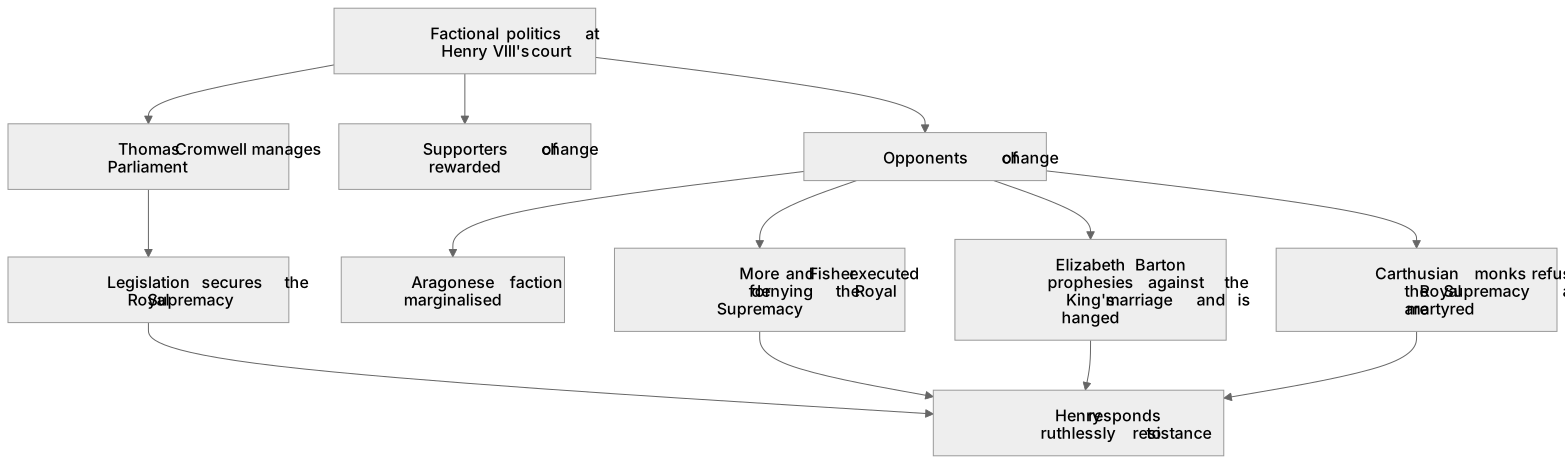
Key words
Say what each word means before you turn the card.
Factionalism
Try answering aloud or in your head before turning the card.
Royal Supremacy
Try answering aloud or in your head before turning the card.
Opposition and Resistance
Try answering aloud or in your head before turning the card.
Parliamentary Power
Try answering aloud or in your head before turning the card.
See every definition
- Factionalism
- Factional politics dominated Henry VIII's court, with conservative and reformist groups competing.
- Royal Supremacy
- Cromwell drafted legislation to secure this and outmanoeuvre conservative opponents; More and Fisher were executed for denying it.
- Opposition and Resistance
- Henry responded ruthlessly to resistance, showing a zero-tolerance policy towards opposition regardless of social or spiritual standing.
- Parliamentary Power
- Cromwell expertly managed Parliament, drafting legislation to enact the King's will and give legal weight to the Royal Supremacy.
Label the diagram
Some boxes have lost their names. Pick the right name for each number.
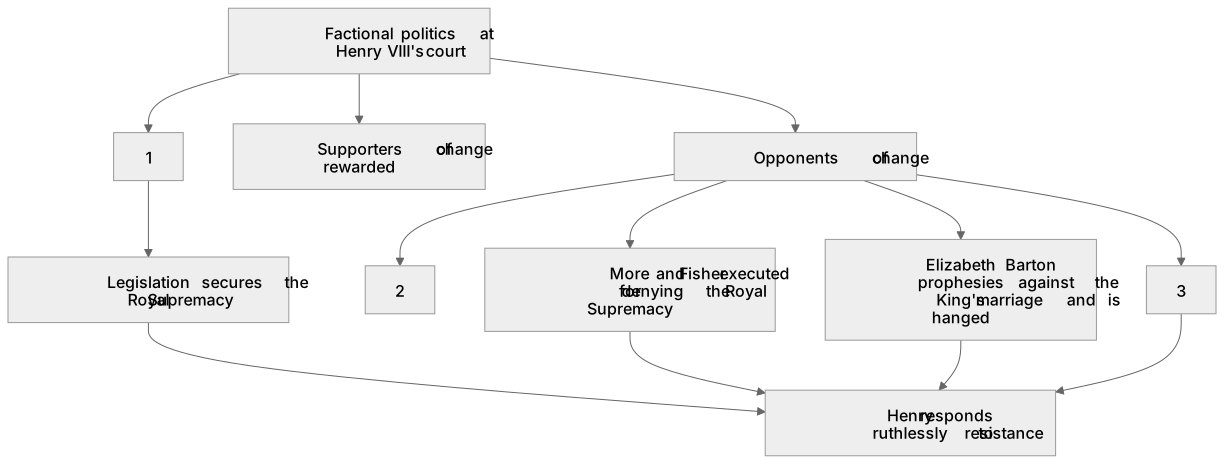
1Box 1
2Box 2
3Box 3
There is more to this lesson
The full lesson goes on to check your understanding and help you earn the marks. Create a free account to carry on, with your progress saved.
A week of Premium from your first lesson · Then the free plan continues · No card, no charge
Test your understanding of 2D Religious conflict and the Church in England, c1529– c1570 – The break from Rome, c1529–1536: The influence of faction: Cromwell and the management of Parliament; the supporters and opponents of change and the King’s responses; the Aragonese faction; More and Fisher; Elizabeth Barton and the Carthusian monks
Active recall beats re-reading. Take an instant quiz now to test what you’ve learned and lock it into long-term memory.
A week of Premium from your first lesson · Then the free plan continues · No card, no charge