AQA · A-Level · History
Course version: 7042 · Version from Sept 2017
The political and social role of the Church: churchmen as royal advisers;…
Full specification wording
2D Religious conflict and the Church in England, c1529– c1570 – The Church in c1529: The political and social role of the Church: churchmen as royal advisers; church teachings on monarchical authority; wealth; church courts; monasteries and parish churches
In c1529, the Catholic Church was deeply embedded in English political and social life.
Checked against the AQA 7042 specification (opens in a new tab) on .
- Point 1 of 4
- 4 key terms
Study notes
From the checked teaching notes for this specification point.
The idea
In c1529, the Catholic Church was deeply embedded in English political and social life. Senior churchmen, such as Cardinal Wolsey, frequently served as royal advisers, dominating government administration. The Church reinforced monarchical authority by teaching that the King ruled by divine right, demanding obedience from subjects. Economically, the Church possessed immense wealth, owning roughly one-third of English land. It operated its own legal system through church courts, which judged moral offences and probate. Socially, monasteries provided vital charity, education, and employment, while parish churches formed the focal point of village life, marking the agricultural calendar and life cycle events.
What earns the marks
- Explain the dual role of senior clerics, such as Cardinal Wolsey, who held both high ecclesiastical office and key state positions like Lord Chancellor.
- Analyse how Church teachings, particularly the Great Chain of Being, legitimised Tudor monarchical authority and discouraged rebellion.
- Evaluate the economic power of the Church, noting its vast landholdings and the collection of tithes which underpinned its wealth.
- Assess the jurisdiction of church courts in regulating social behaviour, handling cases like marriage, wills, and moral transgressions.
- Describe the social functions of monasteries in providing almsgiving and healthcare, and parish churches in hosting community gatherings and festivals.
Common mistakes and how to put them right
Assuming the Church and State were entirely separate entities.
Put it right: In reality, they were deeply intertwined, with clerics running much of the royal administration.
Overstating the unpopularity of church courts.
Put it right: While sometimes criticised for fees, they were widely used and accepted by the laity for resolving local disputes.
Viewing monasteries solely as religious retreats.
Put it right by acknowledging their crucial socio-economic roles as major landowners, employers, and providers of poor relief.
Exam tips
- Use Cardinal Wolsey as a prime example of how political and ecclesiastical power were fused before the Reformation.
- When discussing the Church's wealth, link it to the Crown's later financial motivations for the dissolution of the monasteries.
- Contrast the political influence of the higher clergy with the social importance of the parish priest to provide a balanced view of the Church's role.
Try the lesson
The start of the 2D Religious conflict and the Church in England, c1529– c1570 – The Church in c1529: The political and social role of the Church: churchmen as royal advisers; church teachings on monarchical authority; wealth; church courts; monasteries and parish churches lesson, made from checked teaching notes for this specification point.
Have a go first
In c1529, which of the following best describes the political role of senior churchmen in the English government?
Listen
In c1529, the Catholic Church was deeply embedded in English political and social life. Senior churchmen, such as Cardinal Wolsey, frequently served as royal advisers, dominating government administration. The Church reinforced monarchical authority by teaching that the King ruled by divine right, demanding obedience from subjects. Economically, the Church possessed immense wealth, owning roughly one-third of English land. It operated its own legal system through church courts, which judged moral offences and probate. Socially, monasteries provided vital charity, education, and employment, while parish churches formed the focal point of village life, marking the agricultural calendar and life cycle events. A strong answer earns marks for these points. Explain the dual role of senior clerics, such as Cardinal Wolsey, who held both high ecclesiastical office and key state positions like Lord Chancellor. Analyse how Church teachings, particularly the Great Chain of Being, legitimised Tudor monarchical authority and discouraged rebellion. Evaluate the economic power of the Church, noting its vast landholdings and the collection of tithes which underpinned its wealth. Assess the jurisdiction of church courts in regulating social behaviour, handling cases like marriage, wills, and moral transgressions. A common slip: Viewing monasteries solely as religious retreats. Instead, acknowledging their crucial socio-economic roles as major landowners, employers, and providers of poor relief. Exam tip: Use Cardinal Wolsey as a prime example of how political and ecclesiastical power were fused before the Reformation.
See it

Key words
Say what each word means before you turn the card.
Church and State relations
Try answering aloud or in your head before turning the card.
Social control and authority
Try answering aloud or in your head before turning the card.
Economic power of religious institutions
Try answering aloud or in your head before turning the card.
Community and everyday life
Try answering aloud or in your head before turning the card.
See every definition
- Church and State relations
- Senior churchmen frequently served as royal advisers, dominating government administration, so the Church and State were deeply intertwined rather than separate.
- Social control and authority
- The Church reinforced monarchical authority by teaching that the King ruled by divine right and demanding obedience from subjects.
- Economic power of religious institutions
- The Church possessed immense wealth, owning roughly one-third of English land.
- Community and everyday life
- Monasteries provided vital charity, education and employment, while parish churches formed the focal point of village life, marking the agricultural calendar and life cycle events.
Label the diagram
Some boxes have lost their names. Pick the right name for each number.
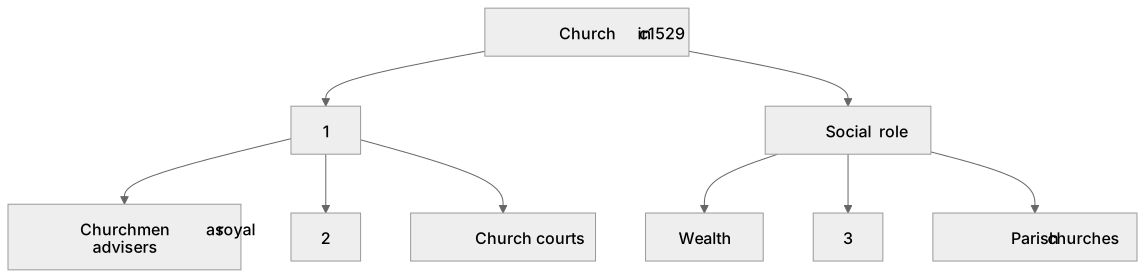
1Box 1
2Box 2
3Box 3
There is more to this lesson
The full lesson goes on to check your understanding and help you earn the marks. Create a free account to carry on, with your progress saved.
A week of Premium from your first lesson · Then the free plan continues · No card, no charge
Test your understanding of 2D Religious conflict and the Church in England, c1529– c1570 – The Church in c1529: The political and social role of the Church: churchmen as royal advisers; church teachings on monarchical authority; wealth; church courts; monasteries and parish churches
Active recall beats re-reading. Take an instant quiz now to test what you’ve learned and lock it into long-term memory.
A week of Premium from your first lesson · Then the free plan continues · No card, no charge