AQA · A-Level · History
Course version: 7042 · Version from Sept 2017
Popular piety and the Church’s spiritual role: lay religious guilds; key…
Full specification wording
2D Religious conflict and the Church in England, c1529– c1570 – The Church in c1529: Popular piety and the Church’s spiritual role: lay religious guilds; key beliefs such as purgatory; the role of the priesthood; the importance of printing
In c1529, popular piety remained robust, driven by the Church's central spiritual role in securing salvation.
Checked against the AQA 7042 specification (opens in a new tab) on .
- Point 2 of 4
- 4 key terms
Study notes
From the checked teaching notes for this specification point.
The idea
In c1529, popular piety remained robust, driven by the Church's central spiritual role in securing salvation. A key belief was purgatory, where souls faced purification before entering heaven. To minimise this time, the laity invested heavily in chantry chapels and joined lay religious guilds, which funded prayers for deceased members and maintained local altars. The priesthood was vital, as only ordained priests could perform the sacraments, notably the Eucharist, essential for grace. Furthermore, the advent of printing amplified religious engagement; while it later spread reformist ideas, early printing predominantly produced traditional Catholic literature, primers, and indulgences, reinforcing orthodox piety.
What earns the marks
- Explain the concept of purgatory and how it drove lay financial investment in the Church through chantries and indulgences.
- Analyse the function of lay religious guilds in fostering community cohesion, providing charitable relief, and ensuring prayers for the dead.
- Evaluate the indispensable role of the priesthood in administering the seven sacraments, particularly the miracle of transubstantiation during Mass.
- Assess the impact of the printing press on popular piety, noting its role in mass-producing traditional devotional works like the Sarum Primer.
- Demonstrate how high levels of church building and donations in the 1520s indicate strong, continuing support for traditional Catholic practices.
Common mistakes and how to put them right
Assuming the printing press only spread Protestant ideas.
Put it right by noting that early English printing heavily supported traditional Catholic piety and devotional literature.
Underestimating the popularity of the traditional Church.
Put it right by citing the widespread participation in lay guilds and financial bequests in wills.
Confusing the role of a priest with a modern minister.
Put it right: Emphasise that pre-Reformation priests were viewed as essential mediators who alone could perform saving sacraments.
Exam tips
- Use evidence from wills and testaments to demonstrate the enduring belief in purgatory and the desire to fund prayers for the soul.
- Discuss lay religious guilds to show that ordinary people were active participants in their faith, not just passive recipients of Church teaching.
- When evaluating the state of the Church in 1529, contrast the vibrant popular piety with the later, top-down nature of the Henrician Reformation.
Try the lesson
The start of the 2D Religious conflict and the Church in England, c1529– c1570 – The Church in c1529: Popular piety and the Church’s spiritual role: lay religious guilds; key beliefs such as purgatory; the role of the priesthood; the importance of printing lesson, made from checked teaching notes for this specification point.
Have a go first
In the context of popular piety in c1529, what was the primary purpose of the Catholic belief in purgatory?
Listen
In c1529, popular piety remained robust, driven by the Church's central spiritual role in securing salvation. A key belief was purgatory, where souls faced purification before entering heaven. To minimise this time, the laity invested heavily in chantry chapels and joined lay religious guilds, which funded prayers for deceased members and maintained local altars. The priesthood was vital, as only ordained priests could perform the sacraments, notably the Eucharist, essential for grace. Furthermore, the advent of printing amplified religious engagement; while it later spread reformist ideas, early printing predominantly produced traditional Catholic literature, primers, and indulgences, reinforcing orthodox piety. A strong answer earns marks for these points. Explain the concept of purgatory and how it drove lay financial investment in the Church through chantries and indulgences. Analyse the function of lay religious guilds in fostering community cohesion, providing charitable relief, and ensuring prayers for the dead. Evaluate the indispensable role of the priesthood in administering the seven sacraments, particularly the miracle of transubstantiation during Mass. Assess the impact of the printing press on popular piety, noting its role in mass-producing traditional devotional works like the Sarum Primer. A common slip: Assuming the printing press only spread Protestant ideas. Instead, noting that early English printing heavily supported traditional Catholic piety and devotional literature. Exam tip: Use evidence from wills and testaments to demonstrate the enduring belief in purgatory and the desire to fund prayers for the soul.
See it
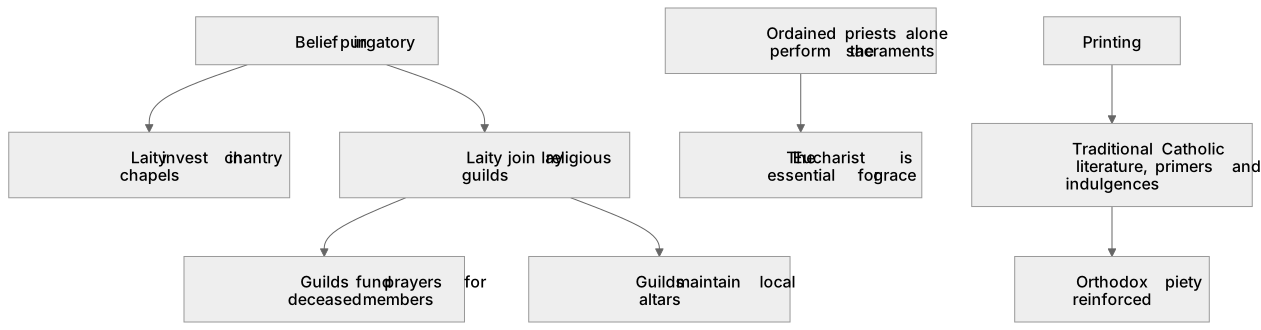
Key words
Say what each word means before you turn the card.
Popular religion and piety
Try answering aloud or in your head before turning the card.
The theology of salvation
Try answering aloud or in your head before turning the card.
Technological change and communication
Try answering aloud or in your head before turning the card.
Community and collective worship
Try answering aloud or in your head before turning the card.
See every definition
- Popular religion and piety
- Lay devotion driven by the Church's central spiritual role in securing salvation, expressed through chantry chapels and lay religious guilds.
- The theology of salvation
- A key belief was purgatory, where souls faced purification before entering heaven, and the laity invested heavily to minimise this time.
- Technological change and communication
- The advent of printing amplified religious engagement, with early printing predominantly producing traditional Catholic literature, primers and indulgences.
- Community and collective worship
- Lay religious guilds funded prayers for deceased members and maintained local altars, while the priesthood was vital as only ordained priests could perform the sacraments.
Label the diagram
Some boxes have lost their names. Pick the right name for each number.
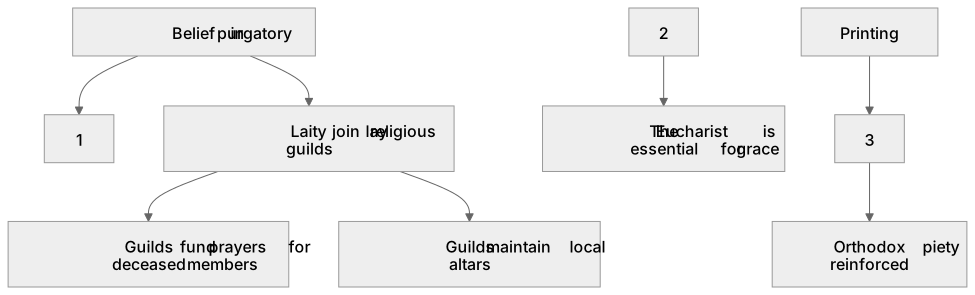
1Box 1
2Box 2
3Box 3
There is more to this lesson
The full lesson goes on to check your understanding and help you earn the marks. Create a free account to carry on, with your progress saved.
A week of Premium from your first lesson · Then the free plan continues · No card, no charge
Test your understanding of 2D Religious conflict and the Church in England, c1529– c1570 – The Church in c1529: Popular piety and the Church’s spiritual role: lay religious guilds; key beliefs such as purgatory; the role of the priesthood; the importance of printing
Active recall beats re-reading. Take an instant quiz now to test what you’ve learned and lock it into long-term memory.
A week of Premium from your first lesson · Then the free plan continues · No card, no charge