AQA · A-Level · History
Course version: 7042 · Version from Sept 2017
Religious divisions on Elizabeth’s accession: Catholics; Protestant…
Full specification wording
2D Religious conflict and the Church in England, c1529– c1570 – The establishment of the Church of England, 1558–c1570 (A-level only): Religious divisions on Elizabeth’s accession: Catholics; Protestant émigrés; divisions within those who supported the restoration of a Protestant Church; peace with France
Upon Elizabeth I’s accession in 1558, England was fractured by religious divisions.
Checked against the AQA 7042 specification (opens in a new tab) on .
- Point 1 of 4
- 4 key terms
Study notes
From the checked teaching notes for this specification point.
The idea
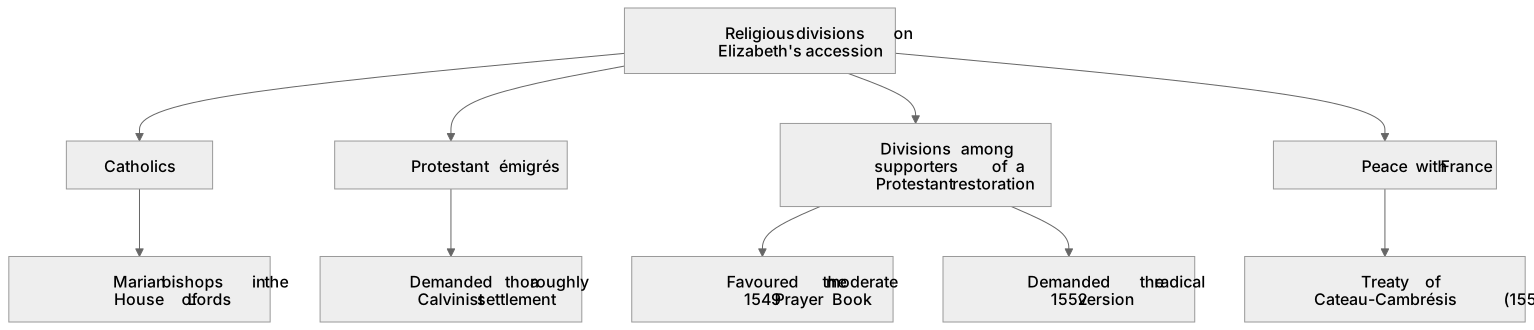
Upon Elizabeth I’s accession in 1558, England was fractured by religious divisions. The Catholic majority, bolstered by Marian bishops in the House of Lords, desired continued allegiance to Rome. Conversely, returning Protestant émigrés, who had fled to radical centres like Geneva, demanded a thoroughly Calvinist settlement. However, divisions existed even among those supporting a Protestant restoration; some favoured the moderate 1549 Prayer Book, while others demanded the radical 1552 version. These domestic tensions were complicated by the need to secure peace with Catholic France. The Treaty of Cateau-Cambrésis (1559) required Elizabeth to tread carefully to avoid provoking a Franco-Scottish Catholic alliance against her fragile regime.
What earns the marks
- Assess the strength of Catholic opposition, particularly the Marian bishops in the House of Lords who initially blocked Protestant legislation.
- Evaluate the influence of returning Marian exiles (Protestant émigrés) who expected a radical Calvinist church model based on their experiences in Geneva and Frankfurt.
- Analyse the internal Protestant divisions, specifically the debate between adopting the moderate 1549 Book of Common Prayer versus the more radical 1552 version.
- Explain how the ongoing war with France and the subsequent Treaty of Cateau-Cambrésis (1559) constrained Elizabeth's early religious policies to avoid provoking Catholic powers.
Common mistakes and how to put them right
Assuming all Protestants wanted the same settlement.
Put it right: Distinguish between moderate Protestants who accepted a compromise and radical returning émigrés who wanted a Calvinist church.
Ignoring the foreign policy context of the religious settlement.
Put it right: Explicitly link the timing of the religious settlement to the conclusion of peace with France at Cateau-Cambrésis.
Overestimating the immediate decline of Catholicism.
Put it right: Acknowledge that Catholics remained a significant majority in the country and held powerful positions in the House of Lords in 1558.
Exam tips
- Link domestic religious divisions directly to foreign policy concerns, showing how peace with France dictated the timing of Elizabeth's religious changes.
- Use specific examples of Protestant divisions, such as the Coxian and Knoxian factions among the Frankfurt exiles, to demonstrate depth of knowledge.
- When evaluating the threat posed by Catholics, differentiate between the conservative laity and the highly vocal Marian bishops in Parliament.
Try the lesson
The start of the 2D Religious conflict and the Church in England, c1529– c1570 – The establishment of the Church of England, 1558–c1570 (A-level only): Religious divisions on Elizabeth’s accession: Catholics; Protestant émigrés; divisions within those who supported the restoration of a Protestant Church; peace with France lesson, made from checked teaching notes for this specification point.
Have a go first
Which group of religious exiles returned to England upon Elizabeth I's accession in 1558, expecting a radical reform of the Church?
Listen
Upon Elizabeth I’s accession in 1558, England was fractured by religious divisions. The Catholic majority, bolstered by Marian bishops in the House of Lords, desired continued allegiance to Rome. Conversely, returning Protestant émigrés, who had fled to radical centres like Geneva, demanded a thoroughly Calvinist settlement. However, divisions existed even among those supporting a Protestant restoration; some favoured the moderate 1549 Prayer Book, while others demanded the radical 1552 version. These domestic tensions were complicated by the need to secure peace with Catholic France. The Treaty of Cateau-Cambrésis (1559) required Elizabeth to tread carefully to avoid provoking a Franco-Scottish Catholic alliance against her fragile regime. A strong answer earns marks for these points. Assess the strength of Catholic opposition, particularly the Marian bishops in the House of Lords who initially blocked Protestant legislation. Evaluate the influence of returning Marian exiles (Protestant émigrés) who expected a radical Calvinist church model based on their experiences in Geneva and Frankfurt. Analyse the internal Protestant divisions, specifically the debate between adopting the moderate 1549 Book of Common Prayer versus the more radical 1552 version. Explain how the ongoing war with France and the subsequent Treaty of Cateau-Cambrésis (1559) constrained Elizabeth's early religious policies to avoid provoking Catholic powers. A common slip: Assuming all Protestants wanted the same settlement. Instead, distinguish between moderate Protestants who accepted a compromise and radical returning émigrés who wanted a Calvinist church. Exam tip: Link domestic religious divisions directly to foreign policy concerns, showing how peace with France dictated the timing of Elizabeth's religious changes.
See it
Key words
Say what each word means before you turn the card.
Religious conflict and compromise
Try answering aloud or in your head before turning the card.
The impact of foreign policy on domestic affairs
Try answering aloud or in your head before turning the card.
Radicalism vs. moderation
Try answering aloud or in your head before turning the card.
Parliamentary opposition
Try answering aloud or in your head before turning the card.
See every definition
- Religious conflict and compromise
- England was fractured by religious divisions on Elizabeth's accession, with Catholics, returning Protestant émigrés and divided supporters of a Protestant restoration pulling in different directions.
- The impact of foreign policy on domestic affairs
- Domestic tensions were complicated by the need to secure peace with Catholic France, requiring Elizabeth to tread carefully to avoid provoking a Franco-Scottish Catholic alliance.
- Radicalism vs. moderation
- Divisions existed even among those supporting a Protestant restoration, with some favouring the moderate 1549 Prayer Book while others demanded the radical 1552 version.
- Parliamentary opposition
- The Catholic majority, bolstered by Marian bishops in the House of Lords, desired continued allegiance to Rome and initially blocked Protestant legislation.
Label the diagram
Some boxes have lost their names. Pick the right name for each number.
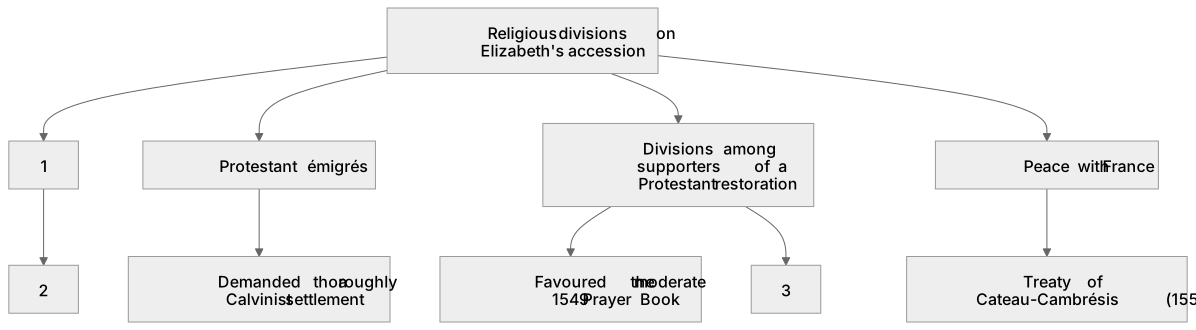
1Box 1
2Box 2
3Box 3
There is more to this lesson
The full lesson goes on to check your understanding and help you earn the marks. Create a free account to carry on, with your progress saved.
A week of Premium from your first lesson · Then the free plan continues · No card, no charge
Test your understanding of 2D Religious conflict and the Church in England, c1529– c1570 – The establishment of the Church of England, 1558–c1570 (A-level only): Religious divisions on Elizabeth’s accession: Catholics; Protestant émigrés; divisions within those who supported the restoration of a Protestant Church; peace with France
Active recall beats re-reading. Take an instant quiz now to test what you’ve learned and lock it into long-term memory.
A week of Premium from your first lesson · Then the free plan continues · No card, no charge