AQA · A-Level · History
Course version: 7042 · Version from Sept 2017
The re-establishment of the Church of England: Elizabeth’s religious…
Full specification wording
2D Religious conflict and the Church in England, c1529– c1570 – The establishment of the Church of England, 1558–c1570 (A-level only): The re-establishment of the Church of England: Elizabeth’s religious beliefs and aims; attempts to reconcile the conflicting groups; the role of Parliament and the passing of the Acts of Supremacy; uniformity and the new Book of Common Prayer
The 1559 Religious Settlement re-established the Church of England, reflecting Elizabeth I’s personal Protestant beliefs and her political aim to achieve stability.
Checked against the AQA 7042 specification (opens in a new tab) on .
- Point 2 of 4
- 2 key terms
Study notes
From the checked teaching notes for this specification point.
The idea
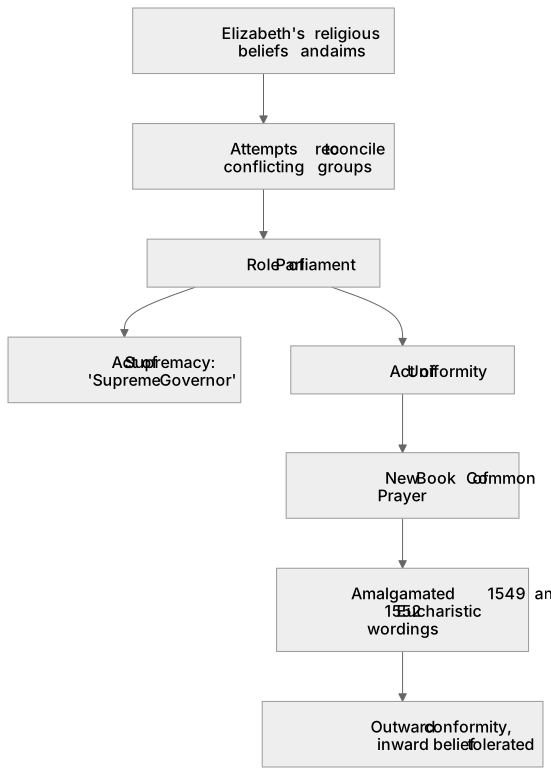
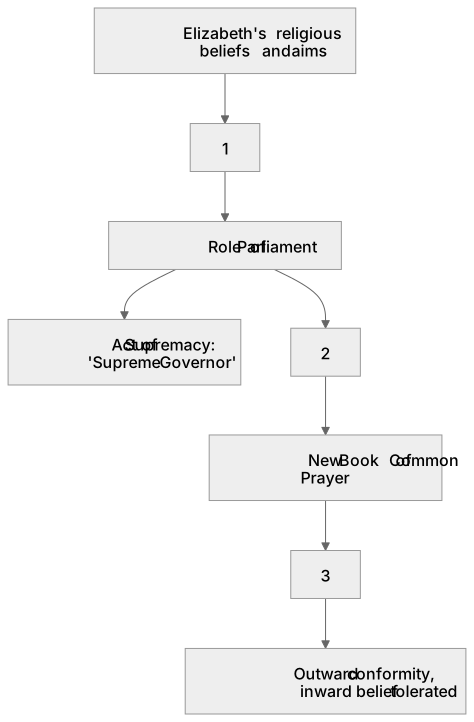
The 1559 Religious Settlement re-established the Church of England, reflecting Elizabeth I’s personal Protestant beliefs and her political aim to achieve stability. To reconcile conflicting groups, the settlement offered a 'via media' (middle way). The role of Parliament was crucial; after initial resistance from the Catholic House of Lords, the Act of Supremacy was passed, naming Elizabeth 'Supreme Governor' rather than 'Supreme Head' to appease both Catholics and misogynistic Protestants. Concurrently, the Act of Uniformity enforced a new Book of Common Prayer. This book cleverly amalgamated the moderate 1549 and radical 1552 wordings of the Eucharist, allowing both Catholic transubstantiation and Protestant memorialism interpretations, thereby enforcing outward conformity while tolerating inward belief.
What earns the marks
- Analyse Elizabeth's personal religious beliefs, noting her preference for Protestant theology combined with a liking for traditional, ornate church ceremony.
- Evaluate the strategic use of the title 'Supreme Governor' in the Act of Supremacy to bypass Catholic objections to a lay head and Protestant objections to a female head of the Church.
- Assess the role of Parliament, specifically the resistance of the Marian bishops in the Lords and Elizabeth's use of the Disputation of Westminster to overcome them.
- Explain how the 1559 Book of Common Prayer attempted to reconcile conflicting groups by combining the 1549 and 1552 Eucharistic declarations.
- Examine the Act of Uniformity's enforcement mechanisms, such as the one-shilling fine for recusancy, aimed at securing outward compliance rather than creating martyrs.
Common mistakes and how to put them right
Stating Elizabeth was named 'Supreme Head' of the Church.
Put it right: Specify that the Act of Supremacy named her 'Supreme Governor' to appease critics.
Claiming the settlement was entirely Protestant with no concessions.
Put it right: Highlight the Catholic concessions, such as the retention of vestments and the ambiguous Eucharistic wording in the Prayer Book.
Assuming Parliament easily passed the settlement.
Put it right: Detail the significant opposition from the Catholic House of Lords that forced Elizabeth to prorogue Parliament and arrest two bishops.
Exam tips
- Use the term 'via media' to describe Elizabeth's aims, but critically evaluate whether it was a true middle way or a Protestant settlement with Catholic ornaments.
- Detail the specific compromises in the 1559 Book of Common Prayer, particularly the wording of the communion, to demonstrate precise knowledge of the Act of Uniformity.
- Discuss the role of the 'Puritan Choir' thesis (Neale) versus revisionist views (Jones) when analysing parliamentary opposition to the settlement.
Try the lesson
The start of the 2D Religious conflict and the Church in England, c1529– c1570 – The establishment of the Church of England, 1558–c1570 (A-level only): The re-establishment of the Church of England: Elizabeth’s religious beliefs and aims; attempts to reconcile the conflicting groups; the role of Parliament and the passing of the Acts of Supremacy; uniformity and the new Book of Common Prayer lesson, made from checked teaching notes for this specification point.
Have a go first
Which legislative acts passed by Parliament in 1559 formed the foundation of Elizabeth I's re-establishment of the Church of England?
Listen
The 1559 Religious Settlement re-established the Church of England, reflecting Elizabeth I’s personal Protestant beliefs and her political aim to achieve stability. To reconcile conflicting groups, the settlement offered a 'via media' (middle way). The role of Parliament was crucial; after initial resistance from the Catholic House of Lords, the Act of Supremacy was passed, naming Elizabeth 'Supreme Governor' rather than 'Supreme Head' to appease both Catholics and misogynistic Protestants. Concurrently, the Act of Uniformity enforced a new Book of Common Prayer. This book cleverly amalgamated the moderate 1549 and radical 1552 wordings of the Eucharist, allowing both Catholic transubstantiation and Protestant memorialism interpretations, thereby enforcing outward conformity while tolerating inward belief. A strong answer earns marks for these points. Analyse Elizabeth's personal religious beliefs, noting her preference for Protestant theology combined with a liking for traditional, ornate church ceremony. Evaluate the strategic use of the title 'Supreme Governor' in the Act of Supremacy to bypass Catholic objections to a lay head and Protestant objections to a female head of the Church. Assess the role of Parliament, specifically the resistance of the Marian bishops in the Lords and Elizabeth's use of the Disputation of Westminster to overcome them. Explain how the 1559 Book of Common Prayer attempted to reconcile conflicting groups by combining the 1549 and 1552 Eucharistic declarations. A common slip: Stating Elizabeth was named 'Supreme Head' of the Church. Instead, specify that the Act of Supremacy named her 'Supreme Governor' to appease critics. Exam tip: Use the term 'via media' to describe Elizabeth's aims, but critically evaluate whether it was a true middle way or a Protestant settlement with Catholic ornaments.
See it
Put the events in order
Put these events in the order they happened, earliest first.
- 1. Moderate wording of the Eucharist in the Prayer Book
- 2. Religious Settlement re-established the Church of England
- 3. Radical wording of the Eucharist in the Prayer Book
Key words
Say what each word means before you turn the card.
The Elizabethan Religious Settlement
Try answering aloud or in your head before turning the card.
The 'Via Media' (Middle Way)
Try answering aloud or in your head before turning the card.
See every definition
- The Elizabethan Religious Settlement
- The 1559 Religious Settlement re-established the Church of England, reflecting Elizabeth I's personal Protestant beliefs and her political aim to achieve stability.
- The 'Via Media' (Middle Way)
- An approach offered by the settlement to reconcile conflicting groups.
Label the diagram
Some boxes have lost their names. Pick the right name for each number.
1Box 1
2Box 2
3Box 3
There is more to this lesson
The full lesson goes on to check your understanding and help you earn the marks. Create a free account to carry on, with your progress saved.
A week of Premium from your first lesson · Then the free plan continues · No card, no charge
Test your understanding of 2D Religious conflict and the Church in England, c1529– c1570 – The establishment of the Church of England, 1558–c1570 (A-level only): The re-establishment of the Church of England: Elizabeth’s religious beliefs and aims; attempts to reconcile the conflicting groups; the role of Parliament and the passing of the Acts of Supremacy; uniformity and the new Book of Common Prayer
Active recall beats re-reading. Take an instant quiz now to test what you’ve learned and lock it into long-term memory.
A week of Premium from your first lesson · Then the free plan continues · No card, no charge