AQA · A-Level · History
Course version: 7042 · Version from Sept 2017
Supporters and opponents of the Settlement: consolidation of the…
Full specification wording
2D Religious conflict and the Church in England, c1529– c1570 – The establishment of the Church of England, 1558–c1570 (A-level only): Supporters and opponents of the Settlement: consolidation of the Settlement through Visitations; the Vestiarian Controversy; the acquiescence of Catholics
Elizabeth I’s 1559 Religious Settlement faced immediate scrutiny from both supporters and opponents.
Checked against the AQA 7042 specification (opens in a new tab) on .
- Point 3 of 4
- 3 key terms
Study notes
From the checked teaching notes for this specification point.
The idea
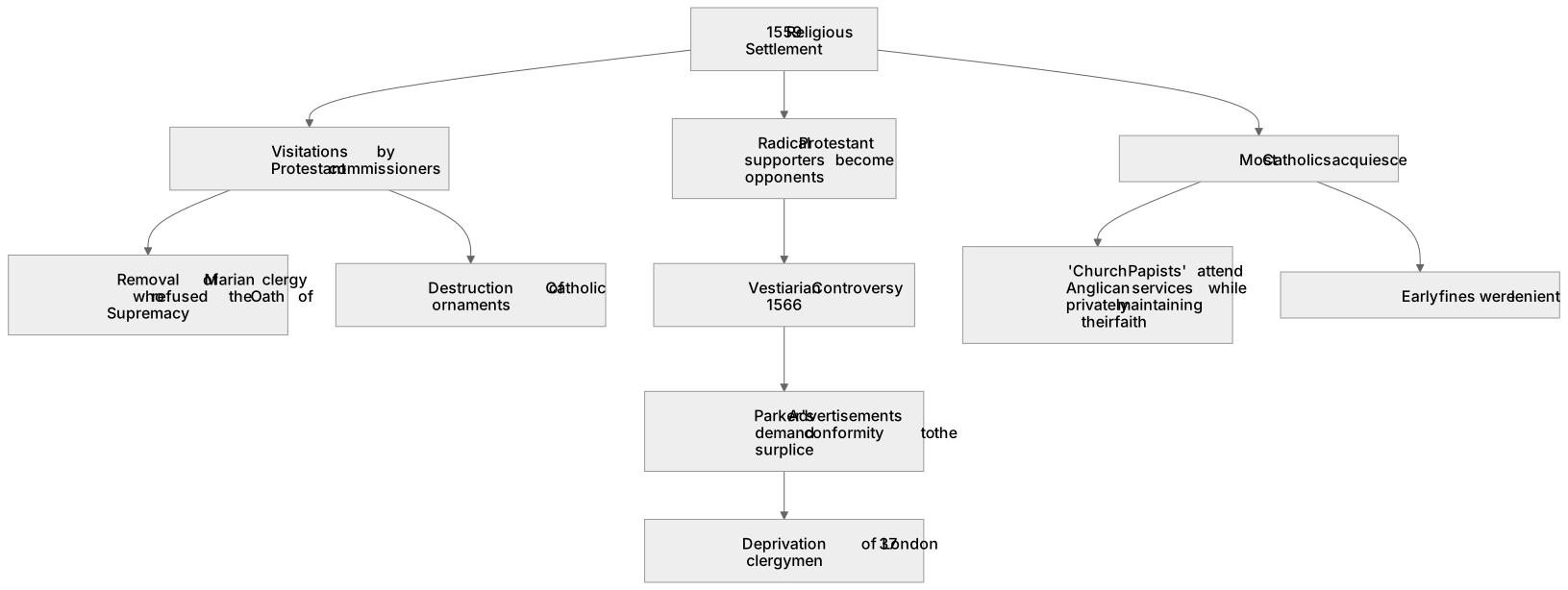
Elizabeth I’s 1559 Religious Settlement faced immediate scrutiny from both supporters and opponents. To consolidate the Settlement, royal injunctions were enforced through Visitations (inspections by Protestant commissioners), resulting in the removal of around 400 Marian clergy who refused the Oath of Supremacy. However, radical Protestant supporters soon became opponents over clerical dress, sparking the Vestiarian Controversy (1566). Archbishop Parker’s 'Advertisements' demanded conformity to the surplice, leading to the deprivation of 37 London clergymen. Meanwhile, most Catholics demonstrated acquiescence, attending Anglican services as 'Church Papists' while privately maintaining their faith, largely because early fines were lenient.
What earns the marks
- Explain the role of the 1559 Visitations in enforcing the Settlement, noting the destruction of Catholic ornaments and the dismissal of non-compliant Marian bishops.
- Analyse the Vestiarian Controversy as a key example of early Puritan opposition, highlighting the tension between royal prerogative and radical Protestant conscience.
- Evaluate the reasons for Catholic acquiescence in the 1560s, including the leniency of recusancy fines and the phenomenon of 'Church Papists'.
- Assess the balance of support and opposition, demonstrating how Elizabeth managed early resistance from both Marian conservatives and returning Marian exiles.
Common mistakes and how to put them right
Assuming the Vestiarian Controversy was a Catholic rebellion.
Put it right: Recognise that the Vestiarian Controversy was driven by radical Protestants (early Puritans) who objected to Catholic-style clerical vestments.
Claiming that Catholics immediately rebelled against the 1559 Settlement.
Put it right: Note that the majority of Catholics initially acquiesced, attending Protestant services outwardly while keeping their private beliefs.
Stating that Visitations only targeted Catholic practices.
Put it right: Understand that while Visitations heavily targeted Catholic relics and imagery, they also enforced strict uniformity that alienated radical Protestants.
Exam tips
- Use the Vestiarian Controversy to demonstrate the emerging fracture between the established Church and radical Protestants.
- When discussing Catholic acquiescence, use the term 'Church Papists' to describe those who outwardly conformed to avoid fines.
- Link the Visitations to the broader theme of royal authority and the practical enforcement of the Acts of Supremacy and Uniformity.
Try the lesson
The start of the 2D Religious conflict and the Church in England, c1529– c1570 – The establishment of the Church of England, 1558–c1570 (A-level only): Supporters and opponents of the Settlement: consolidation of the Settlement through Visitations; the Vestiarian Controversy; the acquiescence of Catholics lesson, made from checked teaching notes for this specification point.
Have a go first
What was the primary cause of the Vestiarian Controversy during the 1560s?
Listen
Elizabeth I’s 1559 Religious Settlement faced immediate scrutiny from both supporters and opponents. To consolidate the Settlement, royal injunctions were enforced through Visitations (inspections by Protestant commissioners), resulting in the removal of around 400 Marian clergy who refused the Oath of Supremacy. However, radical Protestant supporters soon became opponents over clerical dress, sparking the Vestiarian Controversy (1566). Archbishop Parker’s 'Advertisements' demanded conformity to the surplice, leading to the deprivation of 37 London clergymen. Meanwhile, most Catholics demonstrated acquiescence, attending Anglican services as 'Church Papists' while privately maintaining their faith, largely because early fines were lenient. A strong answer earns marks for these points. Explain the role of the 1559 Visitations in enforcing the Settlement, noting the destruction of Catholic ornaments and the dismissal of non-compliant Marian bishops. Analyse the Vestiarian Controversy as a key example of early Puritan opposition, highlighting the tension between royal prerogative and radical Protestant conscience. Evaluate the reasons for Catholic acquiescence in the 1560s, including the leniency of recusancy fines and the phenomenon of 'Church Papists'. Assess the balance of support and opposition, demonstrating how Elizabeth managed early resistance from both Marian conservatives and returning Marian exiles. A common slip: Assuming the Vestiarian Controversy was a Catholic rebellion. Instead, Recognise that the Vestiarian Controversy was driven by radical Protestants (early Puritans) who objected to Catholic-style clerical vestments. Exam tip: Use the Vestiarian Controversy to demonstrate the emerging fracture between the established Church and radical Protestants.
See it
Key words
Say what each word means before you turn the card.
Visitations
Try answering aloud or in your head before turning the card.
Vestiarian Controversy
Try answering aloud or in your head before turning the card.
Church Papists
Try answering aloud or in your head before turning the card.
See every definition
- Visitations
- Inspections by Protestant commissioners used to enforce royal injunctions and consolidate the Settlement, resulting in the removal of Marian clergy who refused the Oath of Supremacy.
- Vestiarian Controversy
- A dispute in 1566 in which radical Protestant supporters became opponents over clerical dress, after Archbishop Parker's 'Advertisements' demanded conformity to the surplice.
- Church Papists
- Catholics who demonstrated acquiescence by attending Anglican services while privately maintaining their faith, largely because early fines were lenient.
Label the diagram
Some boxes have lost their names. Pick the right name for each number.
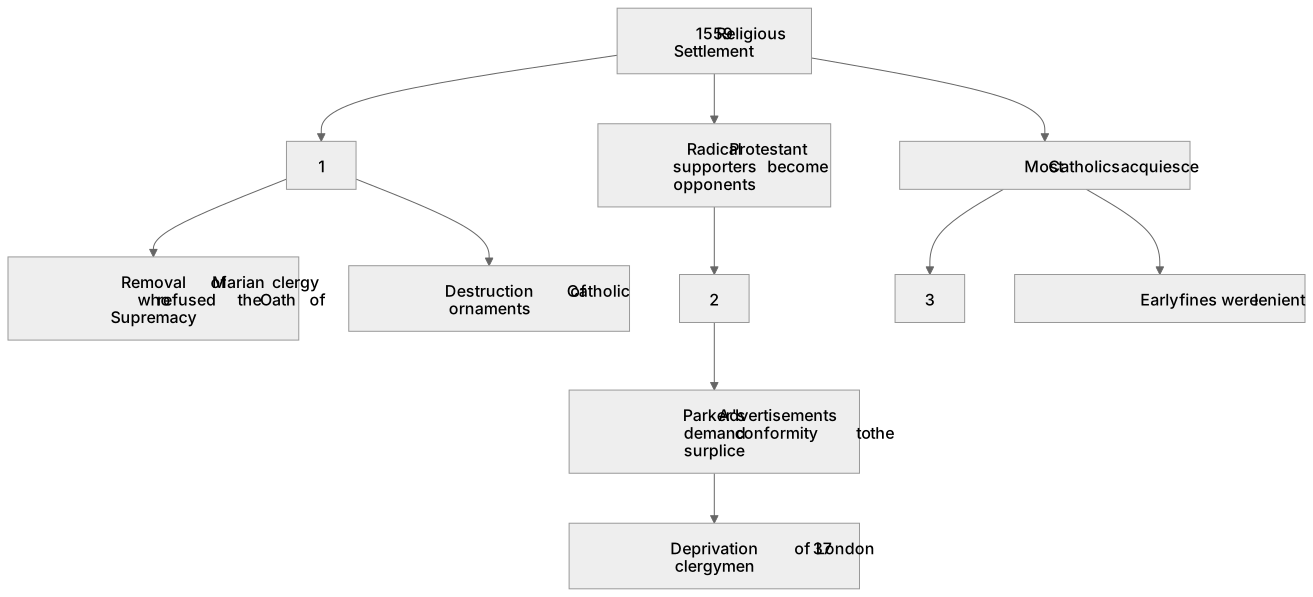
1Box 1
2Box 2
3Box 3
There is more to this lesson
The full lesson goes on to check your understanding and help you earn the marks. Create a free account to carry on, with your progress saved.
A week of Premium from your first lesson · Then the free plan continues · No card, no charge
Test your understanding of 2D Religious conflict and the Church in England, c1529– c1570 – The establishment of the Church of England, 1558–c1570 (A-level only): Supporters and opponents of the Settlement: consolidation of the Settlement through Visitations; the Vestiarian Controversy; the acquiescence of Catholics
Active recall beats re-reading. Take an instant quiz now to test what you’ve learned and lock it into long-term memory.
A week of Premium from your first lesson · Then the free plan continues · No card, no charge