AQA · A-Level · History
Course version: 7042 · Version from Sept 2017
Mary’s accession, aims and opposition: the Royal Supremacy and problems…
Full specification wording
2D Religious conflict and the Church in England, c1529– c1570 – The restoration of Papal Authority, 1553–1558 (A-level only): Mary’s accession, aims and opposition: the Royal Supremacy and problems with her first Parliament; the issue of the Spanish Marriage; obstacles to the restoration of the Catholic Church
Mary I’s 1553 accession relied on popular support for the legitimate Tudor line.
Checked against the AQA 7042 specification (opens in a new tab) on .
- Point 1 of 4
- 4 key terms
Study notes
From the checked teaching notes for this specification point.
The idea
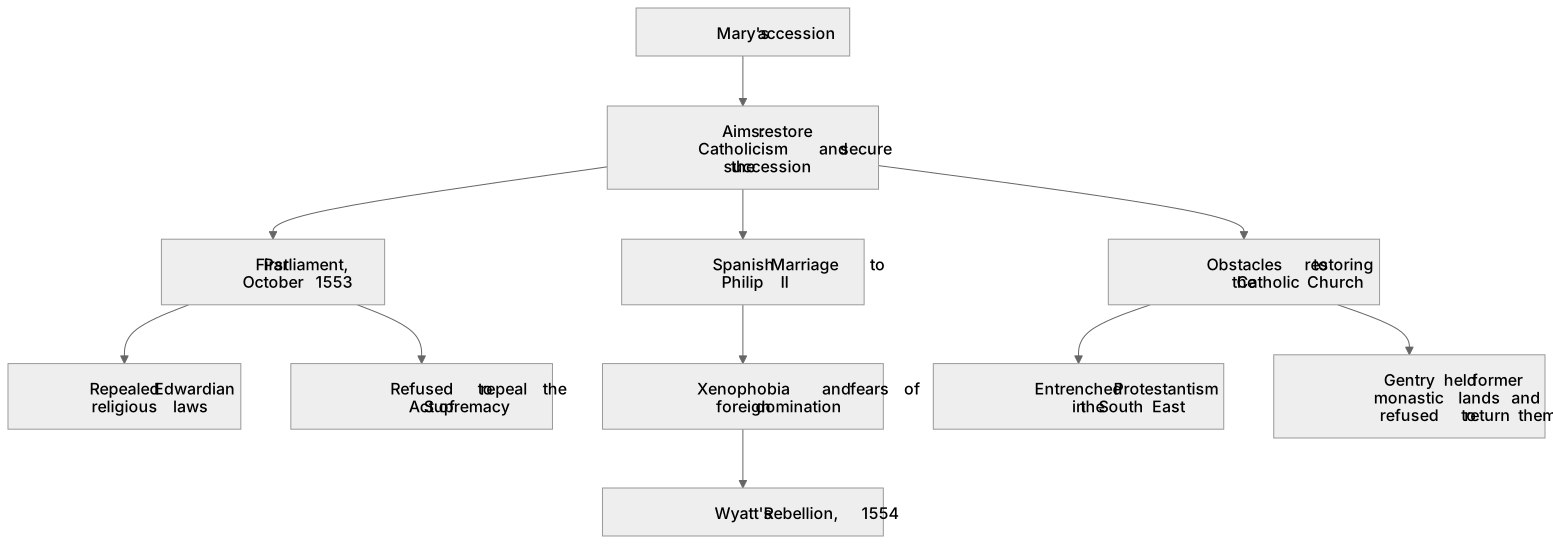
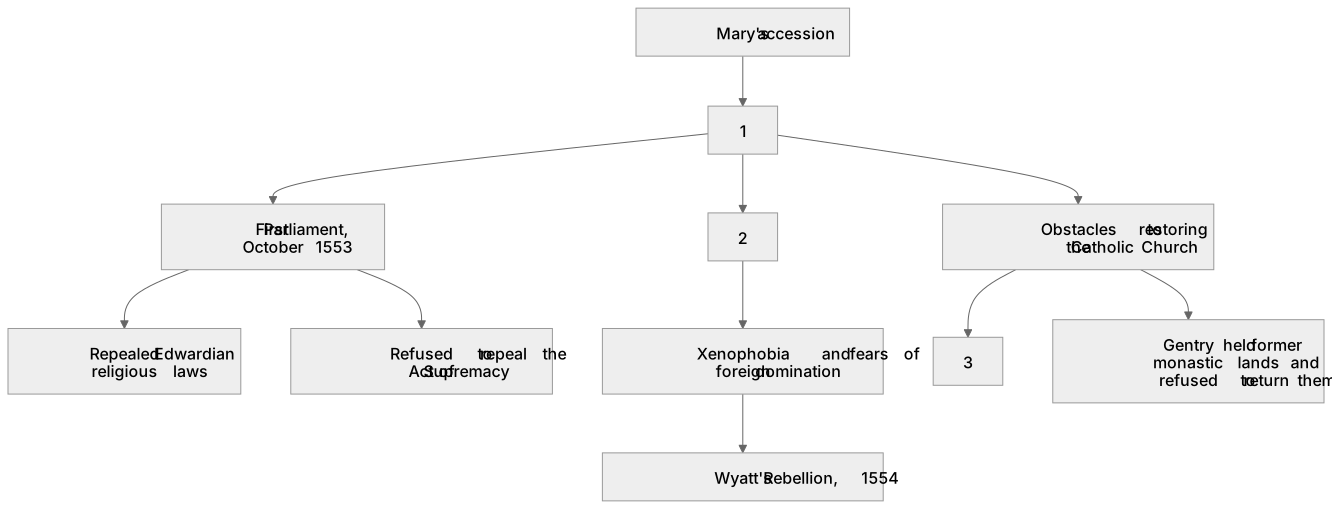
Mary I’s 1553 accession relied on popular support for the legitimate Tudor line. Her primary aims were restoring Catholicism and securing the succession. However, she faced immediate opposition. Her first Parliament in October 1553 repealed Edwardian religious laws but refused to repeal the Act of Supremacy, highlighting legal obstacles to restoring Papal authority. The issue of the Spanish Marriage to Philip II provoked intense xenophobia and fears of foreign domination, culminating in Wyatt’s Rebellion in 1554. Furthermore, significant obstacles to the restoration of the Catholic Church included entrenched Protestantism in the South East and the vested interests of the gentry, who had acquired former monastic lands and refused to return them.
What earns the marks
- Explain the significance of Mary's successful accession despite the Devise for the Succession.
- Analyse the tension between Mary's religious aims and the political reality of the Royal Supremacy in her first Parliament.
- Evaluate the causes of opposition to the Spanish Marriage, distinguishing between religious grievances and xenophobic fears.
- Assess the practical obstacles to Catholic restoration, particularly the issue of secularised monastic lands held by the gentry.
Common mistakes and how to put them right
Assuming Mary's first Parliament immediately restored Papal authority.
Put it right: Note that the first Parliament only repealed Edwardian legislation; Papal authority was not restored until later due to disputes over monastic lands.
Claiming Wyatt's Rebellion was solely a Protestant uprising.
Put it right: Explain that while religion was a factor, the primary catalyst was widespread xenophobic opposition to the Spanish Marriage.
Stating Mary faced no opposition upon her accession.
Put it right: Acknowledge the initial threat posed by Northumberland and Lady Jane Grey, even though Mary quickly overcame it through popular support.
Exam tips
- Link the issue of the Spanish Marriage directly to the outbreak of Wyatt's Rebellion to demonstrate cause and effect.
- When discussing obstacles to Catholic restoration, emphasise the economic motivations of the gentry regarding monastic lands.
- Contrast Mary's clear religious aims with the pragmatic political resistance she faced in her first Parliament.
Try the lesson
The start of the 2D Religious conflict and the Church in England, c1529– c1570 – The restoration of Papal Authority, 1553–1558 (A-level only): Mary’s accession, aims and opposition: the Royal Supremacy and problems with her first Parliament; the issue of the Spanish Marriage; obstacles to the restoration of the Catholic Church lesson, made from checked teaching notes for this specification point.
Have a go first
What was a significant problem Mary I encountered with her first Parliament in October 1553 regarding the Royal Supremacy?
Listen
Mary I’s 1553 accession relied on popular support for the legitimate Tudor line. Her primary aims were restoring Catholicism and securing the succession. However, she faced immediate opposition. Her first Parliament in October 1553 repealed Edwardian religious laws but refused to repeal the Act of Supremacy, highlighting legal obstacles to restoring Papal authority. The issue of the Spanish Marriage to Philip II provoked intense xenophobia and fears of foreign domination, culminating in Wyatt’s Rebellion in 1554. Furthermore, significant obstacles to the restoration of the Catholic Church included entrenched Protestantism in the South East and the vested interests of the gentry, who had acquired former monastic lands and refused to return them. A strong answer earns marks for these points. Explain the significance of Mary's successful accession despite the Devise for the Succession. Analyse the tension between Mary's religious aims and the political reality of the Royal Supremacy in her first Parliament. Evaluate the causes of opposition to the Spanish Marriage, distinguishing between religious grievances and xenophobic fears. Assess the practical obstacles to Catholic restoration, particularly the issue of secularised monastic lands held by the gentry. A common slip: Assuming Mary's first Parliament immediately restored Papal authority. Instead, Note that the first Parliament only repealed Edwardian legislation; Papal authority was not restored until later due to disputes over monastic lands. Exam tip: Link the issue of the Spanish Marriage directly to the outbreak of Wyatt's Rebellion to demonstrate cause and effect.
See it
Key words
Say what each word means before you turn the card.
Royal Supremacy
Try answering aloud or in your head before turning the card.
Spanish Marriage
Try answering aloud or in your head before turning the card.
Wyatt's Rebellion
Try answering aloud or in your head before turning the card.
monastic lands
Try answering aloud or in your head before turning the card.
See every definition
- Royal Supremacy
- Mary's first Parliament refused to repeal this, highlighting legal obstacles to restoring Papal authority.
- Spanish Marriage
- The proposed marriage to Philip II provoked intense xenophobia and fears of foreign domination, culminating in Wyatt's Rebellion in 1554.
- Wyatt's Rebellion
- This 1554 revolt was primarily catalysed by widespread xenophobic opposition to the Spanish Marriage, though religion was also a factor.
- monastic lands
- Former monastic lands had been acquired by the gentry, whose vested interests formed a practical obstacle to Catholic restoration.
Label the diagram
Some boxes have lost their names. Pick the right name for each number.
1Box 1
2Box 2
3Box 3
There is more to this lesson
The full lesson goes on to check your understanding and help you earn the marks. Create a free account to carry on, with your progress saved.
A week of Premium from your first lesson · Then the free plan continues · No card, no charge
Test your understanding of 2D Religious conflict and the Church in England, c1529– c1570 – The restoration of Papal Authority, 1553–1558 (A-level only): Mary’s accession, aims and opposition: the Royal Supremacy and problems with her first Parliament; the issue of the Spanish Marriage; obstacles to the restoration of the Catholic Church
Active recall beats re-reading. Take an instant quiz now to test what you’ve learned and lock it into long-term memory.
A week of Premium from your first lesson · Then the free plan continues · No card, no charge