AQA · A-Level · History
Course version: 7042 · Version from Sept 2017
The restoration of Papal Authority: the second Parliament and the…
Full specification wording
2D Religious conflict and the Church in England, c1529– c1570 – The restoration of Papal Authority, 1553–1558 (A-level only): The restoration of Papal Authority: the second Parliament and the restoration of Papal Authority and Catholic doctrine; Mary as a reformer; the limits of the restoration
The formal restoration of Papal Authority and Catholic doctrine was a complex process.
Checked against the AQA 7042 specification (opens in a new tab) on .
- Point 2 of 4
- 4 key terms
Study notes
From the checked teaching notes for this specification point.
The idea
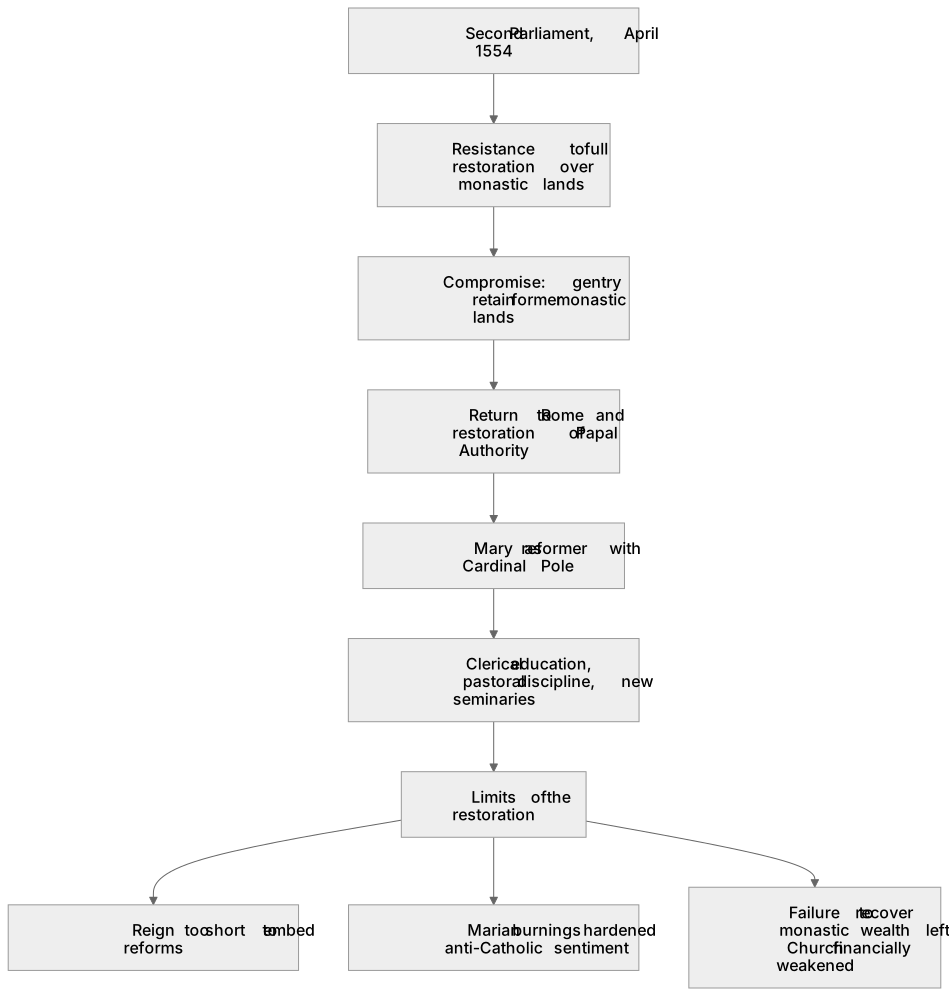
The formal restoration of Papal Authority and Catholic doctrine was a complex process. Mary's second Parliament in April 1554 initially resisted full restoration due to disputes over monastic lands. However, a subsequent compromise allowing the gentry to retain these lands enabled the return to Rome. Beyond mere reaction, Mary acted as a dedicated Catholic reformer. Guided by Cardinal Pole, she attempted to improve clerical education, enforce pastoral discipline, and establish new seminaries. However, the limits of the restoration were significant. Her reign was too short to deeply embed these reforms, and the Marian burnings often hardened anti-Catholic sentiment. Furthermore, the failure to recover monastic wealth left the restored Church financially weakened and dependent.
What earns the marks
- Explain the legislative steps taken to restore Papal Authority and Catholic doctrine, noting parliamentary resistance.
- Analyse the compromise over former monastic lands that was necessary to secure parliamentary approval for the return to Rome.
- Evaluate Mary and Cardinal Pole's positive reforming initiatives, such as improving clerical education and discipline.
- Assess the limits of the Catholic restoration, including the brevity of Mary's reign and the financial weakness of the Church.
Common mistakes and how to put them right
Viewing Mary's religious policy solely as a backward-looking reaction.
Put it right: Emphasise Mary as a reformer who, alongside Cardinal Pole, implemented forward-looking changes that anticipated the Catholic Counter-Reformation.
Stating that Parliament eagerly embraced the return to Rome.
Put it right: Highlight that the second Parliament strongly resisted restoring Papal Authority until the economic security of secularised Church lands was guaranteed.
Assuming the Marian burnings successfully eradicated Protestantism.
Put it right: Explain that the burnings often had the opposite effect, creating martyrs and hardening Protestant resistance, which limited the restoration's success.
Exam tips
- Use Cardinal Pole's legatine synod of 1555 to 1556 as a concrete example of Mary's positive reforming agenda.
- When discussing the limits of the restoration, balance the impact of the burnings with practical issues like the lack of time and Church finances.
- Clearly distinguish between the restoration of Catholic doctrine, such as transubstantiation, and the structural restoration of Papal Authority.
Try the lesson
The start of the 2D Religious conflict and the Church in England, c1529– c1570 – The restoration of Papal Authority, 1553–1558 (A-level only): The restoration of Papal Authority: the second Parliament and the restoration of Papal Authority and Catholic doctrine; Mary as a reformer; the limits of the restoration lesson, made from checked teaching notes for this specification point.
Have a go first
How was Papal authority formally restored in England during Mary I's reign?
Listen
The formal restoration of Papal Authority and Catholic doctrine was a complex process. Mary's second Parliament in April 1554 initially resisted full restoration due to disputes over monastic lands. However, a subsequent compromise allowing the gentry to retain these lands enabled the return to Rome. Beyond mere reaction, Mary acted as a dedicated Catholic reformer. Guided by Cardinal Pole, she attempted to improve clerical education, enforce pastoral discipline, and establish new seminaries. However, the limits of the restoration were significant. Her reign was too short to deeply embed these reforms, and the Marian burnings often hardened anti-Catholic sentiment. Furthermore, the failure to recover monastic wealth left the restored Church financially weakened and dependent. A strong answer earns marks for these points. Explain the legislative steps taken to restore Papal Authority and Catholic doctrine, noting parliamentary resistance. Analyse the compromise over former monastic lands that was necessary to secure parliamentary approval for the return to Rome. Evaluate Mary and Cardinal Pole's positive reforming initiatives, such as improving clerical education and discipline. Assess the limits of the Catholic restoration, including the brevity of Mary's reign and the financial weakness of the Church. A common slip: Viewing Mary's religious policy solely as a backward-looking reaction. Instead, Emphasise Mary as a reformer who, alongside Cardinal Pole, implemented forward-looking changes that anticipated the Catholic Counter-Reformation. Exam tip: Use Cardinal Pole's legatine synod of 1555 to 1556 as a concrete example of Mary's positive reforming agenda.
See it
Key words
Say what each word means before you turn the card.
Church and State
Try answering aloud or in your head before turning the card.
Religious reform and reaction
Try answering aloud or in your head before turning the card.
Economic impact of religious change
Try answering aloud or in your head before turning the card.
Social control and persecution
Try answering aloud or in your head before turning the card.
See every definition
- Church and State
- The relationship between religious authority and parliamentary power, shown when the second Parliament resisted full restoration until the economic security of secularised Church lands was guaranteed.
- Religious reform and reaction
- Mary acted as a dedicated Catholic reformer, attempting with Cardinal Pole to improve clerical education, enforce pastoral discipline and establish new seminaries, rather than merely reacting.
- Economic impact of religious change
- A compromise allowing the gentry to retain former monastic lands enabled the return to Rome, but the failure to recover monastic wealth left the restored Church financially weakened and dependent.
- Social control and persecution
- The Marian burnings often hardened anti-Catholic sentiment, creating martyrs and hardening Protestant resistance, which limited the restoration's success.
Label the diagram
Some boxes have lost their names. Pick the right name for each number.
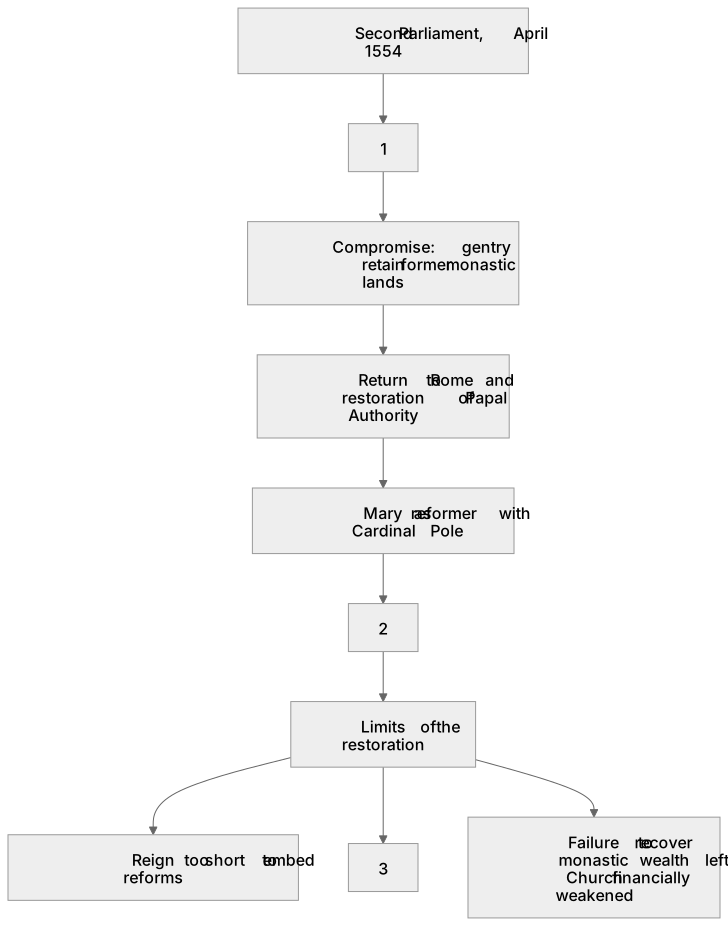
1Box 1
2Box 2
3Box 3
There is more to this lesson
The full lesson goes on to check your understanding and help you earn the marks. Create a free account to carry on, with your progress saved.
A week of Premium from your first lesson · Then the free plan continues · No card, no charge
Test your understanding of 2D Religious conflict and the Church in England, c1529– c1570 – The restoration of Papal Authority, 1553–1558 (A-level only): The restoration of Papal Authority: the second Parliament and the restoration of Papal Authority and Catholic doctrine; Mary as a reformer; the limits of the restoration
Active recall beats re-reading. Take an instant quiz now to test what you’ve learned and lock it into long-term memory.
A week of Premium from your first lesson · Then the free plan continues · No card, no charge