AQA · A-Level · History
Course version: 7042 · Version from Sept 2017
Persecution and reform: reasons for, extent of and repercussions of the…
Full specification wording
2D Religious conflict and the Church in England, c1529– c1570 – The restoration of Papal Authority, 1553–1558 (A-level only): Persecution and reform: reasons for, extent of and repercussions of the persecution of Protestants; Mary, Pole and the attempt to reform Catholicism
Mary I and Cardinal Reginald Pole sought to restore and reform English Catholicism, not merely reverse Edwardian changes.
Checked against the AQA 7042 specification (opens in a new tab) on .
- Point 3 of 4
- 4 key terms
Study notes
From the checked teaching notes for this specification point.
The idea
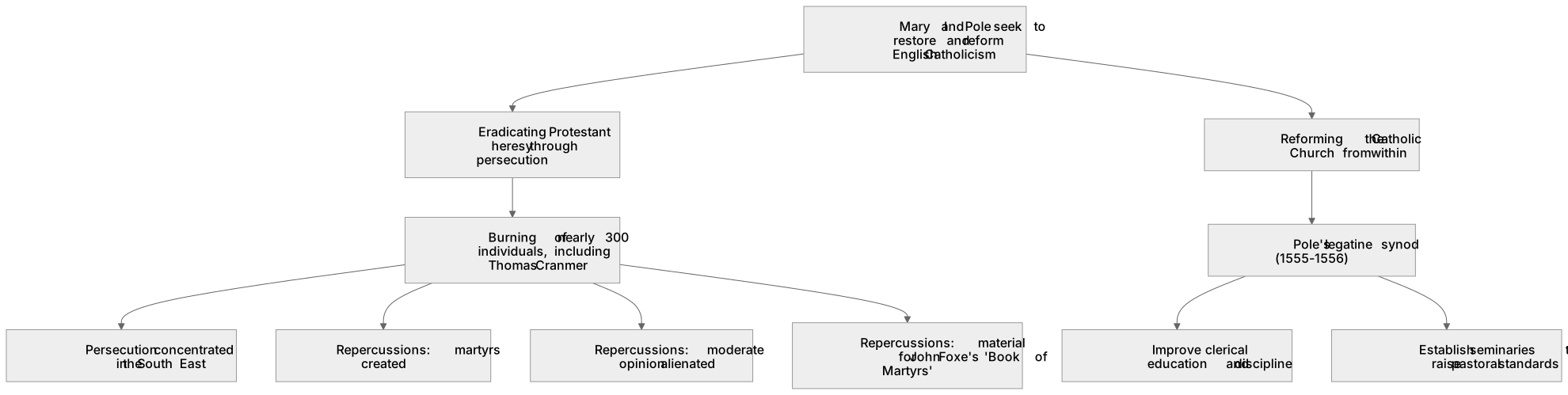
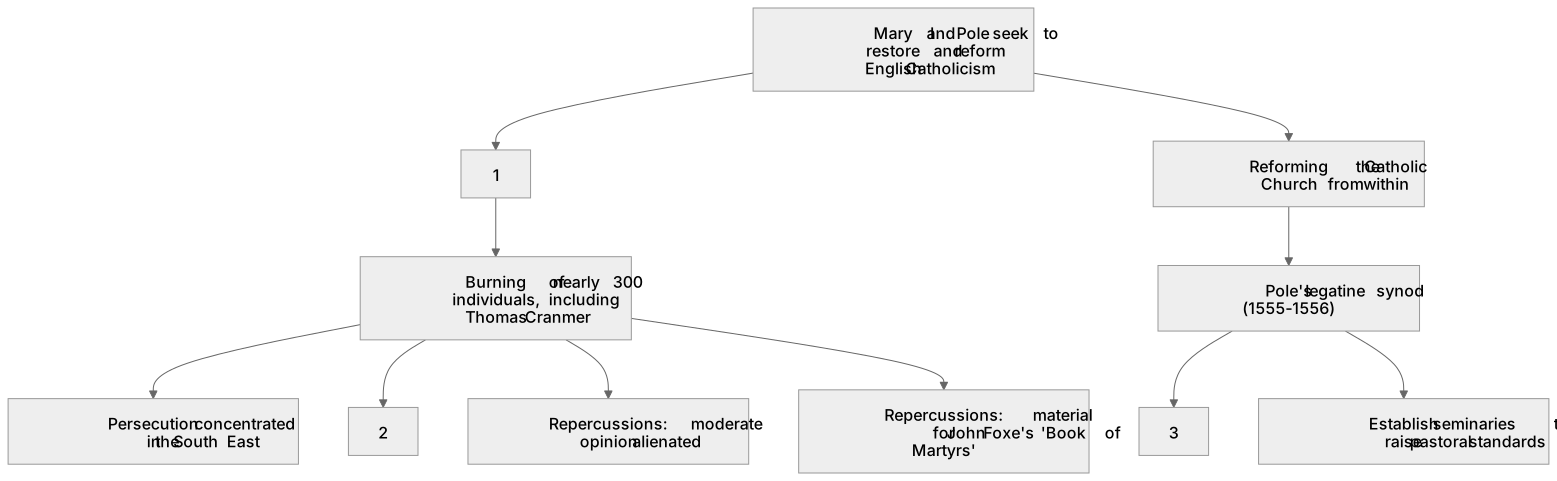
Mary I and Cardinal Reginald Pole sought to restore and reform English Catholicism, not merely reverse Edwardian changes. Pole’s legatine synod (1555–1556) aimed to improve clerical education and discipline, establishing seminaries to raise pastoral standards. However, their strategy also involved eradicating heresy. The persecution of Protestants, driven by Mary’s deep piety and belief that heresy was a cancer, led to the burning of nearly 300 individuals, including Thomas Cranmer. The extent of this persecution was unprecedented in England, largely concentrated in the South East. The repercussions were profound; rather than eliminating Protestantism, the burnings created martyrs, alienated moderate opinion, and provided potent material for John Foxe’s later 'Book of Martyrs'.
What earns the marks
- Explain the dual approach of Marian religious policy: eradicating Protestant heresy through persecution and actively reforming the Catholic Church from within.
- Assess the reasons for persecution, focusing on Mary's genuine belief that she was saving souls and restoring God's favour to England.
- Evaluate the extent of the burnings, noting the geographical concentration in London and the South East, and the social composition of the martyrs.
- Analyse the repercussions of the burnings, particularly how they failed to extinguish Protestantism and instead fostered a powerful anti-Catholic narrative.
- Detail Pole's positive reforms, such as the Twelve Decrees, which emphasised clerical residency, preaching, and the planned establishment of diocesan seminaries.
Common mistakes and how to put them right
Assuming Mary's religious policy was solely focused on burning Protestants.
Put it right: Acknowledge the positive, forward-looking Catholic reforms initiated by Cardinal Pole, such as improving clerical education.
Claiming the burnings successfully eradicated Protestantism in England.
Put it right: Explain that while they removed key leaders, the burnings ultimately created martyrs and strengthened Protestant resolve.
Stating that persecution was uniformly widespread across the whole of England.
Put it right: Specify that the burnings were heavily concentrated in the South East and East Anglia, with far fewer in the North and West.
Exam tips
- When evaluating Mary's religious policies, balance the negative impact of the burnings with the administrative and pastoral reforms attempted by Pole.
- Use specific examples of martyrs, such as Cranmer, Ridley, or Latimer, to illustrate the high-profile nature of the persecution and its political repercussions.
- Consider the limitations placed on Pole's reforms, such as the short duration of the reign and his eventual falling out with Pope Paul IV.
Try the lesson
The start of the 2D Religious conflict and the Church in England, c1529– c1570 – The restoration of Papal Authority, 1553–1558 (A-level only): Persecution and reform: reasons for, extent of and repercussions of the persecution of Protestants; Mary, Pole and the attempt to reform Catholicism lesson, made from checked teaching notes for this specification point.
Have a go first
Approximately how many Protestants were burned at the stake for heresy during the reign of Mary I?
Listen
Mary I and Cardinal Reginald Pole sought to restore and reform English Catholicism, not merely reverse Edwardian changes. Pole’s legatine synod (1555–1556) aimed to improve clerical education and discipline, establishing seminaries to raise pastoral standards. However, their strategy also involved eradicating heresy. The persecution of Protestants, driven by Mary’s deep piety and belief that heresy was a cancer, led to the burning of nearly 300 individuals, including Thomas Cranmer. The extent of this persecution was unprecedented in England, largely concentrated in the South East. The repercussions were profound; rather than eliminating Protestantism, the burnings created martyrs, alienated moderate opinion, and provided potent material for John Foxe’s later 'Book of Martyrs'. A strong answer earns marks for these points. Explain the dual approach of Marian religious policy: eradicating Protestant heresy through persecution and actively reforming the Catholic Church from within. Assess the reasons for persecution, focusing on Mary's genuine belief that she was saving souls and restoring God's favour to England. Evaluate the extent of the burnings, noting the geographical concentration in London and the South East, and the social composition of the martyrs. Analyse the repercussions of the burnings, particularly how they failed to extinguish Protestantism and instead fostered a powerful anti-Catholic narrative. A common slip: Assuming Mary's religious policy was solely focused on burning Protestants. Instead, Acknowledge the positive, forward-looking Catholic reforms initiated by Cardinal Pole, such as improving clerical education. Exam tip: When evaluating Mary's religious policies, balance the negative impact of the burnings with the administrative and pastoral reforms attempted by Pole.
See it
Key words
Say what each word means before you turn the card.
Persecution and martyrdom
Try answering aloud or in your head before turning the card.
Catholic reformation
Try answering aloud or in your head before turning the card.
Papal authority
Try answering aloud or in your head before turning the card.
Religious change
Try answering aloud or in your head before turning the card.
See every definition
- Persecution and martyrdom
- Eradicating heresy through persecution created martyrs rather than eliminating Protestantism, alienating moderate opinion and providing potent material for later anti-Catholic narrative.
- Catholic reformation
- Pole's legatine synod aimed to improve clerical education and discipline, establishing seminaries to raise pastoral standards.
- Papal authority
- Restoration of Papal Authority in England, 1553–1558, was pursued by Mary I and Cardinal Reginald Pole, who sought to restore and reform English Catholicism.
- Religious change
- Mary and Pole sought to restore and reform English Catholicism, not merely reverse Edwardian changes, through both positive reform and the eradication of heresy.
Label the diagram
Some boxes have lost their names. Pick the right name for each number.
1Box 1
2Box 2
3Box 3
There is more to this lesson
The full lesson goes on to check your understanding and help you earn the marks. Create a free account to carry on, with your progress saved.
A week of Premium from your first lesson · Then the free plan continues · No card, no charge
Test your understanding of 2D Religious conflict and the Church in England, c1529– c1570 – The restoration of Papal Authority, 1553–1558 (A-level only): Persecution and reform: reasons for, extent of and repercussions of the persecution of Protestants; Mary, Pole and the attempt to reform Catholicism
Active recall beats re-reading. Take an instant quiz now to test what you’ve learned and lock it into long-term memory.
A week of Premium from your first lesson · Then the free plan continues · No card, no charge