AQA · A-Level · History
Course version: 7042 · Version from Sept 2017
Political issues: the role of Wentworth; policies in Ireland and England;…
Full specification wording
2E The English Revolution, 1625–1660 – An experiment in Absolutism, 1629–1640: Political issues: the role of Wentworth; policies in Ireland and England; the reactions against the Crown; demands for the recall of Parliament
Thomas Wentworth, Earl of Strafford, was central to Charles I’s Personal Rule, implementing the policy of 'Thorough' to enhance royal authority and efficiency.
Checked against the AQA 7042 specification (opens in a new tab) on .
- Point 3 of 4
- 4 key terms
Study notes
From the checked teaching notes for this specification point.
The idea
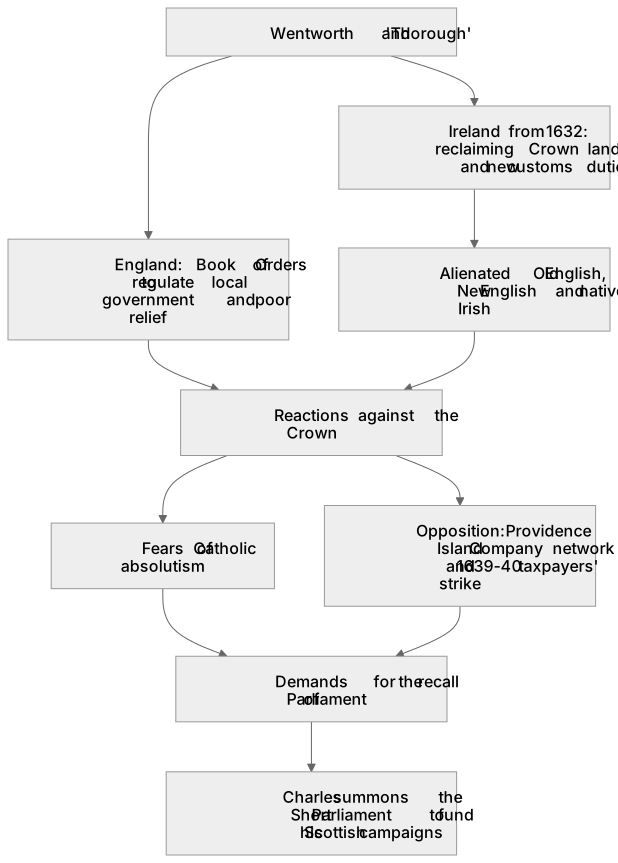
Thomas Wentworth, Earl of Strafford, was central to Charles I’s Personal Rule, implementing the policy of 'Thorough' to enhance royal authority and efficiency. In England, Wentworth enforced the Book of Orders to regulate local government and poor relief. As Lord Deputy of Ireland from 1632, he ruthlessly alienated all factions—Old English, New English, and native Irish—by reclaiming Crown lands and imposing new customs duties to make Ireland financially independent. These authoritarian policies provoked fierce reactions against the Crown, heightening fears of Catholic absolutism. Growing opposition, exemplified by the Providence Island Company's covert network and the 1639-40 taxpayers' strike, culminated in overwhelming demands for the recall of Parliament, forcing Charles to summon the Short Parliament to fund his Scottish campaigns.
What earns the marks
- Evaluate Wentworth's implementation of 'Thorough' in England, specifically his use of the Book of Orders to centralise control over local magistrates.
- Analyse Wentworth's financial and political strategies in Ireland, including the manipulation of the Irish Parliament and the imposition of the Book of Rates.
- Assess the growing reaction against the Crown, noting how Wentworth's authoritarian methods alienated the political nation and fuelled fears of absolutism.
- Explain the connection between the collapse of Charles I's finances during the Scottish crisis and the mounting demands from the gentry for the recall of Parliament.
Common mistakes and how to put them right
Assuming Wentworth's policies in Ireland were universally popular with the Protestant New English.
Put it right: Wentworth alienated the New English alongside the Old English and native Irish by reclaiming church lands and enforcing strict royal prerogative.
Confusing Wentworth's role in England with his role in Ireland.
Put it right: Wentworth was President of the Council of the North in England before becoming Lord Deputy of Ireland in 1632; his policies must be contextualised by location.
Stating that demands for Parliament's recall were solely due to Wentworth.
Put it right: Demands for Parliament were driven by a combination of Wentworth's authoritarianism, Laudian religious policies, and the financial collapse caused by the Scottish crisis.
Exam tips
- Use the concept of 'Thorough' to link Wentworth's administrative reforms in both the North of England and Ireland.
- When discussing reactions against the Crown, reference specific opposition networks like the Providence Island Company to demonstrate depth of knowledge.
- Evaluate how Wentworth's success in making Ireland profitable paradoxically increased English fears that Charles could use an Irish army to enforce absolutism in England.
Try the lesson
The start of the 2E The English Revolution, 1625–1660 – An experiment in Absolutism, 1629–1640: Political issues: the role of Wentworth; policies in Ireland and England; the reactions against the Crown; demands for the recall of Parliament lesson, made from checked teaching notes for this specification point.
Have a go first
What was a primary objective of Thomas Wentworth's policy of 'Thorough' during his time as Lord Deputy of Ireland in the 1630s?
Listen
Thomas Wentworth, Earl of Strafford, was central to Charles I’s Personal Rule, implementing the policy of 'Thorough' to enhance royal authority and efficiency. In England, Wentworth enforced the Book of Orders to regulate local government and poor relief. As Lord Deputy of Ireland from 1632, he ruthlessly alienated all factions—Old English, New English, and native Irish—by reclaiming Crown lands and imposing new customs duties to make Ireland financially independent. These authoritarian policies provoked fierce reactions against the Crown, heightening fears of Catholic absolutism. Growing opposition, exemplified by the Providence Island Company's covert network and the 1639-40 taxpayers' strike, culminated in overwhelming demands for the recall of Parliament, forcing Charles to summon the Short Parliament to fund his Scottish campaigns. A strong answer earns marks for these points. Evaluate Wentworth's implementation of 'Thorough' in England, specifically his use of the Book of Orders to centralise control over local magistrates. Analyse Wentworth's financial and political strategies in Ireland, including the manipulation of the Irish Parliament and the imposition of the Book of Rates. Assess the growing reaction against the Crown, noting how Wentworth's authoritarian methods alienated the political nation and fuelled fears of absolutism. Explain the connection between the collapse of Charles I's finances during the Scottish crisis and the mounting demands from the gentry for the recall of Parliament. A common slip: Assuming Wentworth's policies in Ireland were universally popular with the Protestant New English. Instead, Wentworth alienated the New English alongside the Old English and native Irish by reclaiming church lands and enforcing strict royal prerogative. Exam tip: Use the concept of 'Thorough' to link Wentworth's administrative reforms in both the North of England and Ireland.
See it
Key words
Say what each word means before you turn the card.
Absolutism and Prerogative
Try answering aloud or in your head before turning the card.
Opposition and Dissent
Try answering aloud or in your head before turning the card.
Financial Independence
Try answering aloud or in your head before turning the card.
Multiple Kingdoms
Try answering aloud or in your head before turning the card.
See every definition
- Absolutism and Prerogative
- The authoritarian policies pursued by the Crown heightened fears of Catholic absolutism, and strict royal prerogative was enforced in Ireland.
- Opposition and Dissent
- Growing opposition, exemplified by the Providence Island Company's covert network and the 1639-40 taxpayers' strike, culminated in demands for the recall of Parliament.
- Financial Independence
- As Lord Deputy of Ireland from 1632, Wentworth imposed new customs duties to make Ireland financially independent.
- Multiple Kingdoms
- Charles was forced to summon the Short Parliament to fund his Scottish campaigns, connecting the collapse of his finances during the Scottish crisis to demands for Parliament's recall.
Label the diagram
Some boxes have lost their names. Pick the right name for each number.
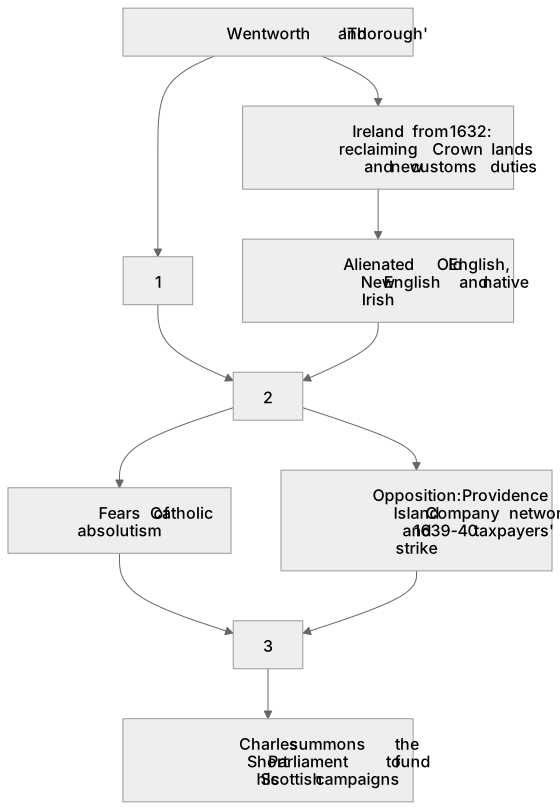
1Box 1
2Box 2
3Box 3
There is more to this lesson
The full lesson goes on to check your understanding and help you earn the marks. Create a free account to carry on, with your progress saved.
A week of Premium from your first lesson · Then the free plan continues · No card, no charge
Test your understanding of 2E The English Revolution, 1625–1660 – An experiment in Absolutism, 1629–1640: Political issues: the role of Wentworth; policies in Ireland and England; the reactions against the Crown; demands for the recall of Parliament
Active recall beats re-reading. Take an instant quiz now to test what you’ve learned and lock it into long-term memory.
A week of Premium from your first lesson · Then the free plan continues · No card, no charge