AQA · A-Level · History
Course version: 7042 · Version from Sept 2017
Religious issues: Laud and Arminianism in England and Scotland; the growth…
Full specification wording
2E The English Revolution, 1625–1660 – An experiment in Absolutism, 1629–1640: Religious issues: Laud and Arminianism in England and Scotland; the growth of opposition from Puritans
Religious issues were central to the breakdown of Charles I’s Personal Rule.
Checked against the AQA 7042 specification (opens in a new tab) on .
- Point 2 of 4
- 3 key terms
Study notes
From the checked teaching notes for this specification point.
The idea
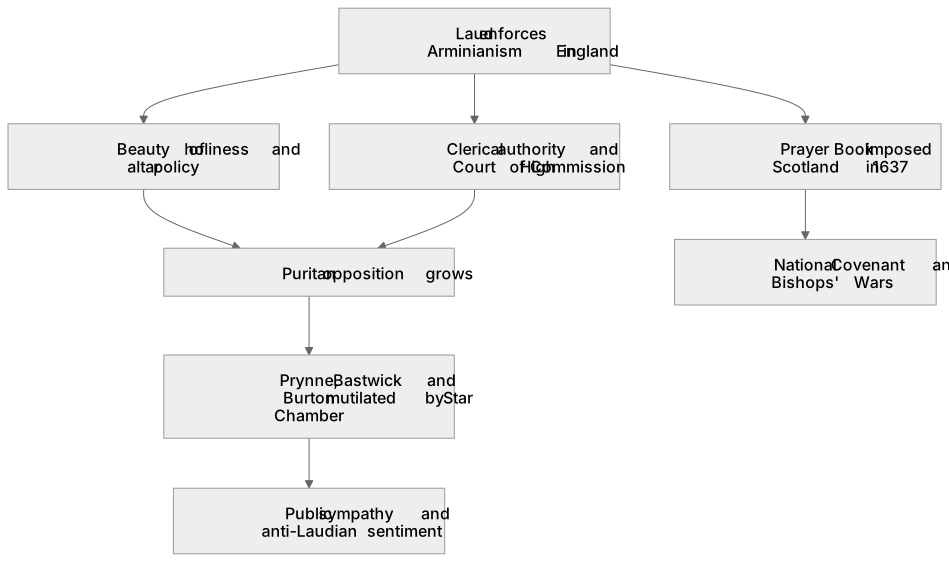
Religious issues were central to the breakdown of Charles I’s Personal Rule. William Laud, Archbishop of Canterbury from 1633, enforced Arminianism across England, emphasising the 'beauty of holiness', clerical authority, and the altar policy, which moved communion tables to the east end. In Scotland, Charles and Laud disastrously attempted to impose a new English-style Prayer Book in 1637, sparking the National Covenant and the Bishops' Wars. These Arminian reforms alienated many, fuelling the growth of opposition from Puritans who viewed the changes as a covert return to Catholicism. Prominent Puritans like Prynne, Bastwick, and Burton were mutilated by the Star Chamber for their vocal resistance, which only amplified public sympathy and solidified anti-Laudian sentiment.
What earns the marks
- Define the key features of Laudian Arminianism in England, including the altar controversy, emphasis on sacraments, and the 'beauty of holiness'.
- Explain the specific religious policies imposed on Scotland, notably the 1636 Book of Canons and the 1637 Prayer Book.
- Analyse the growth of Puritan opposition, referencing the pamphleteering of figures like Prynne, Bastwick, and Burton.
- Evaluate how the enforcement of Arminianism through the Court of High Commission heightened fears of a Catholic conspiracy.
Common mistakes and how to put them right
Using the terms Arminian and Catholic interchangeably.
Put it right: Arminians were Protestants who rejected Calvinist predestination and favoured ceremony, though Puritans feared they were crypto-Catholics.
Assuming the Scottish rebellion was purely political.
Put it right: The Scottish resistance was fundamentally religious, driven by Presbyterian opposition to the imposition of the Laudian Prayer Book.
Claiming Puritans were a small, insignificant minority during the 1630s.
Put it right: Puritanism had a broad and growing influence among the gentry and merchant classes, forming the core of the opposition to Charles.
Exam tips
- Connect Laudian religious policies directly to the outbreak of the Scottish rebellion to show how religious issues triggered the collapse of the Personal Rule.
- Use the punishment of Prynne, Bastwick, and Burton to illustrate the severity of Laudian enforcement and the resulting public backlash.
- Distinguish clearly between the religious context of England, which was Anglican and Puritan, and Scotland, which was Presbyterian, when discussing Laudian reforms.
Try the lesson
The start of the 2E The English Revolution, 1625–1660 – An experiment in Absolutism, 1629–1640: Religious issues: Laud and Arminianism in England and Scotland; the growth of opposition from Puritans lesson, made from checked teaching notes for this specification point.
Have a go first
Which of the following changes to church interiors was a key feature of Archbishop William Laud's Arminian reforms in England?
Listen
Religious issues were central to the breakdown of Charles I’s Personal Rule. William Laud, Archbishop of Canterbury from 1633, enforced Arminianism across England, emphasising the 'beauty of holiness', clerical authority, and the altar policy, which moved communion tables to the east end. In Scotland, Charles and Laud disastrously attempted to impose a new English-style Prayer Book in 1637, sparking the National Covenant and the Bishops' Wars. These Arminian reforms alienated many, fuelling the growth of opposition from Puritans who viewed the changes as a covert return to Catholicism. Prominent Puritans like Prynne, Bastwick, and Burton were mutilated by the Star Chamber for their vocal resistance, which only amplified public sympathy and solidified anti-Laudian sentiment. A strong answer earns marks for these points. Define the key features of Laudian Arminianism in England, including the altar controversy, emphasis on sacraments, and the 'beauty of holiness'. Explain the specific religious policies imposed on Scotland, notably the 1636 Book of Canons and the 1637 Prayer Book. Analyse the growth of Puritan opposition, referencing the pamphleteering of figures like Prynne, Bastwick, and Burton. Evaluate how the enforcement of Arminianism through the Court of High Commission heightened fears of a Catholic conspiracy. A common slip: Using the terms Arminian and Catholic interchangeably. Instead, Arminians were Protestants who rejected Calvinist predestination and favoured ceremony, though Puritans feared they were crypto-Catholics. Exam tip: Connect Laudian religious policies directly to the outbreak of the Scottish rebellion to show how religious issues triggered the collapse of the Personal Rule.
See it
Key words
Say what each word means before you turn the card.
Arminianism
Try answering aloud or in your head before turning the card.
Puritanism
Try answering aloud or in your head before turning the card.
The Scottish Crisis
Try answering aloud or in your head before turning the card.
See every definition
- Arminianism
- Enforced across England by William Laud, Archbishop of Canterbury from 1633, it emphasised the 'beauty of holiness', clerical authority, and the altar policy.
- Puritanism
- Its influence grew broadly among the gentry and merchant classes, forming the core of opposition to Charles, and its adherents viewed the Arminian changes as a covert return to Catholicism.
- The Scottish Crisis
- Charles and Laud disastrously attempted to impose a new English-style Prayer Book in 1637, sparking the National Covenant and the Bishops' Wars.
Label the diagram
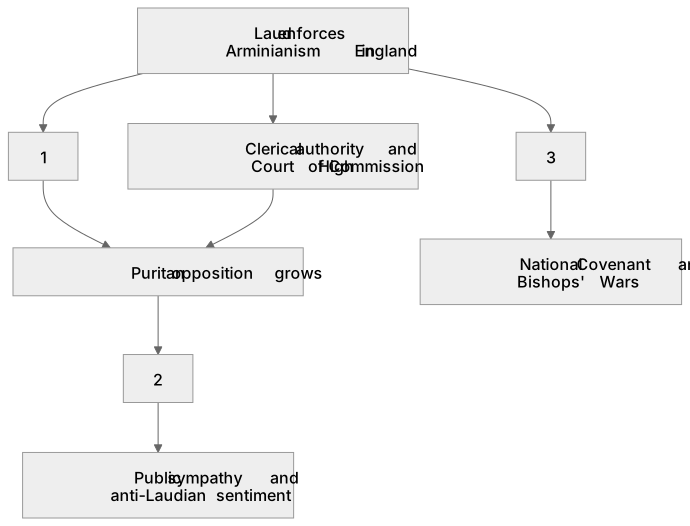
Some boxes have lost their names. Pick the right name for each number.
1Box 1
2Box 2
3Box 3
There is more to this lesson
The full lesson goes on to check your understanding and help you earn the marks. Create a free account to carry on, with your progress saved.
A week of Premium from your first lesson · Then the free plan continues · No card, no charge
Test your understanding of 2E The English Revolution, 1625–1660 – An experiment in Absolutism, 1629–1640: Religious issues: Laud and Arminianism in England and Scotland; the growth of opposition from Puritans
Active recall beats re-reading. Take an instant quiz now to test what you’ve learned and lock it into long-term memory.
A week of Premium from your first lesson · Then the free plan continues · No card, no charge