AQA · A-Level · History
Course version: 7042 · Version from Sept 2017
The monarchy restored: political vacuum after the death of Cromwell;…
Full specification wording
2E The English Revolution, 1625–1660 – Experiments in government and society, 1648–1660 (A-level only): The monarchy restored: political vacuum after the death of Cromwell; negotiations for the return of the monarchy under Charles II; the legacy of the English Revolution by 1660
Cromwell's death in 1658 created a severe political vacuum.
Checked against the AQA 7042 specification (opens in a new tab) on .
- Point 4 of 4
- 4 key terms
Study notes
From the checked teaching notes for this specification point.
The idea
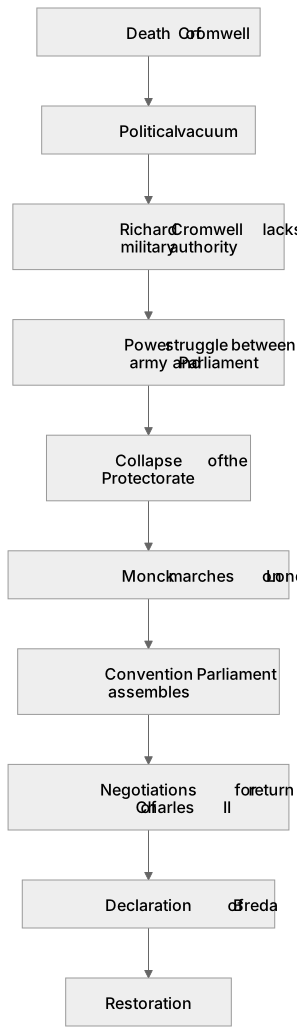
Cromwell's death in 1658 created a severe political vacuum. His son Richard lacked military authority, sparking a power struggle between the army and Parliament that collapsed the Protectorate. Amidst this chaos, General Monck marched on London, enabling the Convention Parliament to assemble. Negotiations for the return of the monarchy under Charles II culminated in the Declaration of Breda (1660). This promised amnesty, religious toleration, and army pay, securing a peaceful restoration. By 1660, the legacy of the English Revolution was profound. While absolute monarchy was fatally undermined and Parliament's role cemented, the radical experiments left the political nation with a deep-seated fear of standing armies and religious sectarianism.
What earns the marks
- Explain how the lack of a strong successor and the division between the army and Parliament created a political vacuum in 1659.
- Assess the role of General Monck in navigating the political crisis and facilitating the Convention Parliament.
- Evaluate the significance of the Declaration of Breda in the negotiations for the return of Charles II, particularly its vague but reassuring promises.
- Analyse the legacy of the Revolution by 1660, focusing on the permanent shift in the balance of power between Crown and Parliament and the enduring fear of radicalism.
Common mistakes and how to put them right
Assuming the Restoration was inevitable immediately after Oliver Cromwell's death.
Put it right: Emphasise that the Restoration only became likely after the collapse of the restored Rump and Monck's intervention in late 1659 and early 1660.
Stating the Declaration of Breda was a legally binding constitution.
Put it right: Describe the Declaration of Breda as a manifesto of promises that relied on Parliament to legislate the specifics.
Claiming the Revolution left no lasting legacy because the monarchy was restored.
Put it right: Highlight that the restored monarchy was fundamentally different, with Parliament's financial and legislative power permanently enhanced.
Exam tips
- Focus on the Declaration of Breda as a brilliant piece of political negotiation that appealed to multiple factions simultaneously.
- When discussing the political vacuum, contrast Richard Cromwell's lack of military experience with his father's strong army connections.
- Use the term 'political nation' to describe the gentry and merchants whose desire for stability ultimately drove the Restoration.
Try the lesson
The start of the 2E The English Revolution, 1625–1660 – Experiments in government and society, 1648–1660 (A-level only): The monarchy restored: political vacuum after the death of Cromwell; negotiations for the return of the monarchy under Charles II; the legacy of the English Revolution by 1660 lesson, made from checked teaching notes for this specification point.
Have a go first
Following the death of Oliver Cromwell in September 1658, who succeeded him as Lord Protector, leading to a political vacuum?
Listen
Cromwell's death in 1658 created a severe political vacuum. His son Richard lacked military authority, sparking a power struggle between the army and Parliament that collapsed the Protectorate. Amidst this chaos, General Monck marched on London, enabling the Convention Parliament to assemble. Negotiations for the return of the monarchy under Charles II culminated in the Declaration of Breda (1660). This promised amnesty, religious toleration, and army pay, securing a peaceful restoration. By 1660, the legacy of the English Revolution was profound. While absolute monarchy was fatally undermined and Parliament's role cemented, the radical experiments left the political nation with a deep-seated fear of standing armies and religious sectarianism. A strong answer earns marks for these points. Explain how the lack of a strong successor and the division between the army and Parliament created a political vacuum in 1659. Assess the role of General Monck in navigating the political crisis and facilitating the Convention Parliament. Evaluate the significance of the Declaration of Breda in the negotiations for the return of Charles II, particularly its vague but reassuring promises. Analyse the legacy of the Revolution by 1660, focusing on the permanent shift in the balance of power between Crown and Parliament and the enduring fear of radicalism. A common slip: Assuming the Restoration was inevitable immediately after Oliver Cromwell's death. Instead, Emphasise that the Restoration only became likely after the collapse of the restored Rump and Monck's intervention in late 1659 and early 1660. Exam tip: Focus on the Declaration of Breda as a brilliant piece of political negotiation that appealed to multiple factions simultaneously.
See it
Key words
Say what each word means before you turn the card.
The collapse of republican government
Try answering aloud or in your head before turning the card.
The role of the military in politics
Try answering aloud or in your head before turning the card.
Pragmatism and political compromise
Try answering aloud or in your head before turning the card.
Long-term constitutional change
Try answering aloud or in your head before turning the card.
See every definition
- The collapse of republican government
- A power struggle between the army and Parliament after Cromwell's death collapsed the Protectorate, as Richard lacked military authority.
- The role of the military in politics
- General Monck marched on London, enabling the Convention Parliament to assemble amidst the chaos.
- Pragmatism and political compromise
- The Declaration of Breda promised amnesty, religious toleration and army pay, securing a peaceful restoration.
- Long-term constitutional change
- By 1660 absolute monarchy was fatally undermined and Parliament's role cemented, though fear of standing armies and religious sectarianism endured.
Label the diagram
Some boxes have lost their names. Pick the right name for each number.
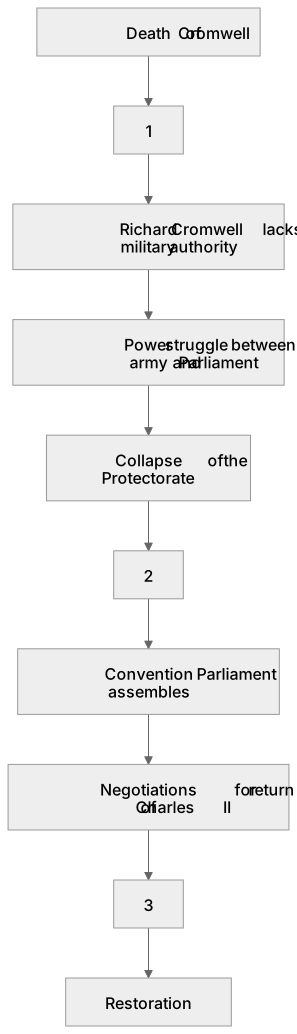
1Box 1
2Box 2
3Box 3
There is more to this lesson
The full lesson goes on to check your understanding and help you earn the marks. Create a free account to carry on, with your progress saved.
A week of Premium from your first lesson · Then the free plan continues · No card, no charge
Test your understanding of 2E The English Revolution, 1625–1660 – Experiments in government and society, 1648–1660 (A-level only): The monarchy restored: political vacuum after the death of Cromwell; negotiations for the return of the monarchy under Charles II; the legacy of the English Revolution by 1660
Active recall beats re-reading. Take an instant quiz now to test what you’ve learned and lock it into long-term memory.
A week of Premium from your first lesson · Then the free plan continues · No card, no charge