AQA · A-Level · History
Course version: 7042 · Version from Sept 2017
Oliver Cromwell and the Protectorate: Cromwell’s personality and approach…
Full specification wording
2E The English Revolution, 1625–1660 – Experiments in government and society, 1648–1660 (A-level only): Oliver Cromwell and the Protectorate: Cromwell’s personality and approach to government and his refusal of the Crown; the limits of religious toleration; the Major Generals; the problem of the succession to Cromwell
Cromwell’s Protectorate was defined by his desire for political 'healing and settling' alongside godly reformation.
Checked against the AQA 7042 specification (opens in a new tab) on .
- Point 3 of 4
- 4 key terms
Study notes
From the checked teaching notes for this specification point.
The idea
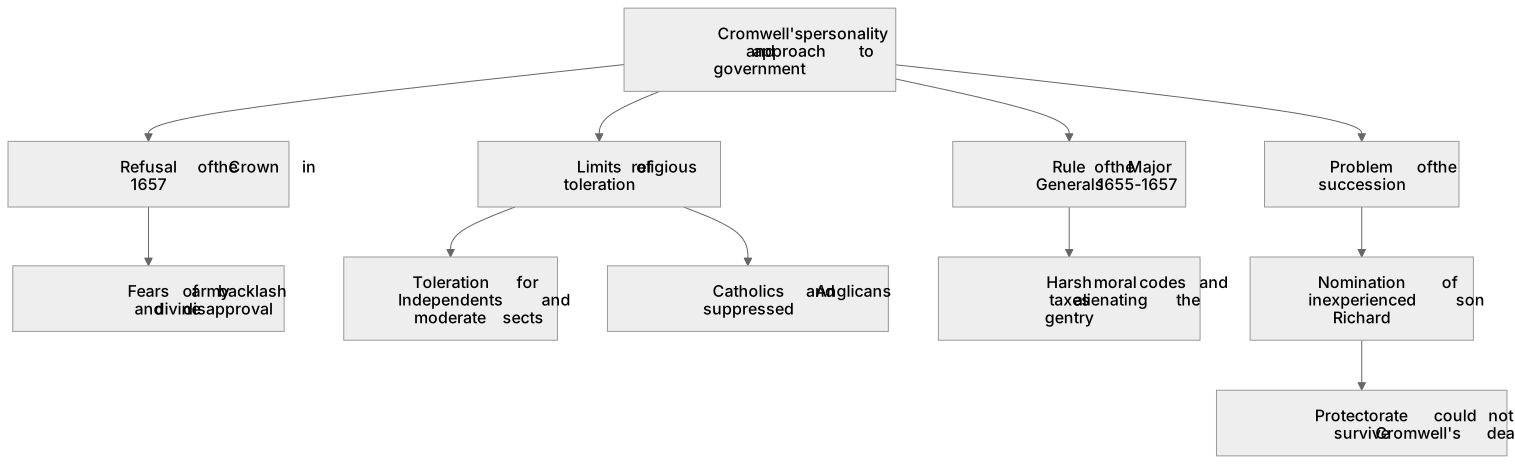
Cromwell’s Protectorate was defined by his desire for political 'healing and settling' alongside godly reformation. His government relied heavily on his personal authority. When offered the monarchy via the Humble Petition and Advice (1657), Cromwell refused the Crown, fearing army backlash and divine disapproval. Religious toleration expanded for Independents, but strict limits remained, with Catholics and Anglicans suppressed. The Rule of the Major Generals (1655–1657) imposed harsh moral codes and taxes, deeply alienating the gentry. Finally, the problem of succession exposed the regime's fragility; Cromwell's nomination of his inexperienced son, Richard, ensured the Protectorate could not survive his death.
What earns the marks
- Explain how Cromwell's providentialism and reliance on the army shaped his approach to government and his ultimate refusal of the Crown in 1657.
- Assess the impact of the Major Generals in alienating the traditional political nation through the decimation tax and enforcement of godly reformation.
- Evaluate the extent of religious toleration, noting the inclusion of moderate sects and Jews, contrasted with the persecution of Catholics and Anglicans.
- Analyse the structural weaknesses of the Protectorate, specifically how the succession of Richard Cromwell highlighted the regime's dependence on Oliver's unique military and political standing.
Common mistakes and how to put them right
Claiming Cromwell accepted the Crown in 1657.
Put it right: State that Cromwell accepted the Humble Petition and Advice but explicitly refused the title of King.
Stating there was absolute religious freedom during the Protectorate.
Put it right: Specify that toleration was limited to Protestant sects, while Catholics, Anglicans, and radical blasphemers were excluded.
Confusing the Rule of the Major Generals with the earlier Rump Parliament.
Put it right: Place the Major Generals accurately between 1655 and 1657 as a direct response to Penruddock's uprising.
Exam tips
- Use the James Nayler case (1656) as a concrete example to demonstrate the limits of religious toleration and the tension between Cromwell and his parliaments.
- When discussing Cromwell's refusal of the Crown, weigh the influence of army opposition against his own providential fears of committing a sin.
- Link the failure of the Major Generals directly to the gentry's desire for a return to traditional, civilian local government.
Try the lesson
The start of the 2E The English Revolution, 1625–1660 – Experiments in government and society, 1648–1660 (A-level only): Oliver Cromwell and the Protectorate: Cromwell’s personality and approach to government and his refusal of the Crown; the limits of religious toleration; the Major Generals; the problem of the succession to Cromwell lesson, made from checked teaching notes for this specification point.
Have a go first
In 1657, Oliver Cromwell was offered the Crown under the Humble Petition and Advice. What was his final decision regarding this offer?
Listen
Cromwell’s Protectorate was defined by his desire for political 'healing and settling' alongside godly reformation. His government relied heavily on his personal authority. When offered the monarchy via the Humble Petition and Advice (1657), Cromwell refused the Crown, fearing army backlash and divine disapproval. Religious toleration expanded for Independents, but strict limits remained, with Catholics and Anglicans suppressed. The Rule of the Major Generals (1655–1657) imposed harsh moral codes and taxes, deeply alienating the gentry. Finally, the problem of succession exposed the regime's fragility; Cromwell's nomination of his inexperienced son, Richard, ensured the Protectorate could not survive his death. A strong answer earns marks for these points. Explain how Cromwell's providentialism and reliance on the army shaped his approach to government and his ultimate refusal of the Crown in 1657. Assess the impact of the Major Generals in alienating the traditional political nation through the decimation tax and enforcement of godly reformation. Evaluate the extent of religious toleration, noting the inclusion of moderate sects and Jews, contrasted with the persecution of Catholics and Anglicans. Analyse the structural weaknesses of the Protectorate, specifically how the succession of Richard Cromwell highlighted the regime's dependence on Oliver's unique military and political standing. A common slip: Claiming Cromwell accepted the Crown in 1657. Instead, State that Cromwell accepted the Humble Petition and Advice but explicitly refused the title of King. Exam tip: Use the James Nayler case (1656) as a concrete example to demonstrate the limits of religious toleration and the tension between Cromwell and his parliaments.
See it
Key words
Say what each word means before you turn the card.
Godly reformation versus political stability
Try answering aloud or in your head before turning the card.
The role of the military in government
Try answering aloud or in your head before turning the card.
Religious radicalism and toleration
Try answering aloud or in your head before turning the card.
The crisis of succession and legitimacy
Try answering aloud or in your head before turning the card.
See every definition
- Godly reformation versus political stability
- Cromwell's Protectorate was defined by his desire for political 'healing and settling' alongside godly reformation.
- The role of the military in government
- His government relied heavily on his personal authority, and the Rule of the Major Generals imposed harsh moral codes and taxes, deeply alienating the gentry.
- Religious radicalism and toleration
- Religious toleration expanded for Independents, but strict limits remained, with Catholics and Anglicans suppressed.
- The crisis of succession and legitimacy
- The problem of succession exposed the regime's fragility; Cromwell's nomination of his inexperienced son, Richard, ensured the Protectorate could not survive his death.
Label the diagram
Some boxes have lost their names. Pick the right name for each number.
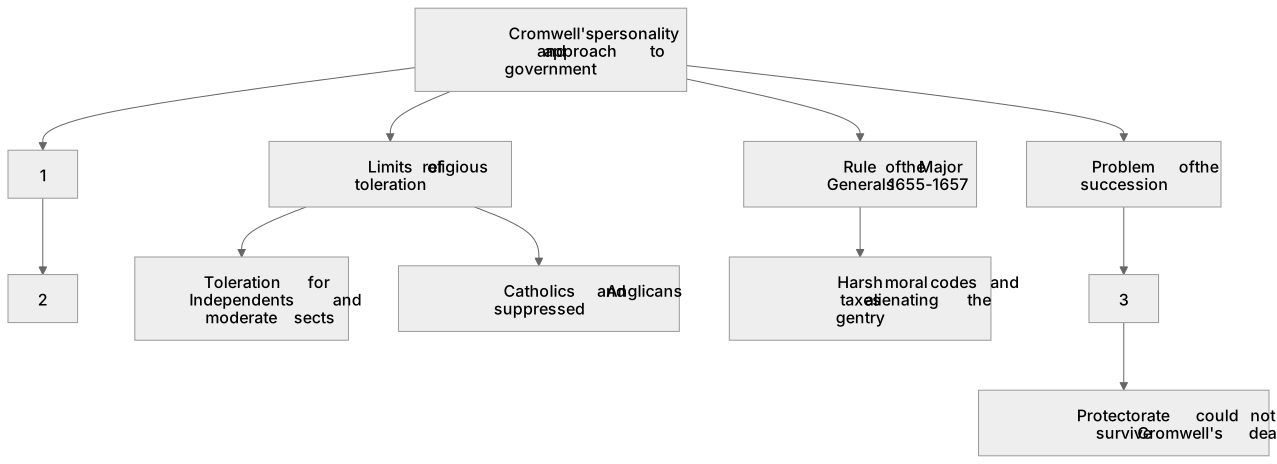
1Box 1
2Box 2
3Box 3
There is more to this lesson
The full lesson goes on to check your understanding and help you earn the marks. Create a free account to carry on, with your progress saved.
A week of Premium from your first lesson · Then the free plan continues · No card, no charge
Test your understanding of 2E The English Revolution, 1625–1660 – Experiments in government and society, 1648–1660 (A-level only): Oliver Cromwell and the Protectorate: Cromwell’s personality and approach to government and his refusal of the Crown; the limits of religious toleration; the Major Generals; the problem of the succession to Cromwell
Active recall beats re-reading. Take an instant quiz now to test what you’ve learned and lock it into long-term memory.
A week of Premium from your first lesson · Then the free plan continues · No card, no charge