AQA · A-Level · History
Course version: 7042 · Version from Sept 2017
The Third Civil War: the attempted Royalist revival; the defeat and exile…
Full specification wording
2E The English Revolution, 1625–1660 – Experiments in government and society, 1648–1660 (A-level only): The Third Civil War: the attempted Royalist revival; the defeat and exile of Prince Charles
The Third Civil War (1649–1651) emerged from an attempted Royalist revival after Charles I's execution.
Checked against the AQA 7042 specification (opens in a new tab) on .
- Point 1 of 4
Study notes
From the checked teaching notes for this specification point.
The idea
The Third Civil War (1649–1651) emerged from an attempted Royalist revival after Charles I's execution. Prince Charles allied with Scottish Covenanters, accepting Presbyterianism to secure military backing against the English republic. Cromwell countered by invading Scotland, winning decisively at Dunbar in 1650. Undeterred, Charles marched a Scottish army into England to rally English Royalists, but faced a crushing defeat at the Battle of Worcester in 1651. Following this destruction of Royalist military hopes, Prince Charles evaded capture and fled into a prolonged exile on the Continent. This decisive defeat ended the Civil Wars, neutralising the Royalist threat for a decade and cementing the authority of the new republican regime.
What earns the marks
- Explain the terms of the Treaty of Breda (1650) and how Prince Charles's alliance with the Covenanters facilitated the attempted Royalist revival.
- Assess the strategic importance of Cromwell's victory at the Battle of Dunbar (1650) in crippling the Scottish-Royalist war effort.
- Analyse the reasons for the failure of the Royalist invasion of England, particularly the lack of support from English Royalists during the march to Worcester.
- Evaluate the consequences of the Battle of Worcester (1651) in securing the English republic and forcing Prince Charles into a nine-year exile.
Common mistakes and how to put them right
Confusing the Second and Third Civil Wars.
Put it right: Ensure the Third Civil War is specifically identified as the 1649-1651 conflict involving Prince Charles and the Scots, not the 1648 uprisings.
Assuming English Royalists heavily supported Charles at Worcester.
Put it right: Note that English Royalist turnout was extremely poor, which was a key factor in his defeat.
Stating Charles was captured after Worcester.
Put it right: Specify that Charles successfully evaded capture and escaped into exile on the Continent.
Exam tips
- When evaluating the survival of the Republic, contrast the severe threat posed by the Scottish alliance with the ultimate weakness of English Royalist support in 1651.
- Use the Battle of Worcester as a definitive turning point that shifted the Republic's focus from military survival to political settlement.
- Link Prince Charles's exile to the broader European context, noting how foreign powers were reluctant to support a defeated exile over the formidable New Model Army.
Try the lesson
The start of the 2E The English Revolution, 1625–1660 – Experiments in government and society, 1648–1660 (A-level only): The Third Civil War: the attempted Royalist revival; the defeat and exile of Prince Charles lesson, made from checked teaching notes for this specification point.
Have a go first
Which battle in 1651 marked the final defeat of Prince Charles and the end of the Third Civil War, forcing him into exile?
Listen
The Third Civil War (1649–1651) emerged from an attempted Royalist revival after Charles I's execution. Prince Charles allied with Scottish Covenanters, accepting Presbyterianism to secure military backing against the English republic. Cromwell countered by invading Scotland, winning decisively at Dunbar in 1650. Undeterred, Charles marched a Scottish army into England to rally English Royalists, but faced a crushing defeat at the Battle of Worcester in 1651. Following this destruction of Royalist military hopes, Prince Charles evaded capture and fled into a prolonged exile on the Continent. This decisive defeat ended the Civil Wars, neutralising the Royalist threat for a decade and cementing the authority of the new republican regime. A strong answer earns marks for these points. Explain the terms of the Treaty of Breda (1650) and how Prince Charles's alliance with the Covenanters facilitated the attempted Royalist revival. Assess the strategic importance of Cromwell's victory at the Battle of Dunbar (1650) in crippling the Scottish-Royalist war effort. Analyse the reasons for the failure of the Royalist invasion of England, particularly the lack of support from English Royalists during the march to Worcester. Evaluate the consequences of the Battle of Worcester (1651) in securing the English republic and forcing Prince Charles into a nine-year exile. A common slip: Confusing the Second and Third Civil Wars. Instead, Ensure the Third Civil War is specifically identified as the 1649-1651 conflict involving Prince Charles and the Scots, not the 1648 uprisings. Exam tip: When evaluating the survival of the Republic, contrast the severe threat posed by the Scottish alliance with the ultimate weakness of English Royalist support in 1651.
See it
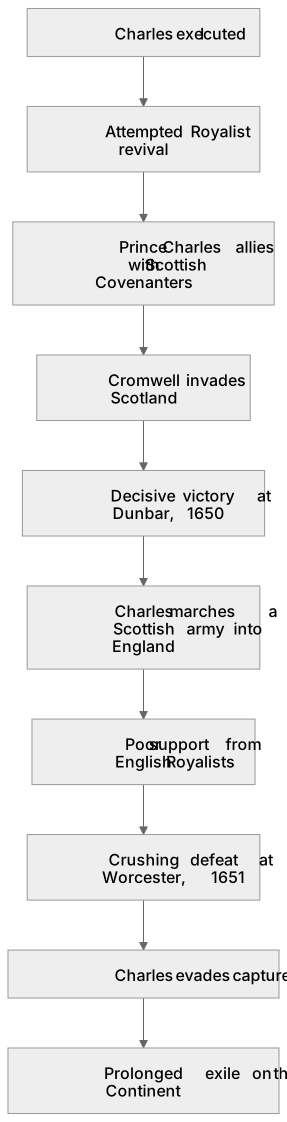
Label the diagram
Some boxes have lost their names. Pick the right name for each number.
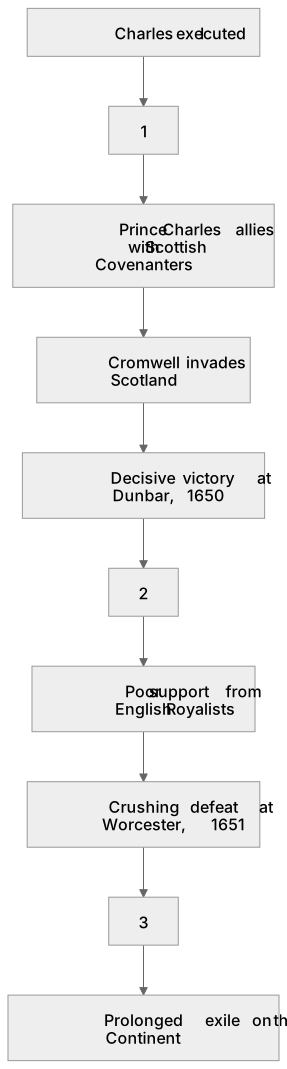
1Box 1
2Box 2
3Box 3
There is more to this lesson
The full lesson goes on to check your understanding and help you earn the marks. Create a free account to carry on, with your progress saved.
A week of Premium from your first lesson · Then the free plan continues · No card, no charge
Test your understanding of 2E The English Revolution, 1625–1660 – Experiments in government and society, 1648–1660 (A-level only): The Third Civil War: the attempted Royalist revival; the defeat and exile of Prince Charles
Active recall beats re-reading. Take an instant quiz now to test what you’ve learned and lock it into long-term memory.
A week of Premium from your first lesson · Then the free plan continues · No card, no charge