AQA · A-Level · History
Course version: 7042 · Version from Sept 2017
Political radicalism: failure of the Levellers and Diggers and the ‘Godly…
Full specification wording
2E The English Revolution, 1625–1660 – Experiments in government and society, 1648–1660 (A-level only): Political radicalism: failure of the Levellers and Diggers and the ‘Godly Society’; Quakers, Baptists and other radical sects; the Rump Parliament as an experiment in radical republicanism; the Parliament of the Saints
The period 1648–1660 saw intense political radicalism and religious experimentation.
Checked against the AQA 7042 specification (opens in a new tab) on .
- Point 2 of 4
- 4 key terms
Study notes
From the checked teaching notes for this specification point.
The idea
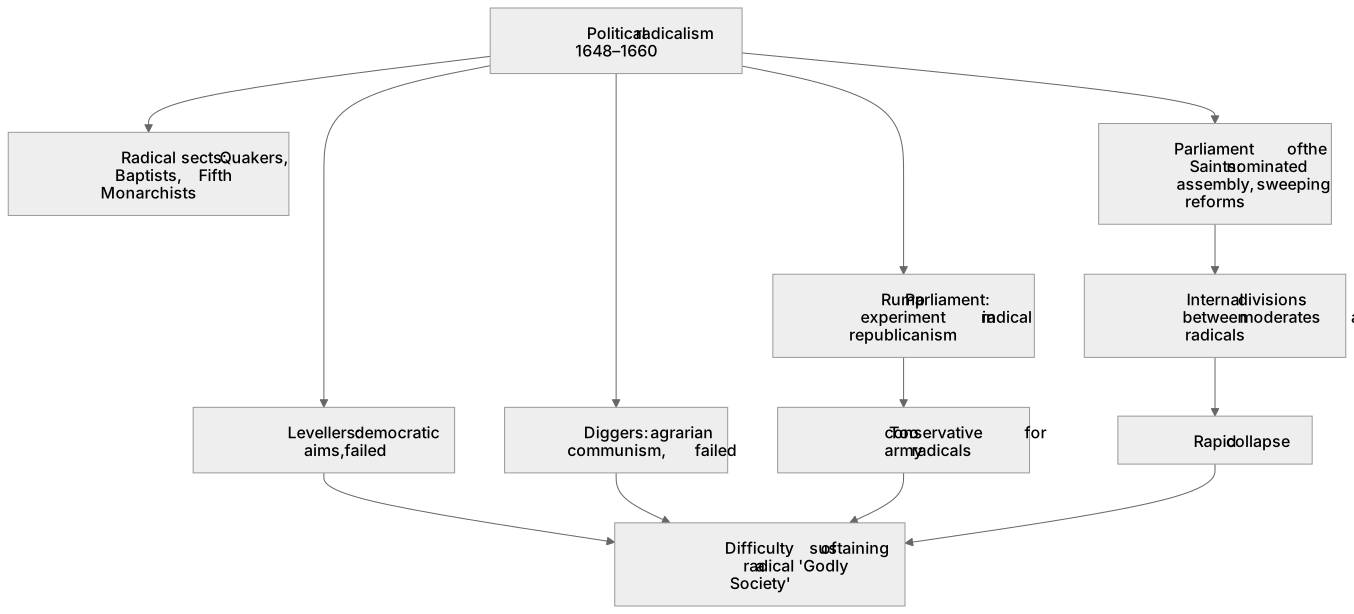
The period 1648–1660 saw intense political radicalism and religious experimentation. The Levellers' push for democratic franchise and the Diggers' agrarian communism both failed, suppressed by a regime fearing social anarchy. The broader vision of a 'Godly Society' struggled against conservative resistance. Radical sects like the Quakers, Baptists, and Fifth Monarchists proliferated, challenging traditional hierarchies. The Rump Parliament (1648–1653) served as an initial experiment in radical republicanism, abolishing the monarchy, yet it proved too conservative for army radicals. Its replacement, the Parliament of the Saints (1653), was a unique assembly of nominated men aiming to enact sweeping reforms. However, internal divisions between moderates and radicals led to its rapid collapse, highlighting the inherent difficulties of sustaining a radical 'Godly Society'.
What earns the marks
- Analyse the reasons for the failure of the Levellers (e.g., Burford mutiny) and Diggers in achieving their political and social aims.
- Evaluate the growth and perceived threat of radical religious sects, including Quakers and Baptists, to the established social order.
- Assess the extent to which the Rump Parliament functioned as a genuine experiment in radical republicanism versus a conservative holding operation.
- Explain the origins, radical objectives, and ultimate failure of the Parliament of the Saints (Barebone's Parliament) in establishing a 'Godly Society'.
Common mistakes and how to put them right
Treating all radical groups as having the same aims.
Put it right: Distinguish clearly between the secular and political aims of the Levellers, the economic radicalism of the Diggers, and the religious focus of the Quakers and Baptists.
Viewing the Rump Parliament as entirely radical.
Put it right: Acknowledge that while its origins (Pride's Purge) and actions (regicide) were radical, its members were largely conservative and resisted further social reform.
Confusing the Rump Parliament with the Parliament of the Saints.
Put it right: Ensure the Rump (the purged Long Parliament) is distinct from the Parliament of the Saints (the nominated assembly of 1653).
Exam tips
- When discussing the failure of radicalism, emphasise the role of the New Model Army leadership in suppressing groups that threatened property and social order.
- Contrast the Rump Parliament's reluctance to enact sweeping reforms with the Parliament of the Saints' overly ambitious and divisive radical agenda.
- Use the proliferation of sects like the Quakers to illustrate the breakdown of censorship and the fear of a 'world turned upside down' among the traditional gentry.
Try the lesson
The start of the 2E The English Revolution, 1625–1660 – Experiments in government and society, 1648–1660 (A-level only): Political radicalism: failure of the Levellers and Diggers and the ‘Godly Society’; Quakers, Baptists and other radical sects; the Rump Parliament as an experiment in radical republicanism; the Parliament of the Saints lesson, made from checked teaching notes for this specification point.
Have a go first
Which radical group during the English Revolution, led by Gerrard Winstanley, attempted to establish egalitarian communes and cultivate common land?
Listen
The period 1648–1660 saw intense political radicalism and religious experimentation. The Levellers' push for democratic franchise and the Diggers' agrarian communism both failed, suppressed by a regime fearing social anarchy. The broader vision of a 'Godly Society' struggled against conservative resistance. Radical sects like the Quakers, Baptists, and Fifth Monarchists proliferated, challenging traditional hierarchies. The Rump Parliament (1648–1653) served as an initial experiment in radical republicanism, abolishing the monarchy, yet it proved too conservative for army radicals. Its replacement, the Parliament of the Saints (1653), was a unique assembly of nominated men aiming to enact sweeping reforms. However, internal divisions between moderates and radicals led to its rapid collapse, highlighting the inherent difficulties of sustaining a radical 'Godly Society'. A strong answer earns marks for these points. Analyse the reasons for the failure of the Levellers (e.g., Burford mutiny) and Diggers in achieving their political and social aims. Evaluate the growth and perceived threat of radical religious sects, including Quakers and Baptists, to the established social order. Assess the extent to which the Rump Parliament functioned as a genuine experiment in radical republicanism versus a conservative holding operation. Explain the origins, radical objectives, and ultimate failure of the Parliament of the Saints (Barebone's Parliament) in establishing a 'Godly Society'. A common slip: Treating all radical groups as having the same aims. Instead, Distinguish clearly between the secular and political aims of the Levellers, the economic radicalism of the Diggers, and the religious focus of the Quakers and Baptists. Exam tip: When discussing the failure of radicalism, emphasise the role of the New Model Army leadership in suppressing groups that threatened property and social order.
See it
Key words
Say what each word means before you turn the card.
Political and social radicalism
Try answering aloud or in your head before turning the card.
Religious dissent and sectarianism
Try answering aloud or in your head before turning the card.
Republican government and constitutional experiments
Try answering aloud or in your head before turning the card.
The tension between radical reform and social conservatism
Try answering aloud or in your head before turning the card.
See every definition
- Political and social radicalism
- Intense political radicalism and religious experimentation in which the Levellers' push for democratic franchise and the Diggers' agrarian communism both failed, suppressed by a regime fearing social anarchy.
- Religious dissent and sectarianism
- Radical sects like the Quakers, Baptists and Fifth Monarchists proliferated, challenging traditional hierarchies, while the broader vision of a 'Godly Society' struggled against conservative resistance.
- Republican government and constitutional experiments
- The Rump Parliament served as an initial experiment in radical republicanism, abolishing the monarchy, and was replaced by the Parliament of the Saints, a unique assembly of nominated men aiming to enact sweeping reforms.
- The tension between radical reform and social conservatism
- The Rump Parliament proved too conservative for army radicals, and internal divisions between moderates and radicals led to the rapid collapse of the Parliament of the Saints.
Label the diagram
Some boxes have lost their names. Pick the right name for each number.
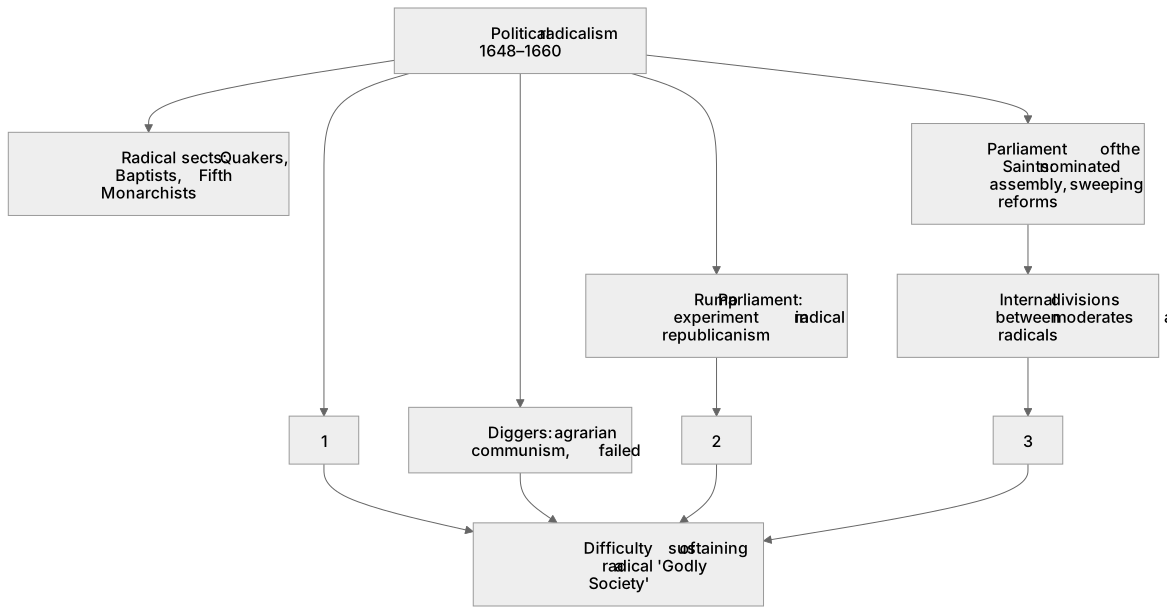
1Box 1
2Box 2
3Box 3
There is more to this lesson
The full lesson goes on to check your understanding and help you earn the marks. Create a free account to carry on, with your progress saved.
A week of Premium from your first lesson · Then the free plan continues · No card, no charge
Test your understanding of 2E The English Revolution, 1625–1660 – Experiments in government and society, 1648–1660 (A-level only): Political radicalism: failure of the Levellers and Diggers and the ‘Godly Society’; Quakers, Baptists and other radical sects; the Rump Parliament as an experiment in radical republicanism; the Parliament of the Saints
Active recall beats re-reading. Take an instant quiz now to test what you’ve learned and lock it into long-term memory.
A week of Premium from your first lesson · Then the free plan continues · No card, no charge