AQA · A-Level · History
Course version: 7042 · Version from Sept 2017
Political and religious divisions: the attitude and actions of Charles I;…
Full specification wording
2E The English Revolution, 1625–1660 – The disintegration of the Political Nation, 1646–1649 (A-level only): Political and religious divisions: the attitude and actions of Charles I; divisions within the opposition to the King; the failure of attempts to reach a political settlement
The period 1646–1649 was defined by deep political and religious divisions that thwarted a stable peace.
Checked against the AQA 7042 specification (opens in a new tab) on .
- Point 2 of 4
Study notes
From the checked teaching notes for this specification point.
The idea
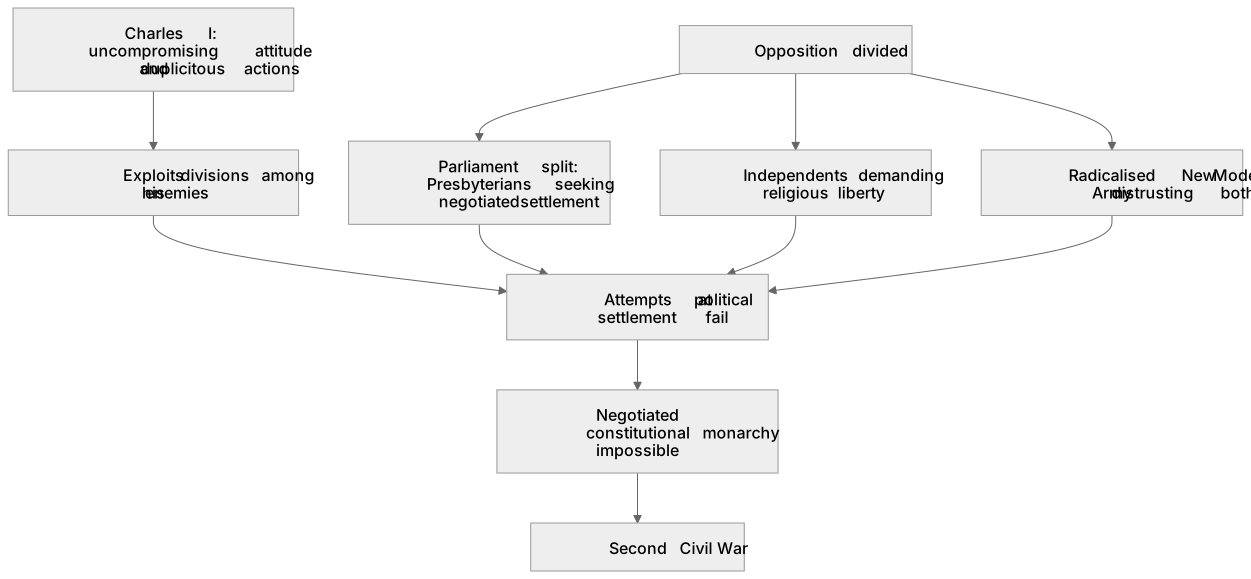
The period 1646–1649 was defined by deep political and religious divisions that thwarted a stable peace. Charles I’s uncompromising attitude and duplicitous actions, notably his refusal to accept defeat and his secret Engagement with the Scots in 1647, deliberately exploited these fractures. The opposition to the King was severely divided: Parliament was split between Presbyterians seeking a negotiated settlement and Independents demanding religious liberty, while the increasingly radicalised New Model Army distrusted both. Consequently, various attempts to reach a political settlement, such as the Newcastle Propositions and the Heads of the Proposals, ultimately failed. Charles’s intransigence and the fragmented opposition made a negotiated constitutional monarchy impossible, leading to the Second Civil War.
What earns the marks
- Analyse how Charles I's belief in Divine Right and his tactical delays prevented a viable post-war settlement.
- Evaluate the impact of the King's secret Engagement with the Scots in triggering the Second Civil War.
- Examine the religious and political divisions between the Political Presbyterians and Political Independents in Parliament.
- Assess why specific settlement proposals, such as the Newcastle Propositions and the Heads of the Proposals, were rejected by the respective parties.
Common mistakes and how to put them right
Treating the parliamentary opposition as a united front after the First Civil War.
Put it right: Emphasise the deep factionalism between the conservative Presbyterians and the radical Independents and the Army.
Stating that Charles I negotiated in good faith to reach a settlement.
Put it right: Highlight that Charles used negotiations as a delaying tactic to exploit divisions among his enemies and rebuild his military strength.
Confusing the terms of the Newcastle Propositions with the Heads of the Proposals.
Put it right: The Newcastle Propositions of 1646 were harsh parliamentary demands including Presbyterianism, whereas the Heads of the Proposals of 1647 were more moderate terms drafted by the Army.
Exam tips
- Contrast the Newcastle Propositions with the Heads of the Proposals to demonstrate the differing priorities of Parliament and the New Model Army.
- Argue whether the failure to reach a settlement was primarily due to Charles I's intransigence or the irreconcilable divisions within the victorious Parliamentarian ranks.
- Use the Engagement with the Scots as a turning point that convinced the Army that Charles I was a 'man of blood' who could not be trusted.
Try the lesson
The start of the 2E The English Revolution, 1625–1660 – The disintegration of the Political Nation, 1646–1649 (A-level only): Political and religious divisions: the attitude and actions of Charles I; divisions within the opposition to the King; the failure of attempts to reach a political settlement lesson, made from checked teaching notes for this specification point.
Have a go first
Following the First Civil War, what was the primary religious division between the Political Presbyterians and the Political Independents in Parliament?
Listen
The period 1646–1649 was defined by deep political and religious divisions that thwarted a stable peace. Charles I’s uncompromising attitude and duplicitous actions, notably his refusal to accept defeat and his secret Engagement with the Scots in 1647, deliberately exploited these fractures. The opposition to the King was severely divided: Parliament was split between Presbyterians seeking a negotiated settlement and Independents demanding religious liberty, while the increasingly radicalised New Model Army distrusted both. Consequently, various attempts to reach a political settlement, such as the Newcastle Propositions and the Heads of the Proposals, ultimately failed. Charles’s intransigence and the fragmented opposition made a negotiated constitutional monarchy impossible, leading to the Second Civil War. A strong answer earns marks for these points. Analyse how Charles I's belief in Divine Right and his tactical delays prevented a viable post-war settlement. Evaluate the impact of the King's secret Engagement with the Scots in triggering the Second Civil War. Examine the religious and political divisions between the Political Presbyterians and Political Independents in Parliament. Assess why specific settlement proposals, such as the Newcastle Propositions and the Heads of the Proposals, were rejected by the respective parties. A common slip: Treating the parliamentary opposition as a united front after the First Civil War. Instead, Emphasise the deep factionalism between the conservative Presbyterians and the radical Independents and the Army. Exam tip: Contrast the Newcastle Propositions with the Heads of the Proposals to demonstrate the differing priorities of Parliament and the New Model Army.
See it
Label the diagram
Some boxes have lost their names. Pick the right name for each number.
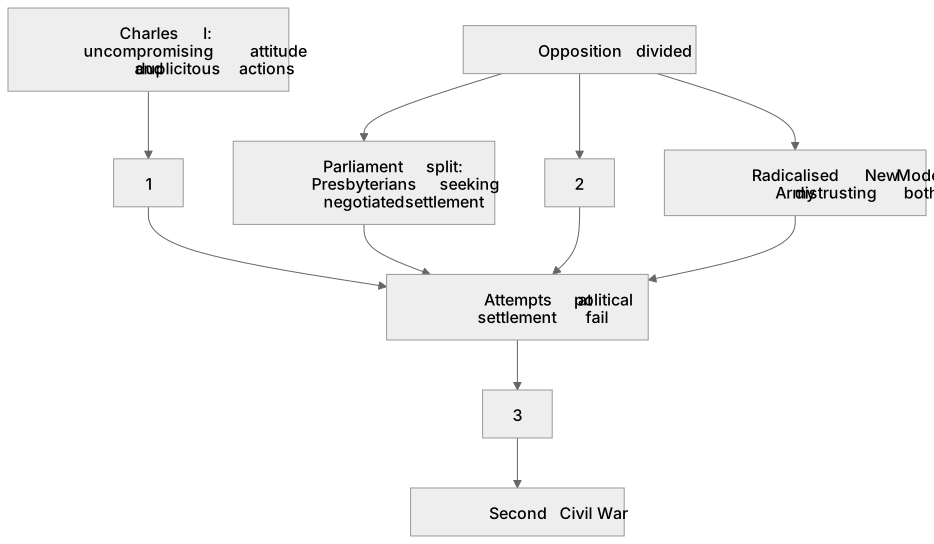
1Box 1
2Box 2
3Box 3
There is more to this lesson
The full lesson goes on to check your understanding and help you earn the marks. Create a free account to carry on, with your progress saved.
A week of Premium from your first lesson · Then the free plan continues · No card, no charge
Test your understanding of 2E The English Revolution, 1625–1660 – The disintegration of the Political Nation, 1646–1649 (A-level only): Political and religious divisions: the attitude and actions of Charles I; divisions within the opposition to the King; the failure of attempts to reach a political settlement
Active recall beats re-reading. Take an instant quiz now to test what you’ve learned and lock it into long-term memory.
A week of Premium from your first lesson · Then the free plan continues · No card, no charge