AQA · A-Level · History
Course version: 7042 · Version from Sept 2017
Political and religious radicalism: the politicisation of the New Model…
Full specification wording
2E The English Revolution, 1625–1660 – The disintegration of the Political Nation, 1646–1649 (A-level only): Political and religious radicalism: the politicisation of the New Model Army; Lilburne and the Levellers; Fifth Monarchists; Ranters and other populist groups
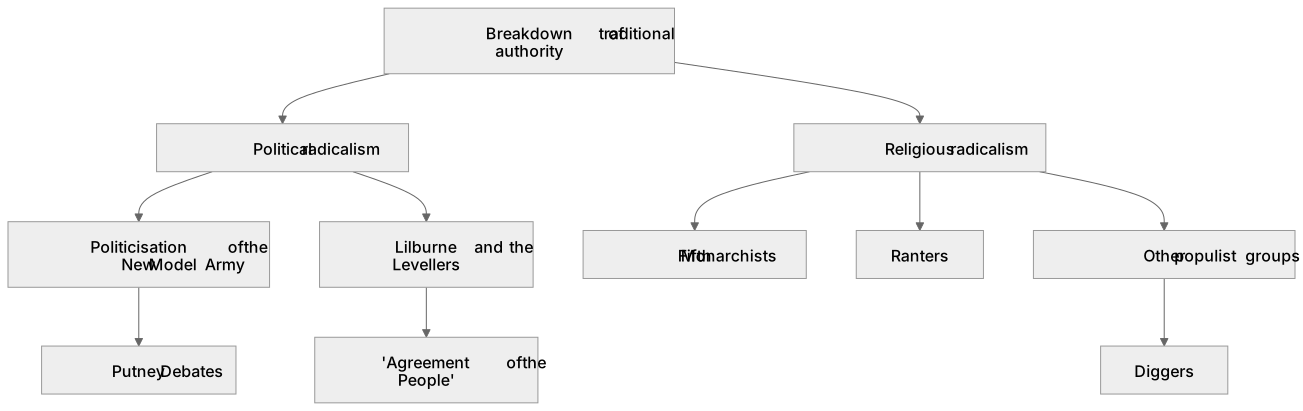
Between 1646 and 1649, the breakdown of traditional authority fuelled intense political and religious radicalism.
Checked against the AQA 7042 specification (opens in a new tab) on .
- Point 1 of 4
- 4 key terms
Study notes
From the checked teaching notes for this specification point.
The idea
Between 1646 and 1649, the breakdown of traditional authority fuelled intense political and religious radicalism. The New Model Army became highly politicised, driven by arrears of pay and religious zeal, culminating in the Putney Debates where soldiers demanded a voice in the settlement. John Lilburne and the Levellers championed popular sovereignty, wider male suffrage, and religious tolerance, drafting the 'Agreement of the People'. Simultaneously, extreme religious sects emerged. The Fifth Monarchists anticipated the imminent return of Christ and advocated a theocracy, while the Ranters rejected orthodox morality, believing that those predestined for salvation could not sin. Other populist groups, such as the Diggers, pushed for agrarian communism, reflecting the era's profound ideological ferment.
What earns the marks
- Explain the factors driving the politicisation of the New Model Army, including material grievances such as pay arrears and ideological radicalism.
- Assess the influence of John Lilburne and the Levellers in promoting democratic ideas, specifically through the 'Agreement of the People'.
- Analyse the theological and political threat posed by the Fifth Monarchists' millenarianism to the established social order.
- Evaluate the social impact and perceived threat of the Ranters and other populist groups like the Diggers in challenging traditional hierarchies.
Common mistakes and how to put them right
Confusing the Levellers with the Diggers.
Put it right: Ensure you distinguish the Levellers, who sought political reform and wider suffrage, from the Diggers, who advocated for agrarian communism and the abolition of private property.
Assuming the New Model Army was uniformly radical.
Put it right: Recognise that radicalism was primarily concentrated among the rank-and-file and Agitators, whereas the Grandees, such as Cromwell and Ireton, were significantly more conservative.
Overstating the actual numbers of Ranters.
Put it right: Acknowledge that while the Ranters caused immense moral panic in the contemporary press, their actual numbers and organised threat were highly exaggerated by conservative propagandists.
Exam tips
- Use the Putney Debates of 1647 as a primary example to demonstrate the clash between Leveller radicalism and the conservatism of the Army Grandees.
- When discussing religious radicalism, explicitly link the breakdown of censorship and the collapse of the established Church to the proliferation of sects.
- Evaluate the extent to which these radical groups actually threatened the political settlement versus the perceived threat amplified by conservative propaganda.
Try the lesson
The start of the 2E The English Revolution, 1625–1660 – The disintegration of the Political Nation, 1646–1649 (A-level only): Political and religious radicalism: the politicisation of the New Model Army; Lilburne and the Levellers; Fifth Monarchists; Ranters and other populist groups lesson, made from checked teaching notes for this specification point.
Have a go first
Which of the following best describes the core belief of the Fifth Monarchists during the English Revolution?
Listen
Between 1646 and 1649, the breakdown of traditional authority fuelled intense political and religious radicalism. The New Model Army became highly politicised, driven by arrears of pay and religious zeal, culminating in the Putney Debates where soldiers demanded a voice in the settlement. John Lilburne and the Levellers championed popular sovereignty, wider male suffrage, and religious tolerance, drafting the 'Agreement of the People'. Simultaneously, extreme religious sects emerged. The Fifth Monarchists anticipated the imminent return of Christ and advocated a theocracy, while the Ranters rejected orthodox morality, believing that those predestined for salvation could not sin. Other populist groups, such as the Diggers, pushed for agrarian communism, reflecting the era's profound ideological ferment. A strong answer earns marks for these points. Explain the factors driving the politicisation of the New Model Army, including material grievances such as pay arrears and ideological radicalism. Assess the influence of John Lilburne and the Levellers in promoting democratic ideas, specifically through the 'Agreement of the People'. Analyse the theological and political threat posed by the Fifth Monarchists' millenarianism to the established social order. Evaluate the social impact and perceived threat of the Ranters and other populist groups like the Diggers in challenging traditional hierarchies. A common slip: Confusing the Levellers with the Diggers. Instead, Ensure you distinguish the Levellers, who sought political reform and wider suffrage, from the Diggers, who advocated for agrarian communism and the abolition of private property. Exam tip: Use the Putney Debates of 1647 as a primary example to demonstrate the clash between Leveller radicalism and the conservatism of the Army Grandees.
See it
Key words
Say what each word means before you turn the card.
Radicalism and dissent
Try answering aloud or in your head before turning the card.
Military intervention in politics
Try answering aloud or in your head before turning the card.
Religious millenarianism
Try answering aloud or in your head before turning the card.
Social hierarchy and popular sovereignty
Try answering aloud or in your head before turning the card.
See every definition
- Radicalism and dissent
- Intense political and religious radicalism fuelled by the breakdown of traditional authority between 1646 and 1649.
- Military intervention in politics
- The New Model Army became highly politicised, driven by arrears of pay and religious zeal, demanding a voice in the settlement.
- Religious millenarianism
- The Fifth Monarchists anticipated the imminent return of Christ and advocated a theocracy.
- Social hierarchy and popular sovereignty
- John Lilburne and the Levellers championed popular sovereignty, wider male suffrage and religious tolerance through the 'Agreement of the People'.
Label the diagram
Some boxes have lost their names. Pick the right name for each number.
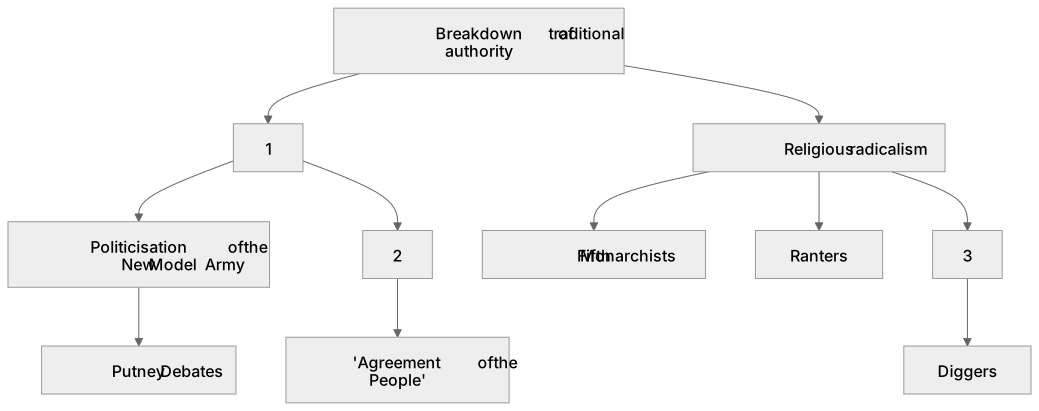
1Box 1
2Box 2
3Box 3
There is more to this lesson
The full lesson goes on to check your understanding and help you earn the marks. Create a free account to carry on, with your progress saved.
A week of Premium from your first lesson · Then the free plan continues · No card, no charge
Test your understanding of 2E The English Revolution, 1625–1660 – The disintegration of the Political Nation, 1646–1649 (A-level only): Political and religious radicalism: the politicisation of the New Model Army; Lilburne and the Levellers; Fifth Monarchists; Ranters and other populist groups
Active recall beats re-reading. Take an instant quiz now to test what you’ve learned and lock it into long-term memory.
A week of Premium from your first lesson · Then the free plan continues · No card, no charge