AQA · A-Level · History
Course version: 7042 · Version from Sept 2017
Monarchy and Divine Right: the character and aims of Charles I; the Queen…
Full specification wording
2E The English Revolution, 1625–1660 – The emergence of conflict and the end of consensus, 1625–1629: Monarchy and Divine Right: the character and aims of Charles I; the Queen and the court; the King's advisers; ideas of royal authority
Charles I firmly believed in the Divine Right of Kings, viewing his royal authority as accountable only to God, which profoundly shaped his uncompromising aims and character.
Checked against the AQA 7042 specification (opens in a new tab) on .
- Point 2 of 4
- 2 key terms
Study notes
From the checked teaching notes for this specification point.
The idea
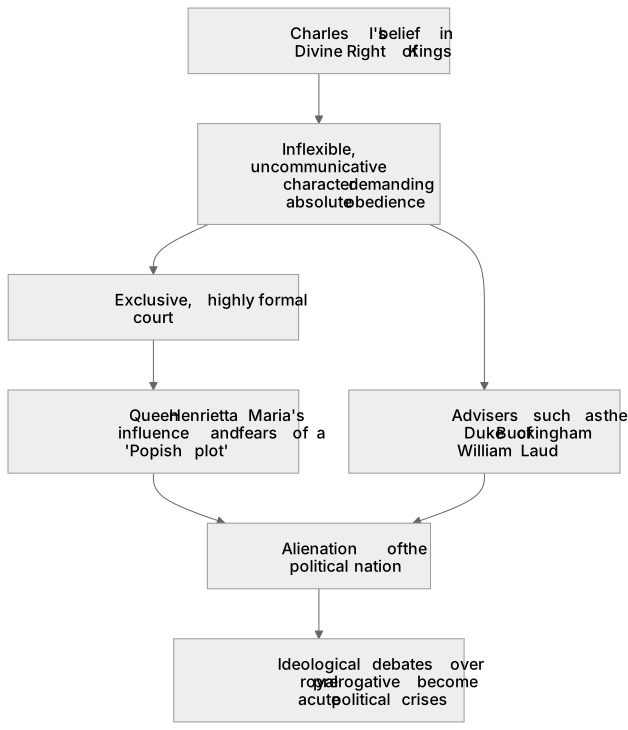
Charles I firmly believed in the Divine Right of Kings, viewing his royal authority as accountable only to God, which profoundly shaped his uncompromising aims and character. Unlike his pragmatic father, Charles was inflexible, uncommunicative, and demanded absolute obedience. His court reflected this, becoming an exclusive, highly formal environment heavily influenced by his Catholic Queen, Henrietta Maria, whose presence fuelled fears of a 'Popish plot'. The King's advisers, notably the deeply unpopular Duke of Buckingham and later figures like William Laud, reinforced his authoritarian tendencies. Consequently, Charles's interpretation of monarchy alienated the political nation, transforming ideological debates over royal prerogative into acute political crises.
What earns the marks
- Analyse how Charles I's strict interpretation of the Divine Right of Kings influenced his unwillingness to negotiate with Parliament.
- Evaluate the impact of Charles I's personal character, particularly his inflexibility and poor communication skills, on the escalation of political conflict.
- Assess the role of Queen Henrietta Maria and the visual culture of the Caroline court in generating fears of Catholic influence and absolutism.
- Examine the influence of key advisers, especially the Duke of Buckingham, in shaping the King's policies and provoking parliamentary opposition.
Common mistakes and how to put them right
Stating that Charles I wanted to establish a Catholic absolute monarchy.
Put it right: Charles was a devout Anglican who believed in Divine Right, though his Arminian preferences and Catholic wife created the illusion of a Catholic agenda.
Treating the court and Parliament as completely separate entities.
Put it right: Many MPs were also courtiers, and the alienation of the broader political nation from the exclusive Caroline court was a key source of tension.
Assuming Henrietta Maria dominated Charles's policy from 1625.
Put it right: Her political influence grew significantly only after the assassination of the Duke of Buckingham in 1628.
Exam tips
- Contrast Charles I's rigid interpretation of royal authority with James I's more pragmatic approach to highlight the shift in the style of monarchy.
- Use specific examples of court culture, such as the commissioning of Rubens' ceiling at the Banqueting House, to illustrate Charles's ideas of divine royal authority.
- Link the unpopularity of the King's advisers directly to parliamentary attempts to restrict royal prerogative, such as the attempted impeachment of Buckingham.
Try the lesson
The start of the 2E The English Revolution, 1625–1660 – The emergence of conflict and the end of consensus, 1625–1629: Monarchy and Divine Right: the character and aims of Charles I; the Queen and the court; the King's advisers; ideas of royal authority lesson, made from checked teaching notes for this specification point.
Have a go first
How did Charles I's interpretation of the 'Divine Right of Kings' primarily influence his early relationship with Parliament?
Listen
Charles I firmly believed in the Divine Right of Kings, viewing his royal authority as accountable only to God, which profoundly shaped his uncompromising aims and character. Unlike his pragmatic father, Charles was inflexible, uncommunicative, and demanded absolute obedience. His court reflected this, becoming an exclusive, highly formal environment heavily influenced by his Catholic Queen, Henrietta Maria, whose presence fuelled fears of a 'Popish plot'. The King's advisers, notably the deeply unpopular Duke of Buckingham and later figures like William Laud, reinforced his authoritarian tendencies. Consequently, Charles's interpretation of monarchy alienated the political nation, transforming ideological debates over royal prerogative into acute political crises. A strong answer earns marks for these points. Analyse how Charles I's strict interpretation of the Divine Right of Kings influenced his unwillingness to negotiate with Parliament. Evaluate the impact of Charles I's personal character, particularly his inflexibility and poor communication skills, on the escalation of political conflict. Assess the role of Queen Henrietta Maria and the visual culture of the Caroline court in generating fears of Catholic influence and absolutism. Examine the influence of key advisers, especially the Duke of Buckingham, in shaping the King's policies and provoking parliamentary opposition. A common slip: Stating that Charles I wanted to establish a Catholic absolute monarchy. Instead, Charles was a devout Anglican who believed in Divine Right, though his Arminian preferences and Catholic wife created the illusion of a Catholic agenda. Exam tip: Contrast Charles I's rigid interpretation of royal authority with James I's more pragmatic approach to highlight the shift in the style of monarchy.
See it
Key words
Say what each word means before you turn the card.
Divine Right of Kings
Try answering aloud or in your head before turning the card.
Caroline court
Try answering aloud or in your head before turning the card.
See every definition
- Divine Right of Kings
- The belief that royal authority is accountable only to God, which profoundly shaped Charles I's uncompromising aims and character.
- Caroline court
- An exclusive, highly formal environment heavily influenced by the Catholic Queen, Henrietta Maria, whose presence fuelled fears of a 'Popish plot'.
Label the diagram
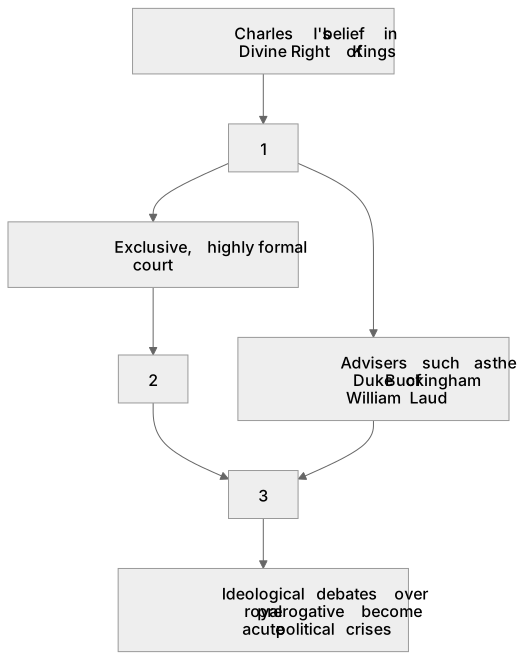
Some boxes have lost their names. Pick the right name for each number.
1Box 1
2Box 2
3Box 3
There is more to this lesson
The full lesson goes on to check your understanding and help you earn the marks. Create a free account to carry on, with your progress saved.
A week of Premium from your first lesson · Then the free plan continues · No card, no charge
Test your understanding of 2E The English Revolution, 1625–1660 – The emergence of conflict and the end of consensus, 1625–1629: Monarchy and Divine Right: the character and aims of Charles I; the Queen and the court; the King's advisers; ideas of royal authority
Active recall beats re-reading. Take an instant quiz now to test what you’ve learned and lock it into long-term memory.
A week of Premium from your first lesson · Then the free plan continues · No card, no charge