AQA · A-Level · History
Course version: 7042 · Version from Sept 2017
Challenges to the arbitrary government of Charles I: reactions against…
Full specification wording
2E The English Revolution, 1625–1660 – The emergence of conflict and the end of consensus, 1625–1629: Challenges to the arbitrary government of Charles I: reactions against financial policies; conflict over Church; reactions against foreign policy and the role of Buckingham
Charles I’s early reign (1625–1629) saw mounting opposition to his perceived arbitrary government.
Checked against the AQA 7042 specification (opens in a new tab) on .
- Point 3 of 4
- 4 key terms
Study notes
From the checked teaching notes for this specification point.
The idea
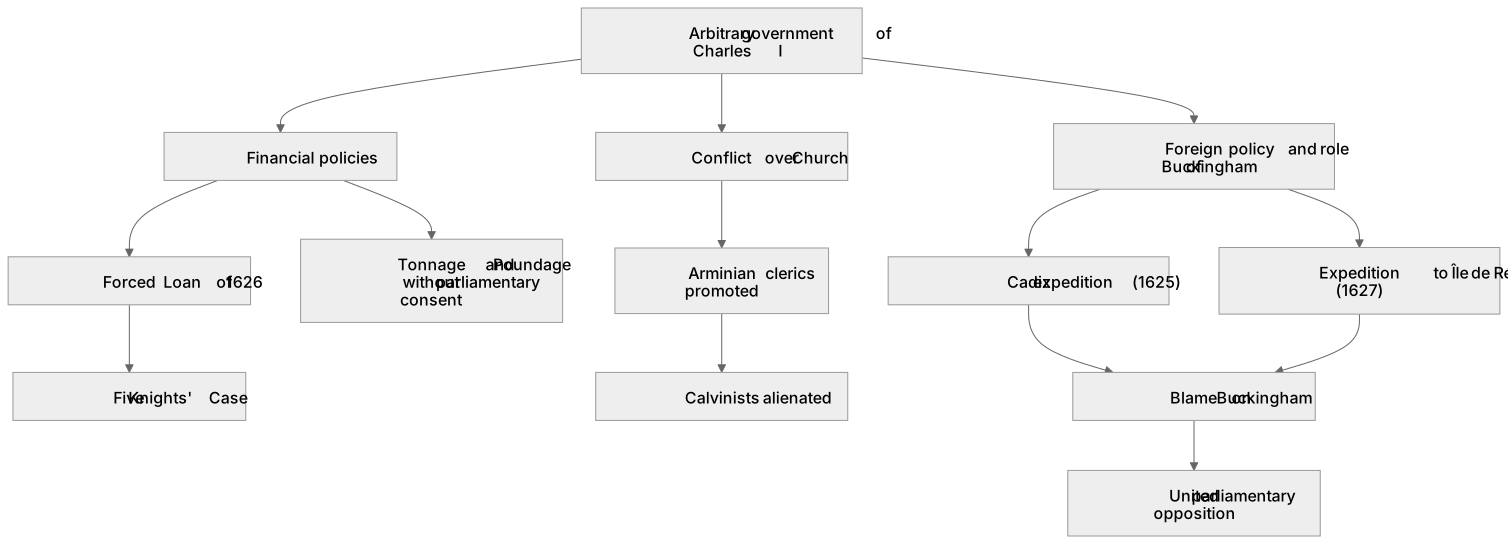
Charles I’s early reign (1625–1629) saw mounting opposition to his perceived arbitrary government. Financial policies, notably the Forced Loan of 1626 and the collection of Tonnage and Poundage without parliamentary consent, provoked widespread resistance, culminating in the Five Knights' Case. Religious conflict escalated as Charles promoted Arminian clerics like Richard Montagu, alienating Calvinists who feared a Catholic resurgence. Foreign policy failures, such as the disastrous Cadiz expedition (1625) and the expedition to Île de Ré (1627), were blamed squarely on the Duke of Buckingham. Buckingham’s dominance over patronage and military strategy united parliamentary opposition, leading to attempts to impeach him and fracturing the relationship between Crown and Parliament.
What earns the marks
- Explain the constitutional implications of the Forced Loan and the Five Knights' Case as evidence of arbitrary government.
- Analyse the religious tensions caused by Charles I's support for Arminianism and the promotion of figures like Richard Montagu and William Laud.
- Evaluate the impact of foreign policy failures at Cadiz and La Rochelle on Crown-Parliament relations.
- Assess the role of the Duke of Buckingham as a focal point for parliamentary grievances and the significance of his assassination in 1628.
Common mistakes and how to put them right
Claiming that Charles I was a Catholic.
Put it right: Charles I was a devout Anglican who favoured Arminianism; it was his Arminian policies and Catholic wife that raised fears of Catholicism, not his own personal faith.
Confusing the Forced Loan with Ship Money.
Put it right: The Forced Loan was a key financial grievance of the 1625–1629 period, whereas Ship Money became a major issue later during the Personal Rule in the 1630s.
Stating that Parliament opposed all foreign wars.
Put it right: Parliament initially supported a naval war against Spain but opposed the specific strategies, financial mismanagement, and the land campaigns directed by Buckingham.
Exam tips
- Link financial, religious, and foreign policy grievances together to demonstrate how they cumulatively created a perception of arbitrary government.
- Use specific examples of foreign policy failures, such as the Cadiz expedition, to explain why Parliament was reluctant to grant Charles adequate funding.
- When discussing Buckingham, evaluate whether he was the root cause of the conflict or merely a convenient scapegoat for Charles's own failings.
Try the lesson
The start of the 2E The English Revolution, 1625–1660 – The emergence of conflict and the end of consensus, 1625–1629: Challenges to the arbitrary government of Charles I: reactions against financial policies; conflict over Church; reactions against foreign policy and the role of Buckingham lesson, made from checked teaching notes for this specification point.
Have a go first
Which military failure in 1625 significantly intensified parliamentary opposition to the Duke of Buckingham's direction of foreign policy?
Listen
Charles I’s early reign (1625–1629) saw mounting opposition to his perceived arbitrary government. Financial policies, notably the Forced Loan of 1626 and the collection of Tonnage and Poundage without parliamentary consent, provoked widespread resistance, culminating in the Five Knights' Case. Religious conflict escalated as Charles promoted Arminian clerics like Richard Montagu, alienating Calvinists who feared a Catholic resurgence. Foreign policy failures, such as the disastrous Cadiz expedition (1625) and the expedition to Île de Ré (1627), were blamed squarely on the Duke of Buckingham. Buckingham’s dominance over patronage and military strategy united parliamentary opposition, leading to attempts to impeach him and fracturing the relationship between Crown and Parliament. A strong answer earns marks for these points. Explain the constitutional implications of the Forced Loan and the Five Knights' Case as evidence of arbitrary government. Analyse the religious tensions caused by Charles I's support for Arminianism and the promotion of figures like Richard Montagu and William Laud. Evaluate the impact of foreign policy failures at Cadiz and La Rochelle on Crown-Parliament relations. Assess the role of the Duke of Buckingham as a focal point for parliamentary grievances and the significance of his assassination in 1628. A common slip: Claiming that Charles I was a Catholic. Instead, Charles I was a devout Anglican who favoured Arminianism; it was his Arminian policies and Catholic wife that raised fears of Catholicism, not his own personal faith. Exam tip: Link financial, religious, and foreign policy grievances together to demonstrate how they cumulatively created a perception of arbitrary government.
See it
Put the events in order
Put these events in the order they happened, earliest first.
- 1. The Duke of Buckingham was assassinated
- 2. The disastrous Cadiz expedition took place
- 3. The expedition to Île de Ré failed
- 4. The Forced Loan provoked widespread resistance
Key words
Say what each word means before you turn the card.
Arbitrary government and the royal prerogative
Try answering aloud or in your head before turning the card.
Religious division and the rise of Arminianism
Try answering aloud or in your head before turning the card.
The financial limitations of the Crown
Try answering aloud or in your head before turning the card.
The influence of royal favourites
Try answering aloud or in your head before turning the card.
See every definition
- Arbitrary government and the royal prerogative
- The perceived arbitrary government of Charles I provoked mounting opposition, expressed through reactions against his financial policies, conflict over the Church, and reactions against foreign policy and the role of Buckingham.
- Religious division and the rise of Arminianism
- Religious conflict escalated as Charles promoted Arminian clerics, alienating Calvinists who feared a Catholic resurgence.
- The financial limitations of the Crown
- Financial policies, notably the Forced Loan of 1626 and the collection of Tonnage and Poundage without parliamentary consent, provoked widespread resistance, culminating in the Five Knights' Case.
- The influence of royal favourites
- Foreign policy failures were blamed squarely on the Duke of Buckingham, whose dominance over patronage and military strategy united parliamentary opposition.
Label the diagram
Some boxes have lost their names. Pick the right name for each number.
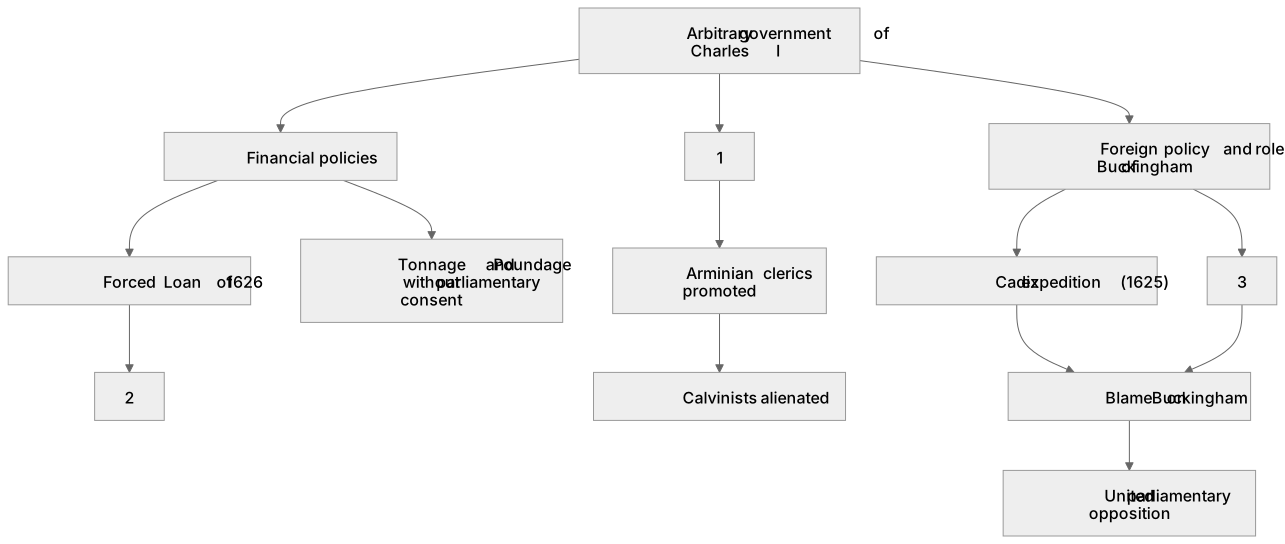
1Box 1
2Box 2
3Box 3
There is more to this lesson
The full lesson goes on to check your understanding and help you earn the marks. Create a free account to carry on, with your progress saved.
A week of Premium from your first lesson · Then the free plan continues · No card, no charge
Test your understanding of 2E The English Revolution, 1625–1660 – The emergence of conflict and the end of consensus, 1625–1629: Challenges to the arbitrary government of Charles I: reactions against financial policies; conflict over Church; reactions against foreign policy and the role of Buckingham
Active recall beats re-reading. Take an instant quiz now to test what you’ve learned and lock it into long-term memory.
A week of Premium from your first lesson · Then the free plan continues · No card, no charge