AQA · A-Level · History
Course version: 7042 · Version from Sept 2017
Parliamentary radicalism; personalities and policies of parliamentary…
Full specification wording
2E The English Revolution, 1625–1660 – The emergence of conflict and the end of consensus, 1625–1629: Parliamentary radicalism; personalities and policies of parliamentary opposition to the King; the Petition of Right; the dissolution of Parliament and the King’s commitment to Personal Rule
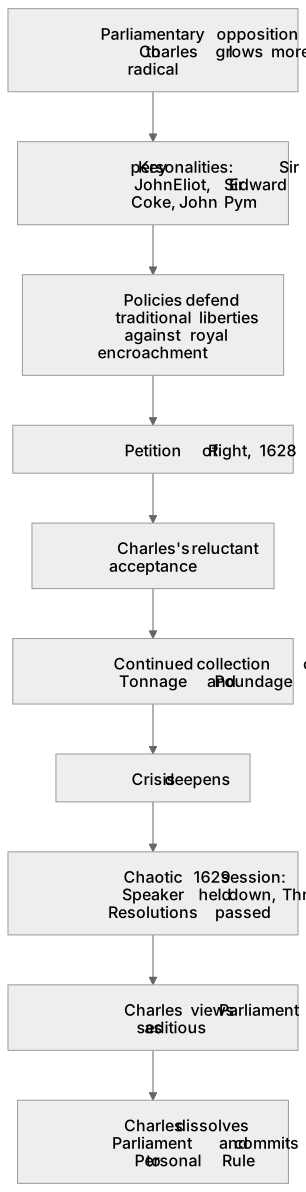
Between 1625 and 1629, parliamentary opposition to Charles I grew increasingly radical, driven by key personalities like Sir John Eliot, Sir Edward Coke, and John Pym.
Checked against the AQA 7042 specification (opens in a new tab) on .
- Point 4 of 4
- 4 key terms
Study notes
From the checked teaching notes for this specification point.
The idea
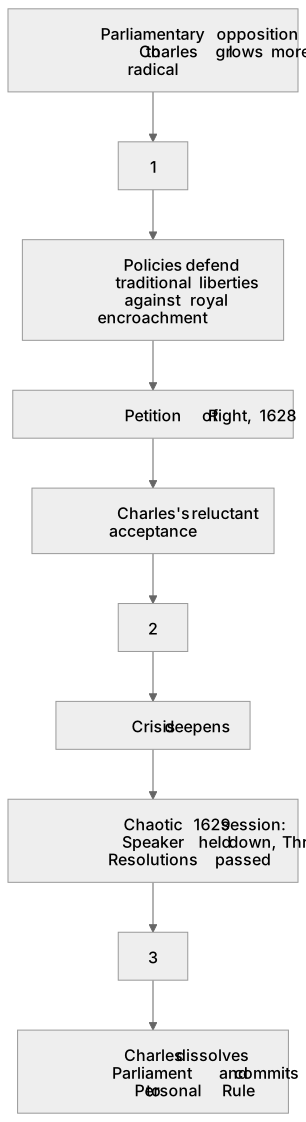
Between 1625 and 1629, parliamentary opposition to Charles I grew increasingly radical, driven by key personalities like Sir John Eliot, Sir Edward Coke, and John Pym. Their policies focused on defending traditional liberties against royal encroachment. This culminated in the 1628 Petition of Right, a landmark constitutional document demanding an end to non-parliamentary taxation, imprisonment without cause, martial law, and billeting. Charles’s reluctant acceptance, followed by his continued collection of Tonnage and Poundage, deepened the crisis. The 1629 session ended in chaos with the passing of the Three Resolutions while the Speaker was held down in his chair. Viewing Parliament as seditious, Charles dissolved it and committed to Personal Rule, governing without Parliament for eleven years.
What earns the marks
- Identify key parliamentary figures such as Sir John Eliot and Sir Edward Coke, and explain their specific roles in organising opposition.
- Analyse the four main clauses of the Petition of Right (1628) and explain how they directly responded to Charles I's earlier policies.
- Evaluate the significance of the 1629 parliamentary session, including the holding down of the Speaker and the passing of the Three Resolutions.
- Assess the reasons for Charles I's decision to dissolve Parliament in 1629 and his subsequent commitment to Personal Rule.
Common mistakes and how to put them right
Describing the Petition of Right as a revolutionary document aiming to overthrow the King.
Put it right: The Petition of Right was framed as a conservative document, seeking to confirm traditional English liberties and restore the ancient constitution, not to depose the monarch.
Assuming Parliament was a unified body of radicals.
Put it right: Parliament contained a spectrum of opinions; the 'radicals' were a vocal minority who managed to lead the Commons during moments of high tension, while many MPs simply wanted a return to consensus.
Stating that Charles I abolished Parliament in 1629.
Put it right: Charles I did not abolish Parliament; he dissolved it and chose not to call another one, embarking on his Personal Rule using his prerogative powers.
Exam tips
- Detail the specific terms of the Petition of Right to demonstrate precise knowledge of parliamentary grievances.
- Contrast the motives of parliamentary leaders like Coke, who focused on legal precedents, with the more aggressive tactics of Eliot.
- Discuss the dissolution of Parliament in 1629 not just as an end to the session, but as the beginning of a deliberate ideological shift towards Personal Rule.
Try the lesson
The start of the 2E The English Revolution, 1625–1660 – The emergence of conflict and the end of consensus, 1625–1629: Parliamentary radicalism; personalities and policies of parliamentary opposition to the King; the Petition of Right; the dissolution of Parliament and the King’s commitment to Personal Rule lesson, made from checked teaching notes for this specification point.
Have a go first
Which of the following grievances was explicitly addressed and condemned by the 1628 Petition of Right?
Listen
Between 1625 and 1629, parliamentary opposition to Charles I grew increasingly radical, driven by key personalities like Sir John Eliot, Sir Edward Coke, and John Pym. Their policies focused on defending traditional liberties against royal encroachment. This culminated in the 1628 Petition of Right, a landmark constitutional document demanding an end to non-parliamentary taxation, imprisonment without cause, martial law, and billeting. Charles’s reluctant acceptance, followed by his continued collection of Tonnage and Poundage, deepened the crisis. The 1629 session ended in chaos with the passing of the Three Resolutions while the Speaker was held down in his chair. Viewing Parliament as seditious, Charles dissolved it and committed to Personal Rule, governing without Parliament for eleven years. A strong answer earns marks for these points. Identify key parliamentary figures such as Sir John Eliot and Sir Edward Coke, and explain their specific roles in organising opposition. Analyse the four main clauses of the Petition of Right (1628) and explain how they directly responded to Charles I's earlier policies. Evaluate the significance of the 1629 parliamentary session, including the holding down of the Speaker and the passing of the Three Resolutions. Assess the reasons for Charles I's decision to dissolve Parliament in 1629 and his subsequent commitment to Personal Rule. A common slip: Describing the Petition of Right as a revolutionary document aiming to overthrow the King. Instead, The Petition of Right was framed as a conservative document, seeking to confirm traditional English liberties and restore the ancient constitution, not to depose the monarch. Exam tip: Detail the specific terms of the Petition of Right to demonstrate precise knowledge of parliamentary grievances.
See it
Key words
Say what each word means before you turn the card.
Petition of Right
Try answering aloud or in your head before turning the card.
Personal Rule
Try answering aloud or in your head before turning the card.
parliamentary opposition
Try answering aloud or in your head before turning the card.
Three Resolutions
Try answering aloud or in your head before turning the card.
See every definition
- Petition of Right
- A landmark constitutional document of 1628 demanding an end to non-parliamentary taxation, imprisonment without cause, martial law and billeting.
- Personal Rule
- Governing without Parliament, to which Charles committed after dissolving Parliament in 1629.
- parliamentary opposition
- Opposition to the King that grew increasingly radical between 1625 and 1629, driven by key personalities and focused on defending traditional liberties.
- Three Resolutions
- Passed in the chaotic 1629 session while the Speaker was held down in his chair.
Label the diagram
Some boxes have lost their names. Pick the right name for each number.
1Box 1
2Box 2
3Box 3
There is more to this lesson
The full lesson goes on to check your understanding and help you earn the marks. Create a free account to carry on, with your progress saved.
A week of Premium from your first lesson · Then the free plan continues · No card, no charge
Test your understanding of 2E The English Revolution, 1625–1660 – The emergence of conflict and the end of consensus, 1625–1629: Parliamentary radicalism; personalities and policies of parliamentary opposition to the King; the Petition of Right; the dissolution of Parliament and the King’s commitment to Personal Rule
Active recall beats re-reading. Take an instant quiz now to test what you’ve learned and lock it into long-term memory.
A week of Premium from your first lesson · Then the free plan continues · No card, no charge