AQA · A-Level · History
Course version: 7042 · Version from Sept 2017
Louis XIV, France and Europe, 1643– 1715 (A-level only) – Challenges at…
Full specification wording
2F The Sun King: Louis XIV, France and Europe, 1643– 1715 (A-level only) – Challenges at home, 1685–1715: Louis XIV and the Church: Gallicanism; relations with Huguenots; Jansenists and Quietists
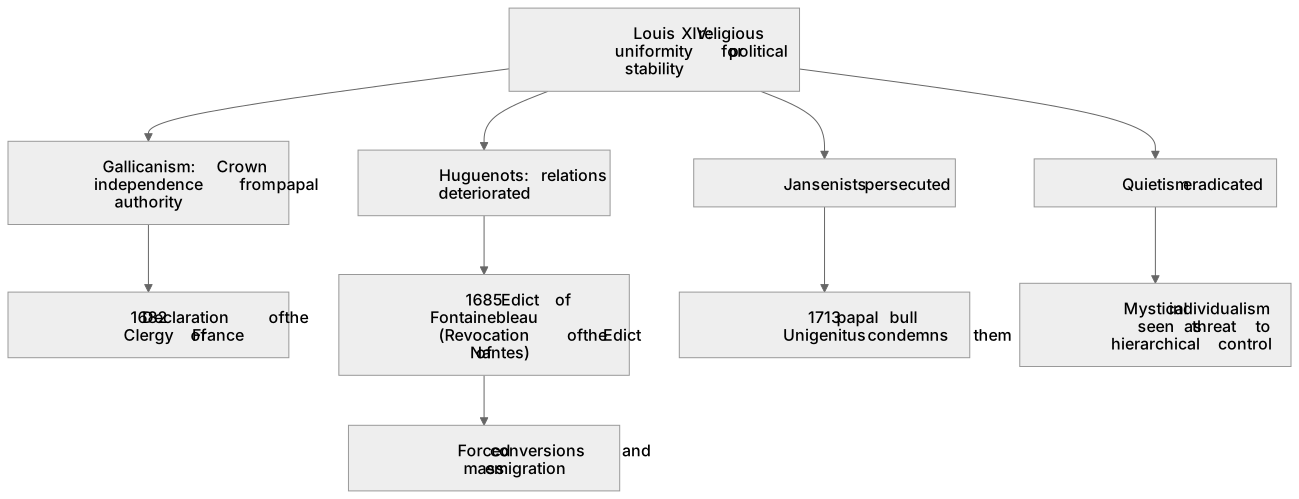
Louis XIV viewed religious uniformity as essential for political stability.
Checked against the AQA 7042 specification (opens in a new tab) on .
- Point 3 of 4
Study notes
From the checked teaching notes for this specification point.
The idea
Louis XIV viewed religious uniformity as essential for political stability. He championed Gallicanism, asserting the French Crown's independence from papal authority, culminating in the 1682 Declaration of the Clergy of France. His relations with Protestant Huguenots deteriorated, leading to the 1685 Edict of Fontainebleau (Revocation of the Edict of Nantes), which forced conversions and triggered mass emigration. Louis also suppressed dissenting Catholic movements. He persecuted the Jansenists, who emphasised divine grace, eventually securing the papal bull Unigenitus (1713) to condemn them. Similarly, he eradicated Quietism, a mystical movement advocating passive contemplation, viewing its individualism as a threat to orthodox hierarchical control.
What earns the marks
- Explain the principles of Gallicanism and how the 1682 Gallican Articles asserted royal authority over the Pope in temporal matters.
- Analyse the motivations behind the Revocation of the Edict of Nantes (1685) and its economic and social impact on France due to Huguenot emigration.
- Evaluate the theological and political threat posed by Jansenism, focusing on Port-Royal and the significance of the papal bull Unigenitus.
- Assess the reasons for the suppression of Quietism, noting the roles of Madame Guyon and Fénelon, and why Louis XIV perceived mystical individualism as subversive.
Common mistakes and how to put them right
Confusing Jansenism with Protestantism.
Put it right: Jansenists were reformist Catholics who remained within the Church despite their Augustinian views on grace.
Assuming the Revocation of the Edict of Nantes successfully eliminated Protestantism.
Put it right: Many Huguenots continued to practice secretly (the Church of the Desert) or rebelled, as seen in the Camisard revolt.
Overstating the Pope's compliance with Gallicanism.
Put it right: Innocent XI fiercely resisted the 1682 Articles, leading to a prolonged diplomatic standoff over the appointment of bishops.
Exam tips
- Link Louis XIV's religious policies directly to his broader pursuit of absolute monarchical authority and the concept of 'one king, one law, one faith'.
- Use specific dates and documents, such as the 1682 Gallican Articles and the 1685 Edict of Fontainebleau, to anchor your arguments chronologically.
- Contrast the different types of threats posed by the Huguenots (a distinct minority) versus the Jansenists and Quietists (internal Catholic divisions).
Try the lesson
The start of the 2F The Sun King: Louis XIV, France and Europe, 1643– 1715 (A-level only) – Challenges at home, 1685–1715: Louis XIV and the Church: Gallicanism; relations with Huguenots; Jansenists and Quietists lesson, made from checked teaching notes for this specification point.
Have a go first
Which religious group was directly targeted by Louis XIV's Edict of Fontainebleau in 1685, resulting in the loss of their legal right to practice their faith?
Listen
Louis XIV viewed religious uniformity as essential for political stability. He championed Gallicanism, asserting the French Crown's independence from papal authority, culminating in the 1682 Declaration of the Clergy of France. His relations with Protestant Huguenots deteriorated, leading to the 1685 Edict of Fontainebleau (Revocation of the Edict of Nantes), which forced conversions and triggered mass emigration. Louis also suppressed dissenting Catholic movements. He persecuted the Jansenists, who emphasised divine grace, eventually securing the papal bull Unigenitus (1713) to condemn them. Similarly, he eradicated Quietism, a mystical movement advocating passive contemplation, viewing its individualism as a threat to orthodox hierarchical control. A strong answer earns marks for these points. Explain the principles of Gallicanism and how the 1682 Gallican Articles asserted royal authority over the Pope in temporal matters. Analyse the motivations behind the Revocation of the Edict of Nantes (1685) and its economic and social impact on France due to Huguenot emigration. Evaluate the theological and political threat posed by Jansenism, focusing on Port-Royal and the significance of the papal bull Unigenitus. Assess the reasons for the suppression of Quietism, noting the roles of Madame Guyon and Fénelon, and why Louis XIV perceived mystical individualism as subversive. Exam tip: Link Louis XIV's religious policies directly to his broader pursuit of absolute monarchical authority and the concept of 'one king, one law, one faith'.
See it
Put the events in order
Put these events in the order they happened, earliest first.
- 1. Declaration of the Clergy of France asserts Crown independence from papal authority
- 2. Papal bull Unigenitus condemns the Jansenists
- 3. Edict of Fontainebleau revokes the Edict of Nantes
Label the diagram
Some boxes have lost their names. Pick the right name for each number.
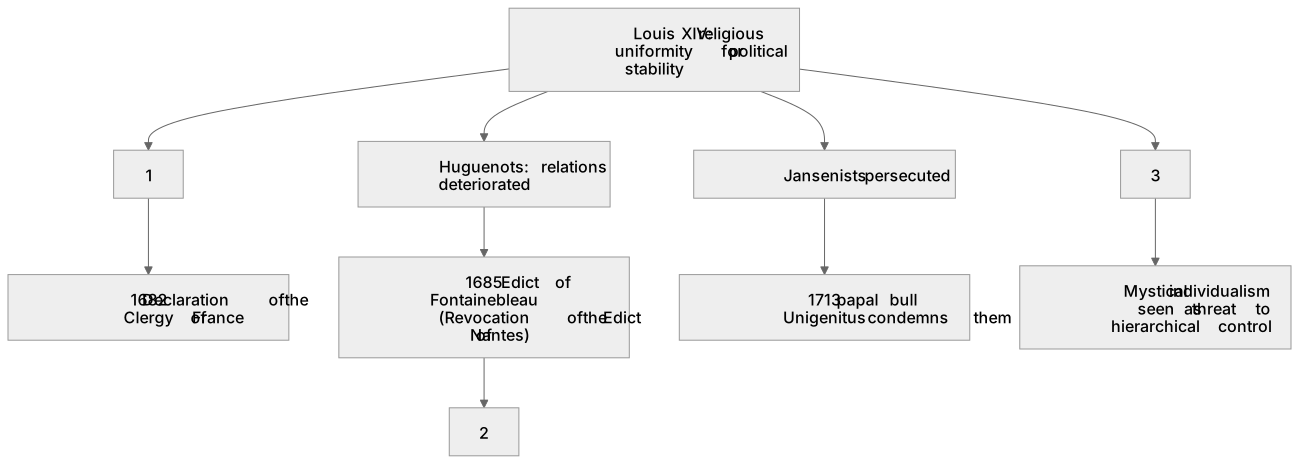
1Box 1
2Box 2
3Box 3
There is more to this lesson
The full lesson goes on to check your understanding and help you earn the marks. Create a free account to carry on, with your progress saved.
A week of Premium from your first lesson · Then the free plan continues · No card, no charge
Test your understanding of 2F The Sun King: Louis XIV, France and Europe, 1643– 1715 (A-level only) – Challenges at home, 1685–1715: Louis XIV and the Church: Gallicanism; relations with Huguenots; Jansenists and Quietists
Active recall beats re-reading. Take an instant quiz now to test what you’ve learned and lock it into long-term memory.
A week of Premium from your first lesson · Then the free plan continues · No card, no charge