AQA · A-Level · History
Course version: 7042 · Version from Sept 2017
Louis XIV, France and Europe, 1643– 1715 (A-level only) – Challenges at…
Full specification wording
2F The Sun King: Louis XIV, France and Europe, 1643– 1715 (A-level only) – Challenges at home, 1685–1715: Pressures from below: social divisions; problems with the regions; discontent and popular protests
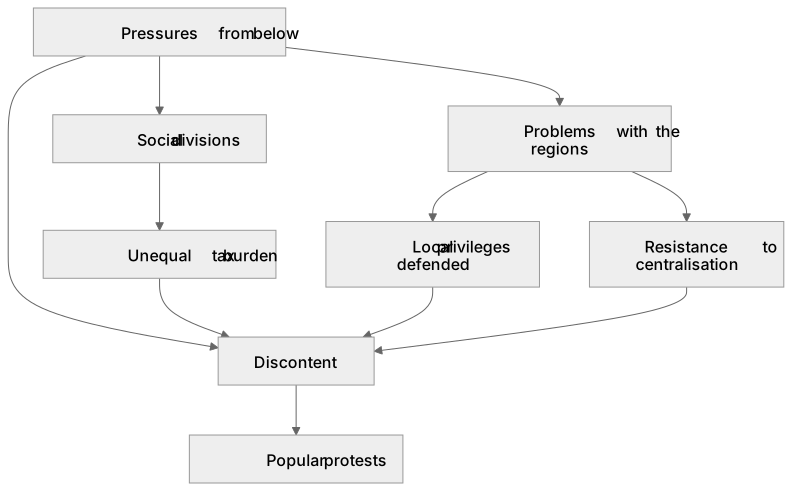
Late seventeenth-century France faced severe pressures from below, exacerbated by war, famine, and heavy taxation.
Checked against the AQA 7042 specification (opens in a new tab) on .
- Point 4 of 4
- 4 key terms
Study notes
From the checked teaching notes for this specification point.
The idea
Late seventeenth-century France faced severe pressures from below, exacerbated by war, famine, and heavy taxation. Deep social divisions existed between the privileged estates, who were largely exempt from direct taxes like the taille, and the heavily burdened Third Estate. Problems with the regions persisted, as peripheral provinces fiercely defended their local privileges and resisted centralisation efforts by royal intendants. This systemic inequality, combined with subsistence crises such as the devastating winter of 1709, fuelled widespread discontent. Popular protests frequently erupted, ranging from anti-tax revolts like the Tard-Avisés to the religiously motivated Camisard rebellion in the Cévennes, directly challenging royal authority.
What earns the marks
- Analyse the structural inequalities of the French estate system, focusing on the unequal distribution of the tax burden, particularly the taille and gabelle.
- Evaluate the tension between central royal authority (intendants) and regional autonomy, especially in the pays d'états like Brittany and Languedoc.
- Assess the impact of external pressures, such as the War of the Spanish Succession and the Great Frost of 1709, on domestic living standards and popular discontent.
- Examine the causes and characteristics of specific popular protests, such as the Camisard revolt (1702-1704) or local anti-tax riots, and the state's methods of suppression.
Common mistakes and how to put them right
Treating the Third Estate as a homogenous group.
Put it right: It encompassed wealthy bourgeoisie, urban workers, and impoverished peasants, each experiencing social pressures differently.
Assuming royal absolutism meant total control over the regions.
Put it right: Local parlements and provincial estates retained significant obstructive power against royal decrees.
Attributing popular protests solely to political opposition.
Put it right: Most uprisings were driven by immediate economic desperation, subsistence crises, or specific new taxes rather than anti-monarchical ideology.
Exam tips
- Connect the economic strain of Louis XIV's continuous foreign wars directly to the increasing social divisions and tax burdens placed on the peasantry.
- Use the concept of the 'subsistence crisis' to explain the timing and severity of popular protests during the latter half of Louis XIV's reign.
- When discussing regional problems, explicitly contrast the pays d'élections (where the king had more direct tax control) with the pays d'états (which negotiated their tax contributions).
Try the lesson
The start of the 2F The Sun King: Louis XIV, France and Europe, 1643– 1715 (A-level only) – Challenges at home, 1685–1715: Pressures from below: social divisions; problems with the regions; discontent and popular protests lesson, made from checked teaching notes for this specification point.
Have a go first
During the later years of Louis XIV's reign, which social group bore the primary burden of the *taille*, the main direct tax in France?
Listen
Late seventeenth-century France faced severe pressures from below, exacerbated by war, famine, and heavy taxation. Deep social divisions existed between the privileged estates, who were largely exempt from direct taxes like the taille, and the heavily burdened Third Estate. Problems with the regions persisted, as peripheral provinces fiercely defended their local privileges and resisted centralisation efforts by royal intendants. This systemic inequality, combined with subsistence crises such as the devastating winter of 1709, fuelled widespread discontent. Popular protests frequently erupted, ranging from anti-tax revolts like the Tard-Avisés to the religiously motivated Camisard rebellion in the Cévennes, directly challenging royal authority. A strong answer earns marks for these points. Analyse the structural inequalities of the French estate system, focusing on the unequal distribution of the tax burden, particularly the taille and gabelle. Evaluate the tension between central royal authority (intendants) and regional autonomy, especially in the pays d'états like Brittany and Languedoc. Assess the impact of external pressures, such as the War of the Spanish Succession and the Great Frost of 1709, on domestic living standards and popular discontent. Examine the causes and characteristics of specific popular protests, such as the Camisard revolt (1702-1704) or local anti-tax riots, and the state's methods of suppression. Exam tip: Connect the economic strain of Louis XIV's continuous foreign wars directly to the increasing social divisions and tax burdens placed on the peasantry.
See it
Key words
Say what each word means before you turn the card.
Social inequality
Try answering aloud or in your head before turning the card.
Centralisation versus regionalism
Try answering aloud or in your head before turning the card.
Economic hardship
Try answering aloud or in your head before turning the card.
Popular rebellion
Try answering aloud or in your head before turning the card.
See every definition
- Social inequality
- Deep social divisions existed between the privileged estates, who were largely exempt from direct taxes like the taille, and the heavily burdened Third Estate.
- Centralisation versus regionalism
- Peripheral provinces fiercely defended their local privileges and resisted centralisation efforts by royal intendants.
- Economic hardship
- Systemic inequality, combined with subsistence crises such as the devastating winter of 1709, fuelled widespread discontent.
- Popular rebellion
- Popular protests frequently erupted, ranging from anti-tax revolts like the Tard-Avisés to the religiously motivated Camisard rebellion in the Cévennes, directly challenging royal authority.
Label the diagram
Some boxes have lost their names. Pick the right name for each number.
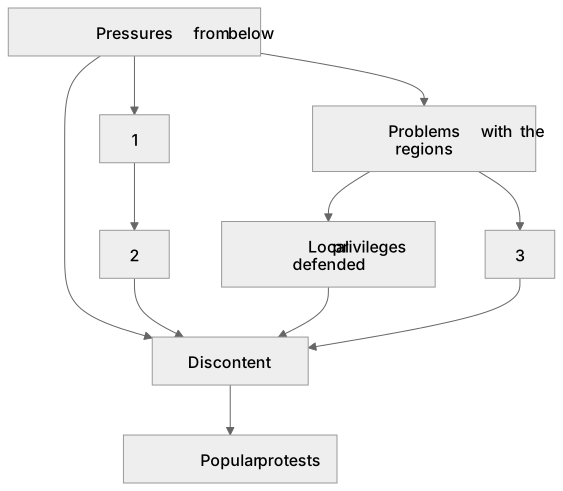
1Box 1
2Box 2
3Box 3
There is more to this lesson
The full lesson goes on to check your understanding and help you earn the marks. Create a free account to carry on, with your progress saved.
A week of Premium from your first lesson · Then the free plan continues · No card, no charge
Test your understanding of 2F The Sun King: Louis XIV, France and Europe, 1643– 1715 (A-level only) – Challenges at home, 1685–1715: Pressures from below: social divisions; problems with the regions; discontent and popular protests
Active recall beats re-reading. Take an instant quiz now to test what you’ve learned and lock it into long-term memory.
A week of Premium from your first lesson · Then the free plan continues · No card, no charge