AQA · A-Level · History
Course version: 7042 · Version from Sept 2017
Louis XIV, France and Europe, 1643– 1715 (A-level only) – Challenges in…
Full specification wording
2F The Sun King: Louis XIV, France and Europe, 1643– 1715 (A-level only) – Challenges in Europe, 1685–1697: The challenge of William of Orange: the Dutch-English alliance after the ‘Glorious Revolution’ of 1688
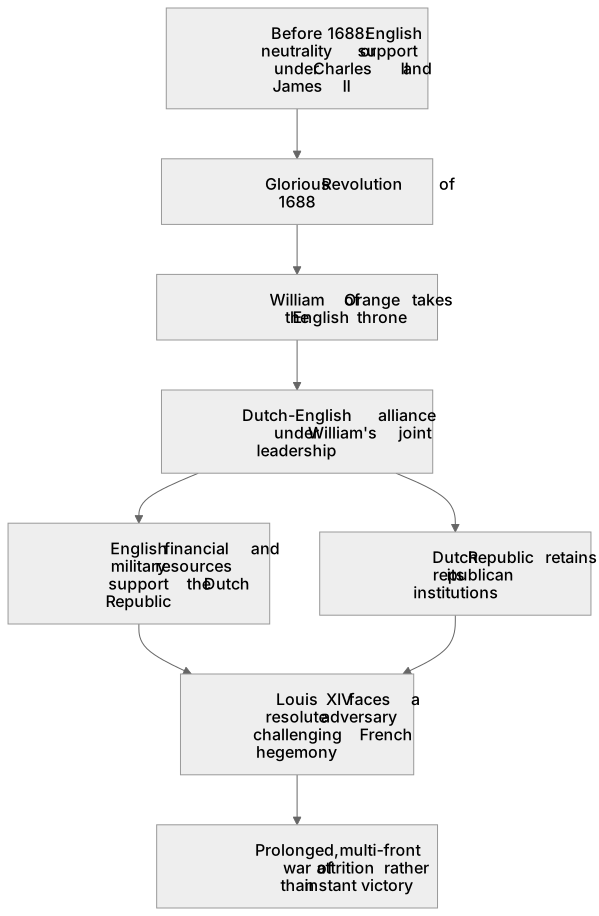
The 'Glorious Revolution' of 1688 fundamentally altered the European balance of power by aligning England and the Dutch Republic under the joint leadership of William of Orange.
Checked against the AQA 7042 specification (opens in a new tab) on .
- Point 1 of 4
- 3 key terms
Study notes
From the checked teaching notes for this specification point.
The idea
The 'Glorious Revolution' of 1688 fundamentally altered the European balance of power by aligning England and the Dutch Republic under the joint leadership of William of Orange. Prior to 1688, Louis XIV had relied on English neutrality or support under Charles II and James II. William’s successful usurpation of the English throne removed this security, creating a formidable Dutch-English alliance dedicated to curbing French expansionism. This personal union provided William with the financial and military resources of England to support the Dutch Republic—which retained its republican institutions—in its existential struggle against France. Consequently, Louis XIV faced a resolute adversary capable of challenging French hegemony.
What earns the marks
- Explain the strategic significance of the Glorious Revolution in removing a pro-French or neutral English monarch and replacing him with Louis XIV's greatest rival.
- Analyse how the Dutch-English alliance combined English financial and naval power with Dutch military and commercial strength.
- Evaluate William of Orange's personal motivation in prioritising the containment of Louis XIV's expansionism above domestic English issues.
- Assess the impact of this alliance on Louis XIV's strategic position, forcing France into a prolonged, multi-front war of attrition.
Common mistakes and how to put them right
Assuming England was actively anti-French before 1688.
Put it right: Emphasise that Charles II and James II were largely sympathetic to, or financially dependent on, Louis XIV.
Describing the Anglo-Dutch alignment as a 'dual monarchy'.
Put it right: Clarify that it was a personal union; William was King of England but Stadtholder in the Dutch Republic, which remained a republic.
Stating the Dutch-English alliance immediately defeated France.
Put it right: Note that the alliance initiated a prolonged period of attrition, notably the Nine Years' War, rather than achieving an instant victory.
Exam tips
- When discussing Louis XIV's foreign policy failures, use the 1688 revolution as a key turning point in his diplomatic isolation.
- Link William's acquisition of the English throne directly to the increased financial resources available for the anti-French coalition.
- Contrast the Anglo-French relationship before and after 1688 to demonstrate the scale of the challenge William of Orange posed to French dominance.
Try the lesson
The start of the 2F The Sun King: Louis XIV, France and Europe, 1643– 1715 (A-level only) – Challenges in Europe, 1685–1697: The challenge of William of Orange: the Dutch-English alliance after the ‘Glorious Revolution’ of 1688 lesson, made from checked teaching notes for this specification point.
Have a go first
What was the primary strategic consequence for Louis XIV of the 'Glorious Revolution' of 1688?
Listen
The 'Glorious Revolution' of 1688 fundamentally altered the European balance of power by aligning England and the Dutch Republic under the joint leadership of William of Orange. Prior to 1688, Louis XIV had relied on English neutrality or support under Charles II and James II. William’s successful usurpation of the English throne removed this security, creating a formidable Dutch-English alliance dedicated to curbing French expansionism. This personal union provided William with the financial and military resources of England to support the Dutch Republic—which retained its republican institutions—in its existential struggle against France. Consequently, Louis XIV faced a resolute adversary capable of challenging French hegemony. A strong answer earns marks for these points. Explain the strategic significance of the Glorious Revolution in removing a pro-French or neutral English monarch and replacing him with Louis XIV's greatest rival. Analyse how the Dutch-English alliance combined English financial and naval power with Dutch military and commercial strength. Evaluate William of Orange's personal motivation in prioritising the containment of Louis XIV's expansionism above domestic English issues. Assess the impact of this alliance on Louis XIV's strategic position, forcing France into a prolonged, multi-front war of attrition. A common slip: Assuming England was actively anti-French before 1688. Instead, Emphasise that Charles II and James II were largely sympathetic to, or financially dependent on, Louis XIV. Exam tip: When discussing Louis XIV's foreign policy failures, use the 1688 revolution as a key turning point in his diplomatic isolation.
See it
Key words
Say what each word means before you turn the card.
Balance of power
Try answering aloud or in your head before turning the card.
Diplomacy and alliances
Try answering aloud or in your head before turning the card.
Military strategy
Try answering aloud or in your head before turning the card.
See every definition
- Balance of power
- The European balance of power was fundamentally altered by the 'Glorious Revolution' of 1688, which aligned England and the Dutch Republic under William of Orange.
- Diplomacy and alliances
- A formidable Dutch-English alliance was created, dedicated to curbing French expansionism and providing William with English resources to support the Dutch Republic against France.
- Military strategy
- Louis XIV faced a resolute adversary capable of challenging French hegemony, forcing France into a prolonged, multi-front war of attrition.
Label the diagram
Some boxes have lost their names. Pick the right name for each number.
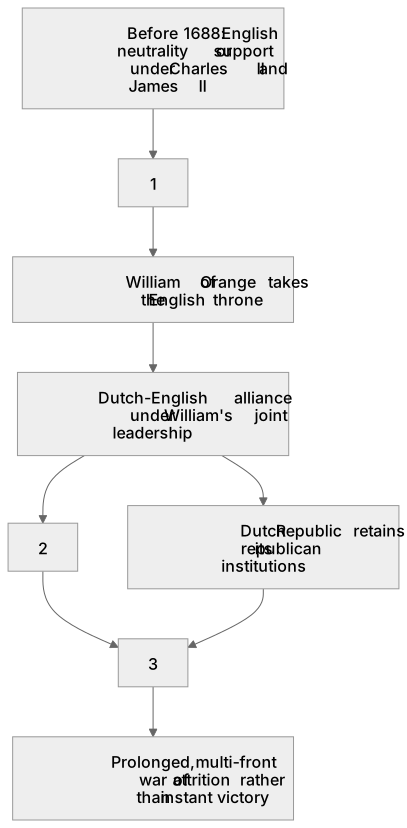
1Box 1
2Box 2
3Box 3
There is more to this lesson
The full lesson goes on to check your understanding and help you earn the marks. Create a free account to carry on, with your progress saved.
A week of Premium from your first lesson · Then the free plan continues · No card, no charge
Test your understanding of 2F The Sun King: Louis XIV, France and Europe, 1643– 1715 (A-level only) – Challenges in Europe, 1685–1697: The challenge of William of Orange: the Dutch-English alliance after the ‘Glorious Revolution’ of 1688
Active recall beats re-reading. Take an instant quiz now to test what you’ve learned and lock it into long-term memory.
A week of Premium from your first lesson · Then the free plan continues · No card, no charge