AQA · A-Level · History
Course version: 7042 · Version from Sept 2017
Louis XIV, France and Europe, 1643– 1715 (A-level only) – Challenges in…
Full specification wording
2F The Sun King: Louis XIV, France and Europe, 1643– 1715 (A-level only) – Challenges in Europe, 1685–1697: The ‘Grand Alliance’: the League of Augsburg and the anti-French alliance between Protestant states; the Empire and Spain
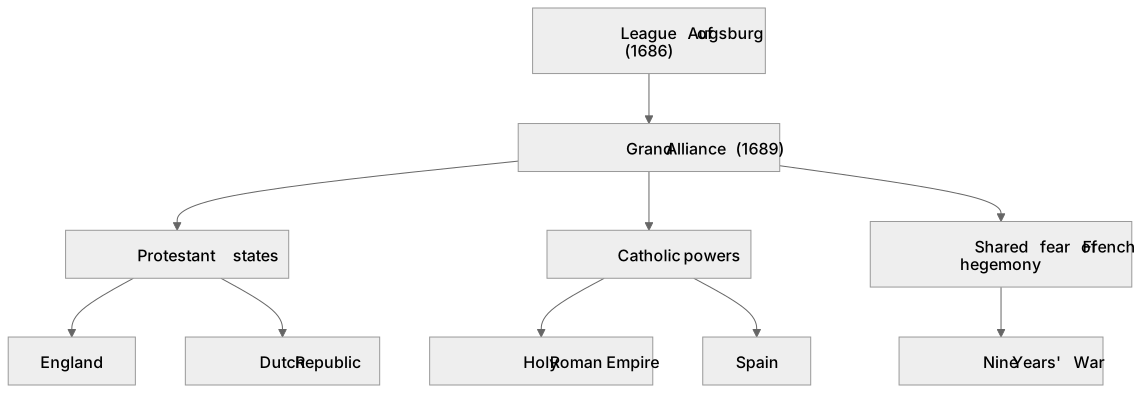
The League of Augsburg (1686), evolving into the 'Grand Alliance' in 1689, was a unified European response to Louis XIV's aggressive expansionism.
Checked against the AQA 7042 specification (opens in a new tab) on .
- Point 2 of 4
- 2 key terms
Study notes
From the checked teaching notes for this specification point.
The idea
The League of Augsburg (1686), evolving into the 'Grand Alliance' in 1689, was a unified European response to Louis XIV's aggressive expansionism. This coalition remarkably bridged deep religious divides, uniting Protestant states like the Dutch Republic and England with Catholic powers, notably the Holy Roman Empire and Spain. Driven by a shared fear of French hegemony following Louis's incursions into the Palatinate, the alliance prioritised geopolitical survival over confessional differences. By combining the forces of Emperor Leopold I, the Spanish Habsburgs, and Protestant nations, the Grand Alliance forced France into a gruelling, multi-front conflict during the Nine Years' War, severely straining French military and economic resources.
What earns the marks
- Identify the origins of the Grand Alliance in the earlier League of Augsburg (1686) as a defensive pact against French aggression.
- Explain how the alliance successfully united Protestant states, such as England and the Dutch Republic, with Catholic powers like Spain and the Holy Roman Empire.
- Analyse the role of the Holy Roman Empire and Spain in providing crucial land forces and opening multiple fronts against France.
- Evaluate the extent to which shared fear of Louis XIV's hegemony overcame traditional religious and dynastic rivalries in Europe.
Common mistakes and how to put them right
Confusing the League of Augsburg (1686) with the Grand Alliance (1689).
Put it right: Distinguish the League as the precursor, which expanded into the Grand Alliance once England joined under William of Orange.
Claiming the alliance was purely a Protestant crusade against Catholic France.
Put it right: Highlight the vital participation of Catholic powers like Spain and the Holy Roman Empire, showing politics outweighed religion.
Underestimating Spain's role due to its declining power.
Put it right: Acknowledge that while declining, Spain's territorial holdings, such as the Spanish Netherlands, were strategically vital to the alliance's containment of France.
Exam tips
- Use the composition of the Grand Alliance to demonstrate how Louis XIV's aggressive foreign policy ultimately isolated France diplomatically.
- Highlight the pragmatic nature of the alliance by contrasting the religious differences of its members with their shared geopolitical goals.
- When evaluating the Nine Years' War, explicitly reference the combined resources of the Empire, Spain, and Protestant states as the primary constraint on French success.
Try the lesson
The start of the 2F The Sun King: Louis XIV, France and Europe, 1643– 1715 (A-level only) – Challenges in Europe, 1685–1697: The ‘Grand Alliance’: the League of Augsburg and the anti-French alliance between Protestant states; the Empire and Spain lesson, made from checked teaching notes for this specification point.
Have a go first
Which combination of European powers formed the core of the Grand Alliance against Louis XIV in 1689?
Listen
The League of Augsburg (1686), evolving into the 'Grand Alliance' in 1689, was a unified European response to Louis XIV's aggressive expansionism. This coalition remarkably bridged deep religious divides, uniting Protestant states like the Dutch Republic and England with Catholic powers, notably the Holy Roman Empire and Spain. Driven by a shared fear of French hegemony following Louis's incursions into the Palatinate, the alliance prioritised geopolitical survival over confessional differences. By combining the forces of Emperor Leopold I, the Spanish Habsburgs, and Protestant nations, the Grand Alliance forced France into a gruelling, multi-front conflict during the Nine Years' War, severely straining French military and economic resources. A strong answer earns marks for these points. Identify the origins of the Grand Alliance in the earlier League of Augsburg (1686) as a defensive pact against French aggression. Explain how the alliance successfully united Protestant states, such as England and the Dutch Republic, with Catholic powers like Spain and the Holy Roman Empire. Analyse the role of the Holy Roman Empire and Spain in providing crucial land forces and opening multiple fronts against France. Evaluate the extent to which shared fear of Louis XIV's hegemony overcame traditional religious and dynastic rivalries in Europe. A common slip: Confusing the League of Augsburg (1686) with the Grand Alliance (1689). Instead, Distinguish the League as the precursor, which expanded into the Grand Alliance once England joined under William of Orange. Exam tip: Use the composition of the Grand Alliance to demonstrate how Louis XIV's aggressive foreign policy ultimately isolated France diplomatically.
See it
Key words
Say what each word means before you turn the card.
Grand Alliance
Try answering aloud or in your head before turning the card.
Containment
Try answering aloud or in your head before turning the card.
See every definition
- Grand Alliance
- A unified European response to Louis XIV's aggressive expansionism that bridged deep religious divides, uniting Protestant states with Catholic powers.
- Containment
- The alliance's strategic aim of containing France through the combined forces of Emperor Leopold I, the Spanish Habsburgs and Protestant nations.
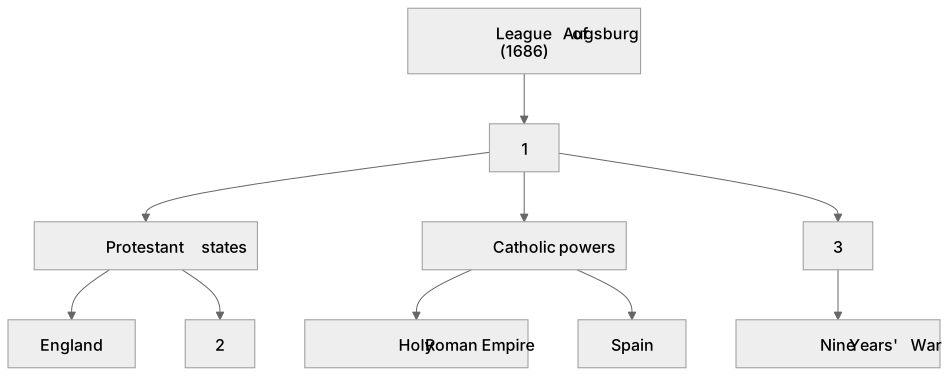
Label the diagram
Some boxes have lost their names. Pick the right name for each number.
1Box 1
2Box 2
3Box 3
There is more to this lesson
The full lesson goes on to check your understanding and help you earn the marks. Create a free account to carry on, with your progress saved.
A week of Premium from your first lesson · Then the free plan continues · No card, no charge
Test your understanding of 2F The Sun King: Louis XIV, France and Europe, 1643– 1715 (A-level only) – Challenges in Europe, 1685–1697: The ‘Grand Alliance’: the League of Augsburg and the anti-French alliance between Protestant states; the Empire and Spain
Active recall beats re-reading. Take an instant quiz now to test what you’ve learned and lock it into long-term memory.
A week of Premium from your first lesson · Then the free plan continues · No card, no charge