AQA · A-Level · History
Course version: 7042 · Version from Sept 2017
Louis XIV, France and Europe, 1643– 1715 (A-level only) – France defeated,…
Full specification wording
2F The Sun King: Louis XIV, France and Europe, 1643– 1715 (A-level only) – France defeated, 1697–1715: The issue of the Spanish Succession: the aims and policies of France; the international response to French claims; the outbreak of war
The impending death of the childless Carlos II of Spain triggered a major diplomatic crisis over the vast Spanish Empire.
Checked against the AQA 7042 specification (opens in a new tab) on .
- Point 1 of 4
- 4 key terms
Study notes
From the checked teaching notes for this specification point.
The idea
The impending death of the childless Carlos II of Spain triggered a major diplomatic crisis over the vast Spanish Empire. Louis XIV’s primary aim was to secure the Bourbon dynasty's strategic and economic interests, initially pursuing diplomacy through the Partition Treaties (1698, 1700). However, when Carlos's will named Louis's grandson, Philip of Anjou, as sole heir, Louis accepted, violating the treaties. His subsequent provocative policies, such as reserving Philip’s right to the French throne and occupying Dutch barrier fortresses, alarmed European powers. The international response was swift: England, the Dutch Republic, and the Holy Roman Emperor formed the Grand Alliance in 1701, leading directly to the outbreak of war in 1702.
What earns the marks
- Explain the dynastic claims of the Bourbons and Habsburgs to the Spanish throne following Carlos II's declining health.
- Analyse Louis XIV's shift from diplomatic partition via the First and Second Partition Treaties to accepting Carlos II's will in 1700.
- Evaluate the provocative policies taken by France, such as expelling Dutch troops from the Spanish Netherlands and securing the Asiento.
- Assess the formation of the Grand Alliance in 1701 as a direct international response to the perceived threat of a unified Franco-Spanish superpower.
Common mistakes and how to put them right
Claiming Louis XIV always intended to seize the entire Spanish Empire.
Put it right: Acknowledge that Louis initially engaged in the Partition Treaties to divide the inheritance diplomatically before Carlos II's will forced a change in policy.
Stating the war broke out solely because Philip became King of Spain.
Put it right: Emphasise that it was Louis's subsequent aggressive actions, like occupying the barrier fortresses, that triggered the Grand Alliance's declaration of war.
Confusing the Grand Alliance of 1701 with the League of Augsburg.
Put it right: Specify that the 1701 Grand Alliance was formed specifically to address the Spanish Succession, uniting England, the Dutch Republic, and Austria.
Exam tips
- Evaluate the extent to which Louis XIV's actions in 1700 and 1701 were defensive measures rather than aggressive expansionism.
- Link specific French policies, such as the transfer of the Asiento to France, to the economic motivations of the international response, particularly from England.
- Use the terms of the Partition Treaties to demonstrate the complexity of European diplomacy prior to the outbreak of war.
Try the lesson
The start of the 2F The Sun King: Louis XIV, France and Europe, 1643– 1715 (A-level only) – France defeated, 1697–1715: The issue of the Spanish Succession: the aims and policies of France; the international response to French claims; the outbreak of war lesson, made from checked teaching notes for this specification point.
Have a go first
What was Louis XIV's primary aim when he accepted the will of Charles II of Spain in 1700?
Listen
The impending death of the childless Carlos II of Spain triggered a major diplomatic crisis over the vast Spanish Empire. Louis XIV’s primary aim was to secure the Bourbon dynasty's strategic and economic interests, initially pursuing diplomacy through the Partition Treaties (1698, 1700). However, when Carlos's will named Louis's grandson, Philip of Anjou, as sole heir, Louis accepted, violating the treaties. His subsequent provocative policies, such as reserving Philip’s right to the French throne and occupying Dutch barrier fortresses, alarmed European powers. The international response was swift: England, the Dutch Republic, and the Holy Roman Emperor formed the Grand Alliance in 1701, leading directly to the outbreak of war in 1702. A strong answer earns marks for these points. Explain the dynastic claims of the Bourbons and Habsburgs to the Spanish throne following Carlos II's declining health. Analyse Louis XIV's shift from diplomatic partition via the First and Second Partition Treaties to accepting Carlos II's will in 1700. Evaluate the provocative policies taken by France, such as expelling Dutch troops from the Spanish Netherlands and securing the Asiento. Assess the formation of the Grand Alliance in 1701 as a direct international response to the perceived threat of a unified Franco-Spanish superpower. A common slip: Claiming Louis XIV always intended to seize the entire Spanish Empire. Instead, Acknowledge that Louis initially engaged in the Partition Treaties to divide the inheritance diplomatically before Carlos II's will forced a change in policy. Exam tip: Evaluate the extent to which Louis XIV's actions in 1700 and 1701 were defensive measures rather than aggressive expansionism.
See it
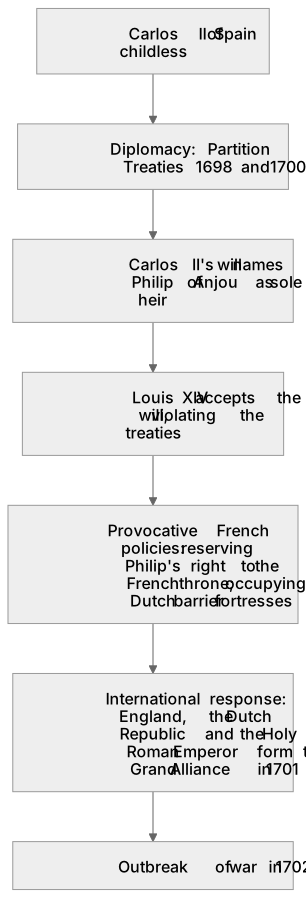
Put it in order
Put these steps in the order they happen.
- 1. Outbreak of war in 1702
- 2. International response: England, the Dutch Republic and the Holy Roman Emperor form the Grand Alliance in 1701
- 3. Carlos II's will names Philip of Anjou as sole heir
- 4. Provocative French policies: reserving Philip's right to the French throne; occupying Dutch barrier fortresses
- 5. Carlos II of Spain childless
- 6. Diplomacy: Partition Treaties 1698 and 1700
- 7. Louis XIV accepts the will, violating the treaties
Put the events in order
Put these events in the order they happened, earliest first.
- 1. War broke out
- 2. Louis XIV pursued diplomacy through the Partition Treaties
- 3. England, the Dutch Republic and the Holy Roman Emperor formed the Grand Alliance
- 4. Carlos II's will named Philip of Anjou as sole heir
Key words
Say what each word means before you turn the card.
Dynastic rivalry
Try answering aloud or in your head before turning the card.
Diplomacy and treaties
Try answering aloud or in your head before turning the card.
Balance of power
Try answering aloud or in your head before turning the card.
Causes of conflict
Try answering aloud or in your head before turning the card.
See every definition
- Dynastic rivalry
- Competing dynastic claims to the Spanish throne following Carlos II's declining health, involving the Bourbons and the Habsburgs.
- Diplomacy and treaties
- Louis XIV initially pursued diplomacy through the Partition Treaties of 1698 and 1700 to divide the inheritance.
- Balance of power
- The international response to the perceived threat of a unified Franco-Spanish superpower, addressed by the Grand Alliance in 1701.
- Causes of conflict
- Louis XIV's provocative policies, such as occupying the barrier fortresses, triggered the Grand Alliance's declaration of war.
Label the diagram
Some boxes have lost their names. Pick the right name for each number.
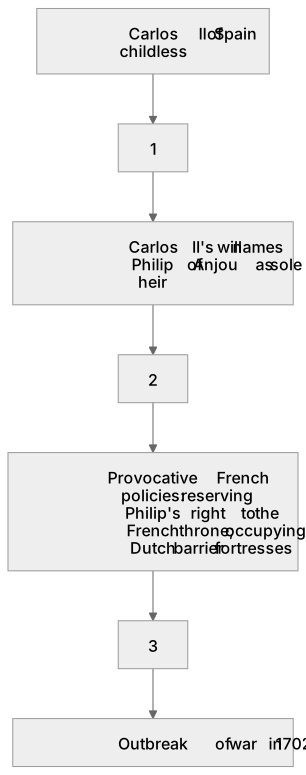
1Box 1
2Box 2
3Box 3
There is more to this lesson
The full lesson goes on to check your understanding and help you earn the marks. Create a free account to carry on, with your progress saved.
A week of Premium from your first lesson · Then the free plan continues · No card, no charge
Test your understanding of 2F The Sun King: Louis XIV, France and Europe, 1643– 1715 (A-level only) – France defeated, 1697–1715: The issue of the Spanish Succession: the aims and policies of France; the international response to French claims; the outbreak of war
Active recall beats re-reading. Take an instant quiz now to test what you’ve learned and lock it into long-term memory.
A week of Premium from your first lesson · Then the free plan continues · No card, no charge